Trump backs down from his ultimatum and accepts a ceasefire in Iran
Washington agrees to a two-week truce following Tehran's proposal, which will reopen the Strait of Hormuz under its control
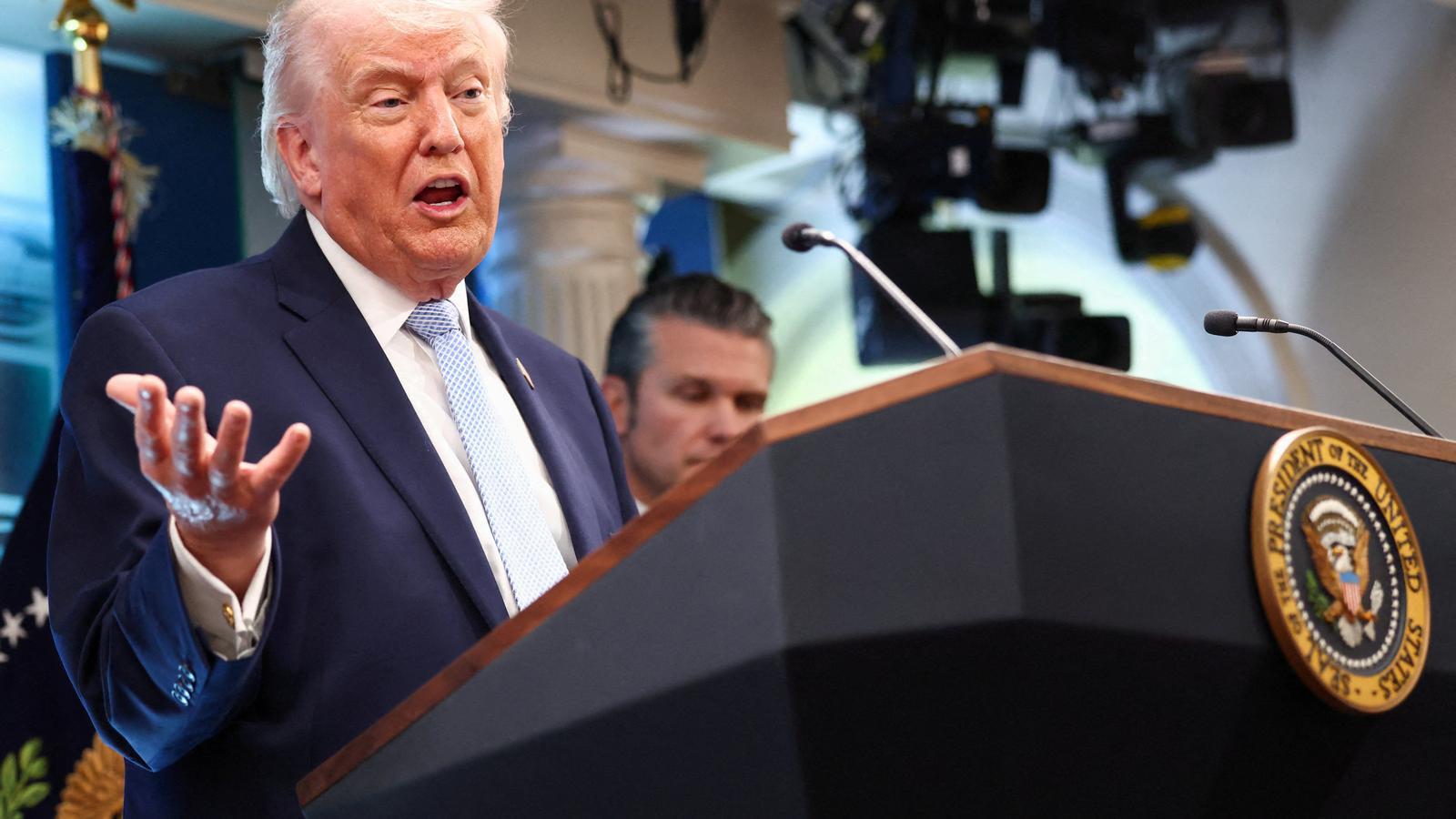

WashingtonThe doomsday announced by Donald Trump has not arrived this morning in Iran either. Shortly before the clock in Washington struck eight in the evening and his final ultimatum expired, the US president has backed down again. The Republican announced on his social network that he is suspending for two weeks "hell" with which he had promised to annihilate Persian civilization, in exchange for Iran reopening the Strait of Hormuz. But the truce, mediated by Pakistan, accentuates the asymmetry that has been observed during the month of conflict. In his confirmation of the agreement, the Iranian Foreign Minister, Abbas Aragchi, stressed that it will be possible to "circulate safely" through the maritime passage "through the coordination of the armed forces of Iran".

Aragchi's statement, which Trump has endorsed and shared on Truth Social, says that the framework for the negotiations will be Iran's 10-point proposal, as well as Washington's 15-point plan. "We have received a ten-point proposal from Iran and believe it constitutes a viable basis for negotiation," the American stated. He adds that "almost all points of past disagreement have already been agreed upon between the United States and Iran, but a two-week period will allow the agreement to be finalized and formalized."
. The one aboard the amphibious ship For the moment, the North American administration has not confirmed if this is the framework they have accessed. White House spokeswoman Karoline Leavitt has limited herself to presenting it as "a victory for the USA thanks to President Trump and our soldiers." Leavitt has assured that this Wednesday the Secretary of Defense, Pete Hegseth, and the Chairman of the Joint Chiefs of Staff, General Dan Caine, will appear to provide an update. The Pentagon had mobilized 7,000 additional soldiers in the Middle East in recent weeks, including two marine units. The one aboard the amphibious ship Tripoli already arrived last weekend, and it is estimated that the other one with the Boxer was due to arrive in mid-April.
Israel continues to attack Lebanon
Despite Trump having underlined that it is a "bilateral ceasefire", the war has always been three-sided. The United States attacked Tehran on February 28 along with Israel. The Israeli government has responded by saying that it supports its partner's ceasefire, but that it will not stop the attacks in Lebanon. Prime Minister Benjamin Netanyahu made this clear in a statement at four-thirty in the morning: "The two-week ceasefire does not include Lebanon." In principle, one of the Iranians' other demands is that the cessation of hostilities also apply to Lebanon and the rest of their allies in the region.
Tel Aviv is endangering the incipient ceasefire, but Trump is already talking about peace. In a post after the announcement, Trump celebrated the milestone as "a great day for world peace" and rushed to say that "the US will help with the recovery of transit in the Strait of Hormuz", where according to the International Maritime Organization some two thousand merchant ships are trapped. "They've had enough! There will be a lot of positive action! A lot of money will be made. Iran can start the reconstruction process. We will load supplies of all kinds and we will simply be around to make sure everything goes well," he wrote on Truth Social. And he finished it off with the assertion that "this could be the golden age of the Middle East." Markets reacted with gains and oil fell after the ceasefire announcement.
Despite the agreement, the Persian Gulf countries – including Kuwait, the United Arab Emirates, Qatar, and Israel – have continued to register missile and drone attacks. It is not clear whether this is a violation of the pause by Iran or whether the information was still reaching the rest of the Iranian forces through the chain of command, which have been acting decentrally for weeks due to the strategy of the United States and Israel to eliminate central command. Beyond the army, the ayatollahs' regime also has the Revolutionary Guard, which acts as a separate body.
Washington's credibility, eroded
Washington's credibility, erodedThis morning's development is not the first U-turn Trump has made in the midst of the military campaign with Iran, but it is the most drastic and sensitive. The shift calls into question the credibility of the president's threats. With the same lack of clarity with which he tried to justify the start of the war, the president is now also trying to sell its end. In the ceasefire announcement, the president assures that they have "met and exceeded all military objectives." Abstract goals that have never been specified. Before the ceasefire was announced, images of a spike in orders at pizzerias near the Pentagon were circulating. It is said that every time the army is about to attack or experiences a crisis situation, orders surge.
Meanwhile, the data the White House clings to to claim victory is that the promised deadlines have been met. "From the very beginning of Operation Epic Fury, President Trump estimated it would last between 4 and 6 weeks. Thanks to the incredible capabilities of our soldiers, we have met and even exceeded our main military objectives in 38 days," Leavitt wrote. The US administration is once again doing with Iran what it did with Gaza, wanting to sell a ceasefire as the end of the war.
