The CCCB opens the archive of the atomic age: from the unlimited promise to the infinite insecurity
An exhibition gathers 250 works to explain how the promise of infinite energy led to the nightmare of total destruction

-
CAT -
CAST
BarcelonaThe U.S. military dropped an atomic bomb on the port of Hiroshima on August 6, 1945, and, three days later, another one on Nagasaki. The thermal emissions and radiation destroyed both cities and killed tens of thousands of people instantly, or over the years. The first five photographs of Hiroshima were taken, on the same day, by local reporter Yoshito Matsushige, as can be seen at the CCCB in the major exhibition The Atomic Era, starting this Thursday and running until May 17.
The devastation of the two explosions was documented by the American military, the Japanese authorities, and private individuals. However, a good part of the filmed material was destroyed by the U.S. occupying army and the Japanese government between September 1945 and April 1952, the year in which the censorship imposed by the United States was lifted and Japan ceased to be under U.S. tutelage. Nearly thirty years later, Iwakichi Kobayashi (1898-1991), who had lost his wife, Kishino, and his twelve-year-old son, Yukio, due to the atomic bomb explosion in Hiroshima, brought to the offices of the Japanese public broadcaster NHK a drawing made with a marker that captured the devastation around the Yorozuyo Bridge. His gesture, as can also be seen in the exhibition, moved the station's management, who made a public appeal for other survivors to send them their memories. In two years, more than 2,200 works from 758 people were collected, which gave rise to the Unforgettable Fire collection.
"The Atomic Era is born associated with a great promise, but also with a nightmare. It is true that there is the promise of the discovery of an almost inexhaustible source of energy that reaffirms modern confidence in science as the engine of supposedly unlimited progress. But this promise contained from the beginning a terrifying nightmare, that of irreversible contamination and the possibility of total destruction," states the director of the CCCB, Judit Carrera.
“This exhibition is timely and pertinent because it arrives at a moment when, unfortunately, the nuclear issue is back on the agenda –explains Carrera–. The nuclear threat is reborn in a context marked by military escalation and the end of the international order born after the Second World War and the multilateral system that was supposed to guarantee us peace and stability. But this nuclear rebirth also has to do with the urgency of the energy transition and the climate crisis and with the accelerated emergence of artificial intelligence, which presents disturbing parallels with the atomic age and which today, with its infinite voracity for data, is presented as the perfect and apparently inevitable justification for the need and unlimited use of nuclear energy”.
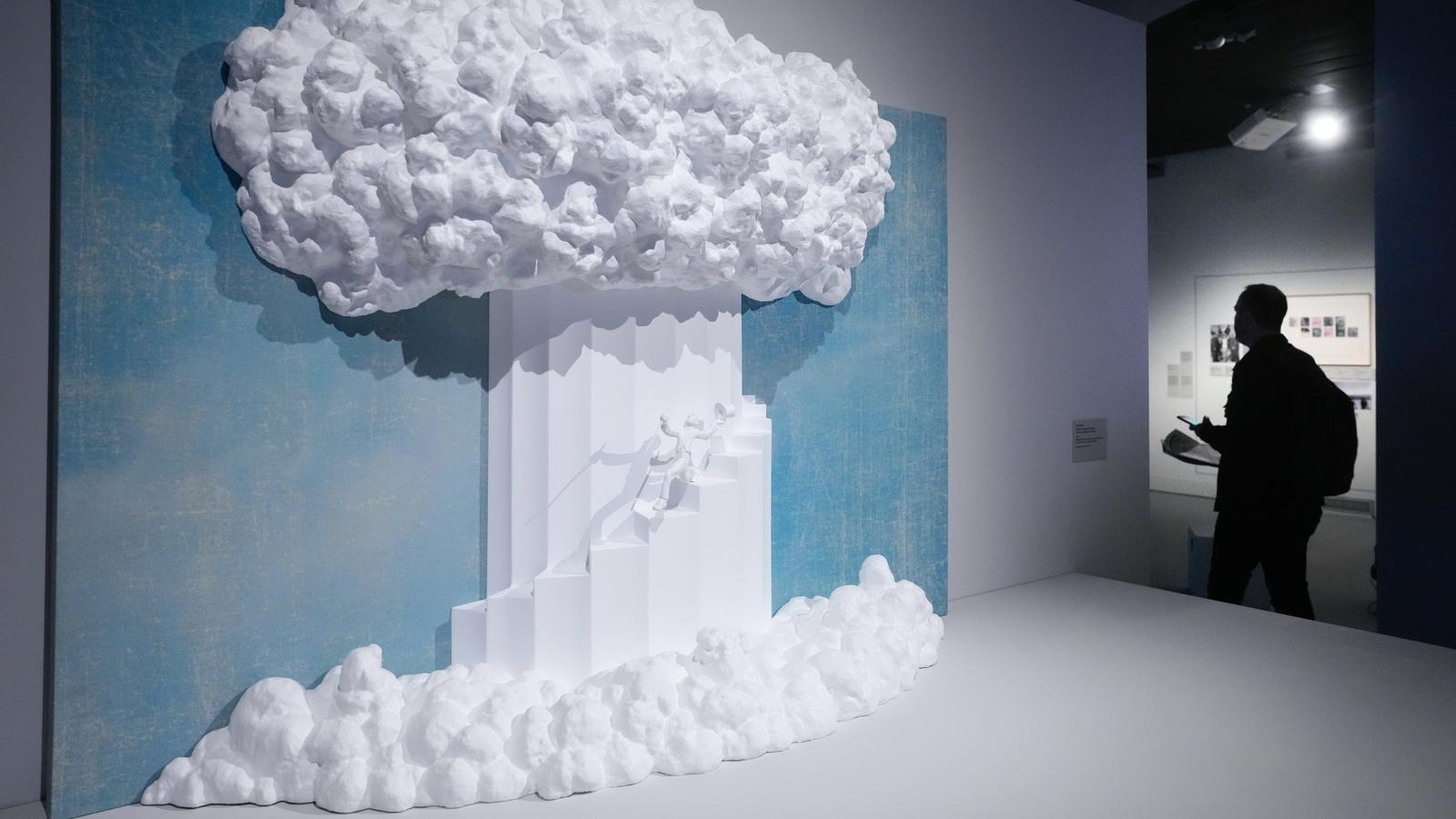
The Atomic Age is an expanded and adapted version of the one that could be seen at the Museum of Modern Art in Paris in 2024. It arrives in Barcelona about twenty years after the exhibition that the CCCB dedicated to Chernobyl. But the current exhibition is more ambitious, because it is “a cultural history of the atomic age that goes from the end of the 19th century to the present day”, as Carrera says. Thus, the exhibition analyzes “how discoveries linked to nuclear energy have irradiated the world of culture and art and, in return, how art and culture have helped to understand the paradoxes of the atomic world”. “Recent geopolitical events, such as the war in Ukraine or tensions in the Mediterranean, have brutally brought this threat back to the forefront of our concerns”, states Julia Garimorth, curator of the exhibition together with Maria Stavrinaki. “This strongly reminds us of a fundamental reality that the philosopher Günther Anders had already highlighted in 1959: that, after the invention of the atomic bomb, we have entered a new historical epoch of «infinite insecurity». For the first time in history, man has, through his actions, the power to provoke his own immediate extinction and, in turn, that of all life on Earth”, says Garimorth.
According to the information gathered in the exhibition, these nine states, listed in order of acquisition, possess nuclear weapons: the United States, Russia, the United Kingdom, France, China, Israel, India, Pakistan, and North Korea. The United States has arsenals in five NATO countries (Germany, Italy, Belgium, the Netherlands, and Turkey). And regarding the tests, very often with colonial biases, between 1945 and 1988 more than 2,000 explosions occurred, with an average of one every ten days. 543 explosions were atmospheric, with an equivalent of 428 million tons of TNT, that is, 29,000 Hiroshimas.
The artists' reactions
The exhibition includes about 250 works, including artworks, films, and documents. The magnificent list of creators is full of great names, among which are Hilma af Klint, Salvador Dalí, Lucio Fontana, Marcel Duchamp, Yoko Ono, David Lynch, Peter Watkins, Joan Rabascall, Piero Manzoni, Asger Jorn, Enrico Baj, Nancy Spero, Bruce Conner, Vladimir Yankilevsky, Roberto Matta, Marisa González, Raymond Pettibon, Viktor Kossakovsky, Pierre Huyghe, Jordi Bernadó, Sammy Baloji, Susan Schuppli, and Beatriz Caravaggio. “The artists' reactions are very diverse, both in their events and in their ideological position. Some express surprise, effort, and even horror at the destructive power of nuclear art. Others are more interested in the formal or plastic possibilities opened up by this new conception of energy,” explains Garimorth.
The journey is divided into three parts, from the discoveries about the atom in the 19th century and the mysticism of Hilma af Klint to the present day, as can be seen in a work by the architect and artist Fernando Cremades about fungi found at the Chernobyl power plant that could be used to decontaminate other places from radiation. It is one of three newly created works commissioned jointly with the Tabakalera center in San Sebastián.
In the case of the Spanish state, nuclear history is “inseparable from Francoism and the position that Spain occupies at the end of the Second World War, after having been part of the fascist bloc, which emerged defeated,” explains Maria Ptqk, the curator in charge of adapting the exhibition to the CCCB. “In 1953, President Eisenhower promoted a program aimed at the entire allied bloc, but which extended globally, called Atoms for Peace. In Spain, this program took shape in the Madrid Pacts of the same year, agreements for technological cooperation between Spain and the United States that led to the construction of the first generation of nuclear power plants with American technology and financing,” says Ptqk. In addition, she points out how censorship prevented a deeper knowledge of the Palomares nuclear accident, which has remained engraved in the collective memory with the image of Manuel Fraga, then Minister of Information and Tourism, bathing on that beach in Almeria in March 1966.
