Sebastià Alzamora, Lletra d’Or award for 'Sala Augusta followed by Llengua materna'
The poetry collection of the Majorcan writer continues gathering recognitions
-
CAT -
CAST
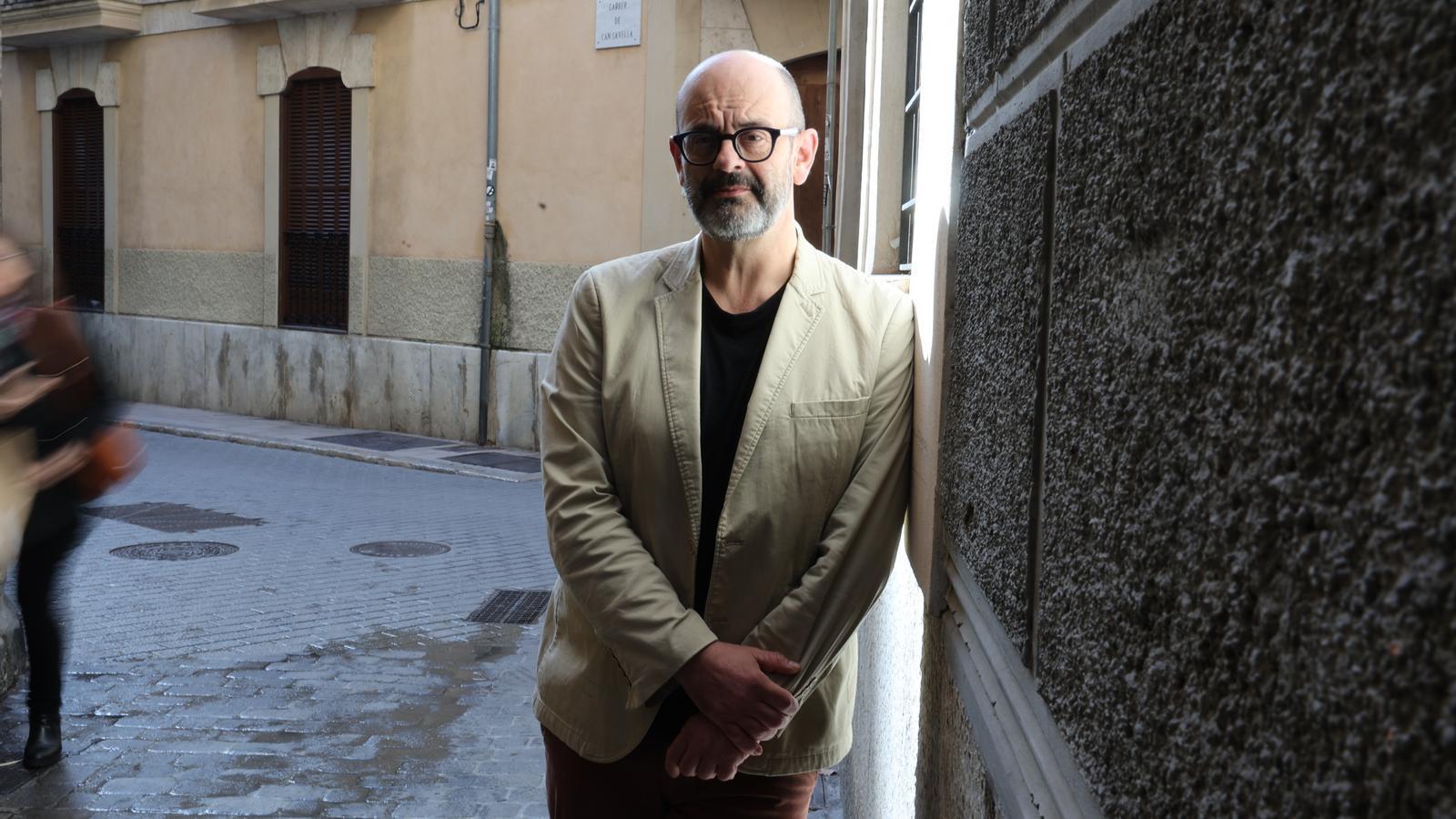
BarcelonaThe writer Sebastià Alzamora (Llucmajor, 1972) has been recognized with the Lletra d'Or award for the best book of 2025 for Sala Augusta followed by Llengua materna (Proa), which brings together two poems. With this book, Alzamora has also won the Critics' Award, the Serra d'Or Critics' Award, the Josep M. Llompart - Cavall Verd (AELC) and the National Prize from the Spanish Ministry of Culture. "I am hugely thrilled. Without wanting to butter anyone up, the fact that the jury is made up of a group of magnificent writers and that they reached a unanimous agreement makes me very happy," stated Alzamora. The good harvest of awards that Sala Augusta followed by Llengua materna has received in recent months leads him to think that the book "speaks of issues that right now matter to us all".
The poetry collection, the author's seventh, consists of two long, free-verse poems. In the first, Sala Augusta, Alzamora rescues images and scenes from the Civil War, such as that of a ship moored in the port of Palma, the Jaume I, which was converted by the Falangists into a prison for a few weeks in 1936. "It focuses on collective memory and on the memory of the people murdered by fascism in Mallorca, but it aims to be valid everywhere," the poet stresses. In the second poem of the book, Llengua materna, Alzamora turns the death and ignominy of the first pages into light through a childhood memory related to his mother. "It speaks of intimate memory and the need to look at one's own history to look at history," says Alzamora, who adds that the book seeks to "protect a memory that is being placed under suspicion, singled out every day more by the heirs of that fascism that is spoken of".
The jury that awarded Sala Augusta followed by Mother tongue was composed of Borja Bagunyà, Míriam Cano, Xènia Dyakonova, Andreu Gomila, Àngels Gregori, Llucia Ramis and Pau Sif. The evaluation, in the form of a sonnet, is signed by Dyakonova:
Why do we still award 'Sala Augusta'
if it already has so many awards, and even
(maybe it's irrelevant, but I don't give a damn)
did the National Award say "I like it"?
Because it is a book that does not go with old-fashioned
skirt, wears jeans. And, like Charlie Chaplin,
it makes you laugh and it makes you cry. And with every word
speak of the dead in a fair way.
Another prize, Tià! Here, be proud of it!
A breakfast, and furthermore, on a weekday,
it is not enough —what can we do— for a piece of writing
longer... but you have the strongest admiration
of all of us. You were a dead mule
and you are always alive in the eyes that have read you.
It is the first time that Alzamora has received a jury's verdict in the form of a sonnet, a peculiarity that has given him "enormous excitement." The writer also explains that, with the recognitions received lately, the book has gained momentum and, even, unexpected readers. "For some time now, I have been receiving comments from people who do not usually read poetry but thanks to the awards they have been encouraged to read this book, they liked it and want to continue reading poetry—points out Alzamora—. Just for having gained some poetry reader, it is already worth it."
The Lletra d'Or award is a prize without financial remuneration. The winner receives a gold lapel pin representing the Greek letter phi, a classic symbol of balance, designed by the jeweler Manel Capdevila. The award was born as a private initiative, outside of any institution. The first three winners were Salvador Espriu, Josep Pla, and Josep Carner.

