Rosalía, an unbridled talent at the Palau Sant Jordi
Collective ecstasy at the first of the four concerts in Barcelona of the tour for the album ‘Lux’

-
CAT -
CAST
- Palau Sant Jordi. April 13, 2026
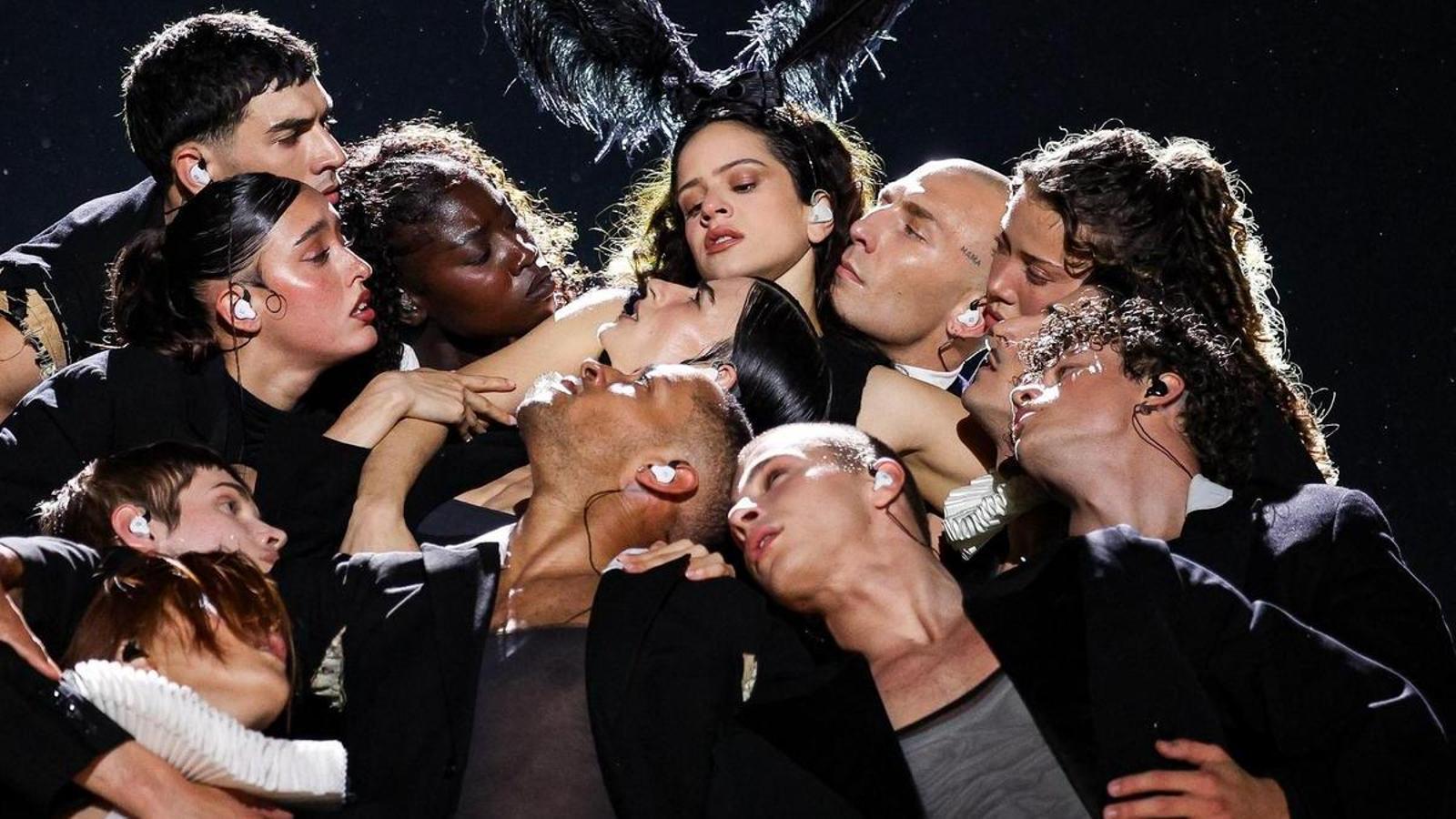
Thousands of videos and chronicles shared on social media and in the news have explained in detail the show that Rosalía premiered in Lyon on March 16. There has been an avalanche of aesthetic, scenic, musical, and even psychological interpretations of this show that has the album Lux as its backbone. With all these fragmentary impacts, it is possible to form an opinion about the concert, marvel at, and admire the proposal of the artist from Sant Esteve Sesrovires. However, experiencing the show live is something much more impactful, as she demonstrated in the first of the four concerts at the Palau Sant Jordi, all of them with sold-out tickets.
Regarding the novelties compared to other tour performances, the subtitles to follow the song lyrics were in Catalan. Another novelty was the tears of gratitude to the audience and Barcelona. "Today my heart was racing because I'm home. I was so eager to return," she explained in Catalan. "Singing in your city is the most intense and rewarding, and also the most daunting," she added in a brief speech in which she recalled that Peret had once advised her not to get nervous before singing. The third novelty has to do with the confessional, where the actress Yolanda Ramos sat, who told a story that was both funny and pathetic about a bad experience with a musician from Taller de Músics, a pubic hair removal, and a glass of water full of hairs.
A breathtaking start
Bold by nature, Rosalía is at an artistic level difficult to surpass. The ambition and care with which she has designed the show and the sound is overwhelming, and it may happen that the impact of experiencing a Rosalía concert is more powerful than the impact conveyed by the interpretation of the songs. The merit of the author of Lux is to achieve both at the same time, and to make it very clear in the first act, one of the most impressive concert openings in recent years. Half an hour late, she appeared to lavish emotion and power, linking Sexo, violencia y llantas, Reliquia (extraordinary voice), Porcelana and Divinize (with the coda of Thank you by Dido) while the scenography hosted a fragile dancer on stage and the music, very powerful, balanced the electronic sound with that of the mega-amplified chamber orchestra occupying a secondary stage shaped like a Latin cross in the center of the floor.
As in Lyon, the Barcelona audience also reacted with ovations of admiration and warmth to the displays of voice and harmony, talent with dramaturgical purpose. "Merci, Barcelona," she simply said after captivating the crowd with Reliquia. In this regard, the culmination of the first act was especially significant. Dressed in the white habit of a suffering woman, or a queen of melodrama, she silenced the Palau Sant Jordi with the contained emotion of Mio Cristo piange diamanti. The audience's outburst at the end of the song gave goosebumps; it was almost as exciting as cyclist Wout van Aert's victory in the Roubaix velodrome last Sunday.

As in previous concerts on the tour, the Barcelona show followed a division into different acts, each with its own aesthetic and emotional tone, playing with black and white in the costumes and taking advantage of the choreographic versatility of (La)Horde and Charm La’Donna, and the imagination of Dimitris Papaioannou. The liberating power of the techno version of Berghain preceded the hedonistic celebration of the Motomami universe, with Saoko, La fama and La combi Versace powered by new string arrangements, more incisive at the end of Saoko. Rosalía is seen having fun before taking refuge in the flamenco solemnity of De madrugá (almost symphonic) and El redentor, ancient spirituality before entering the vanity fair of the version of Can’t take my eyes off you, with the artist framed as the Mona Lisa and challenging gazes with the Montserrat landscape behind her.
Little by little, the thread of a feminism that unites a good part of the songs in Lux begins to emerge, where God functions as a metaphor describing everything that relationships with men have not been. In this context, the confessional would be the gossip version and La perla, with Papaioannou's impressive choreography, the definitive heartbreak song. Although Jeanne is not included in the tour's repertoire, she is a warrior saint, like an armorless Joan of Arc who slays the dragon of men who don't measure up, and who descends the staircase of longing and tragedy in the performance of La yugular, another of the night's memorable moments.

"Jump, jump, jump..."
The confessional and the interpretation with Llorenç Barceló of Sauvignon blanc (in which he recommended Catalan wines: "a Penedès, an Empordà, a Priorat") are understood as moments to relax in a show meticulously crafted down to the last detail. It is the air she needs to attack a frenetic block in the middle of the stage with the orchestra, unleashed in La rumba del perdó and in a CUUUUuuuuuute which she introduced shouting "boti, boti, boti, fill de puta qui no voti" and dancing under a techno botafumeiro. Other pieces from the Motomami era such as Bizcochito and Despechá supply the party (magnificent, the audience's engagement) before the final death and spring, before the operatic tragedy that unfolds in Focu 'ranni and in an impressive Magnolias, an earthly farewell and cosmic resurrection, a culmination after two hours of an unprecedented adventure: the triumph of a talent beyond measure, the consecration of Rosalía as a total work of art.
[The photographs in this chronicle were provided by the promoter Live Nation. Rosalía does not credit press photojournalists on this tour.]
