Russia abandons economic optimism
Sanctions, Ukrainian bombings, labor shortages, and inflation push to the limit an economy geared towards the war effort

-
CAT -
CAST
BarcelonaThe Russian economy has faced pessimistic forecasts since the beginning of the invasion of Ukraine in February 2022, when a large part of Western countries gradually imposed all kinds of industrial and financial sanctions on it. Despite this, Moscow's narrative had been that the country's economy was holding up well to the economic shock, partly thanks to public investment and industrial activity resulting from the war, which offset the impact of the sanctions.
This Kremlin narrative, however, is changing and the Ministry of Economic Development has cut its economic forecasts this month. Until now, it had been the Russian central bank that was responsible for giving bad economic omens, but now the government of President Vladimir Putin has joined in.
In February, it predicted closing 2026 with an economic expansion of 1.3%, but a few days ago it lowered it to 0.4%. For 2027 and 2028, it has also reduced its forecasts, from 2.8% and 2.5%, respectively, to 1.4% and 1.9%.
The Russian Minister of Economy, Maxim Reshetnikov, said that the slowdown is "the natural price of curbing inflation" in a "fine-tuning phase" of the economy. The same forecasts, however, deny this: "A cyclical pause does not last two years, does not depress investment, and does not coincide with stubbornly high inflation," says an article from the American think tank Center for European Policy Analysis (CEPA).
think tank American Center for European Policy Analysis (CEPA).
In fact, these two variables are what most point to the problem of the Russian economy. Three months ago, Moscow expected to close 2026 with an inflation of 4%, but has increased it to 5.6%, while investment was expected to fall by 0.5% this year according to February calculations, but now expects the decline to be 1.5%.

Economy at the productive limit
"The Kremlin will soon face a fundamental choice about whether to radically escalate its demands on Russia's economy and society or to de-escalate its war aims," indicates in an article Nigel Gould-Davies, a specialist researcher on Russia at the Institute for Strategic Studies (IISS), a think tank based in London. "The economy is now close to its total productive capacity and faces diminishing returns in allocating scarce resources to military production," the article adds.
According to the American think tank Center for European Policy Analysis (CEPA), the Russian military industry has gone from representing 3% of economic activity in 2022 to 8% last year. "This was financed first through the National Welfare Fund, then with tax increases, and finally with expensive domestic borrowing. Each of these sources of liquidity is now dry," points out in another article Alexander Kolyandr, a researcher at CEPA.
Moscow insisted that it was advancing militarily in DonbasTo this figure must be added the casualties at the front. The British government places them at 1.3 million, including deaths, disappearances, prisoners, and wounded, as explained at an event in Vienna last month by Colonel Joby Rimmer, advisor to the United Kingdom's delegation to the Organization for Security and Co-operation in Europe (OSCE).
Anti-aircraft sirens across the country
The Russian economy before the war was essentially based on the export of hydrocarbons (oil, natural gas, and coal) and the import of foreign manufactures and services. With the sanctions, both things diminished drastically: energy sales to Europe plummeted and, despite compensating for it somewhat by selling more to Asia, they sold at a much lower price. The British government estimated in February last year that the impact of energy sanctions on the Kremlin's coffers was around 154 billion dollars.energy sales to Europe plummeted and, despite compensating for it somewhat by selling more to Asia, they sold at a much lower price. The British government estimated in February last year that the impact of energy sanctions on the Kremlin's coffers was around 154 billion dollars.
In fact, new Kremlin estimates expect the Urals crude oil barrel to be priced at $50 in 2027 (in February it was projected to be above $60). In addition, Washington's threats led India to stop buying Russian oil from the summer of last year.
Added to this is the damage that the Russian energy industry suffers almost daily from Ukrainian attacks. For months Moscow insisted that it was advancing militarily in Donbas – where the bulk of the fighting is concentrated – although the actual gains were meager. Following Russia's disconnection from Starlink systems, the trend has changed and it is the Russian military themselves who admit that Ukrainian forces currently have the initiative, thanks especially to the superiority of their drones.

Since the start of the war, both countries have invested in improving military drones, but Ukraine currently has the advantage in all aspects. The Ukrainian military industry, with the support of European allies, has developed a series of new drones superior to those of Russia, which also uses Iranian-made devices.
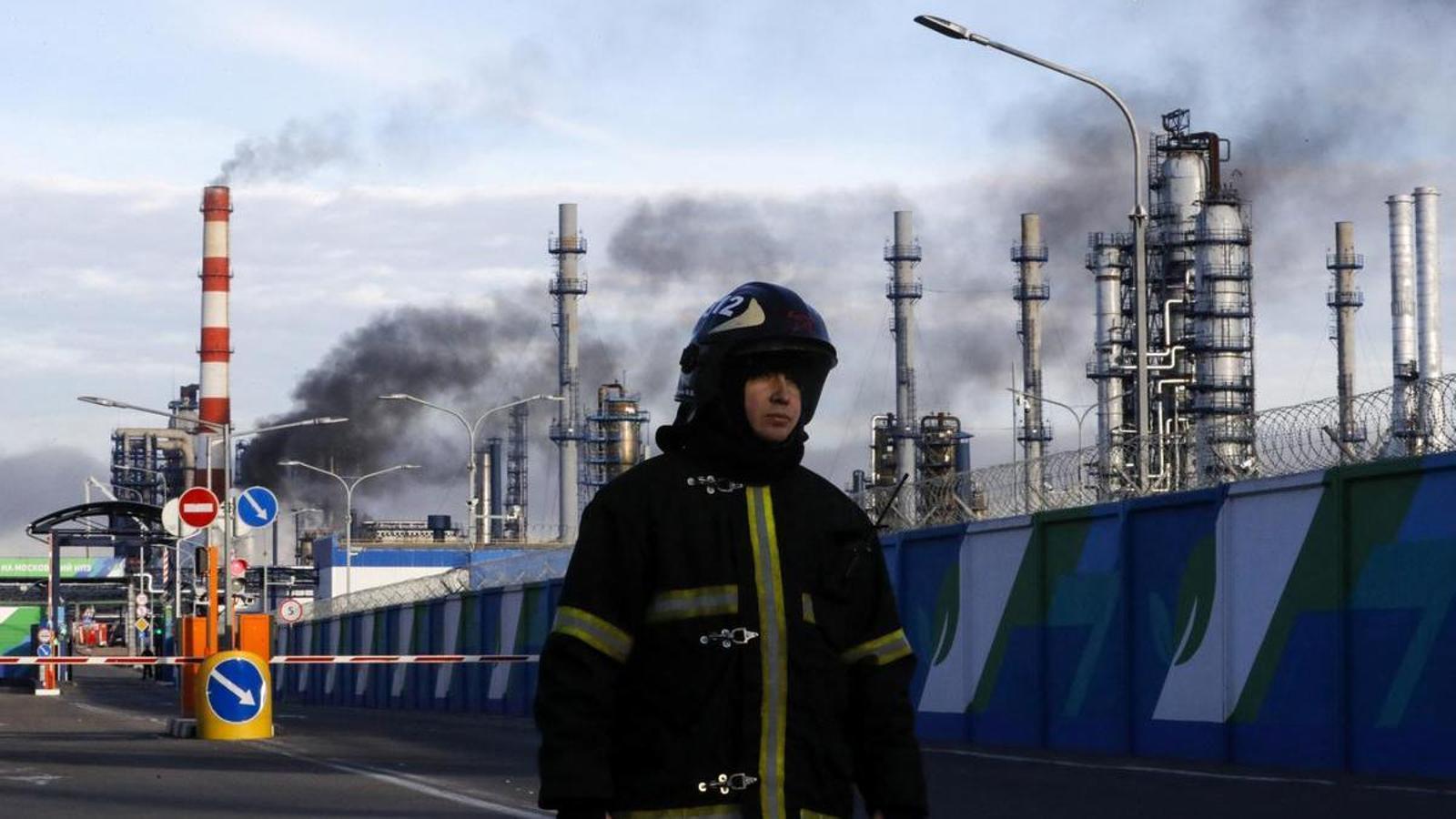
The weight of drones is important for understanding the difficulties faced by the Russian economy. Unlike Russia, which focuses its attacks on electrical infrastructure and civilian areas of major Ukrainian cities, Kyiv focuses its attacks on the Russian energy industry, such as refineries, oil pipeline pumping stations, or fuel depots, in addition to military infrastructure, such as airfields, armament factories, or ammunition depots. The attacks further reduce Moscow's productive and, therefore, export capacity.
Sanctions drive up prices
If energy exports are affected, imports have also been at their lowest for years. Western sanctions have prevented Russian industry from acquiring European and North American technology. Again, China has filled the gap, but only partially. Furthermore, Russian banks remain disconnected from international payment systems, making it difficult for the country's companies to transact with foreign countries.
This fact has a clear consequence: consumer goods and services that previously entered Russia at a good price are now scarce and more expensive, which is driving up inflation. Although the government has insisted for years that it has prices under control, it now expects the central bank to increase interest rates –the cost of borrowing– from 12% to 14.5% this year.
"High interest rates are not, as the Kremlin's closest critics say, a whim of the central bank governor, Elvira Nabiullina: they are the inevitable response to a fiscal policy that pours money into the war economy while sanctions block imports and the technology that should absorb it," the CEPA article indicates. Higher interest rates will further curb the growth of an economy that is still resisting, but suffers more with each passing year.
