The left warn of the danger of a PP and Vox government while Junts attacks both blocks
The PSC, ERC and the FA defend the welfare state while Albiol and Aizcorbe place the emphasis on the control of immigration in the 3Cat debate
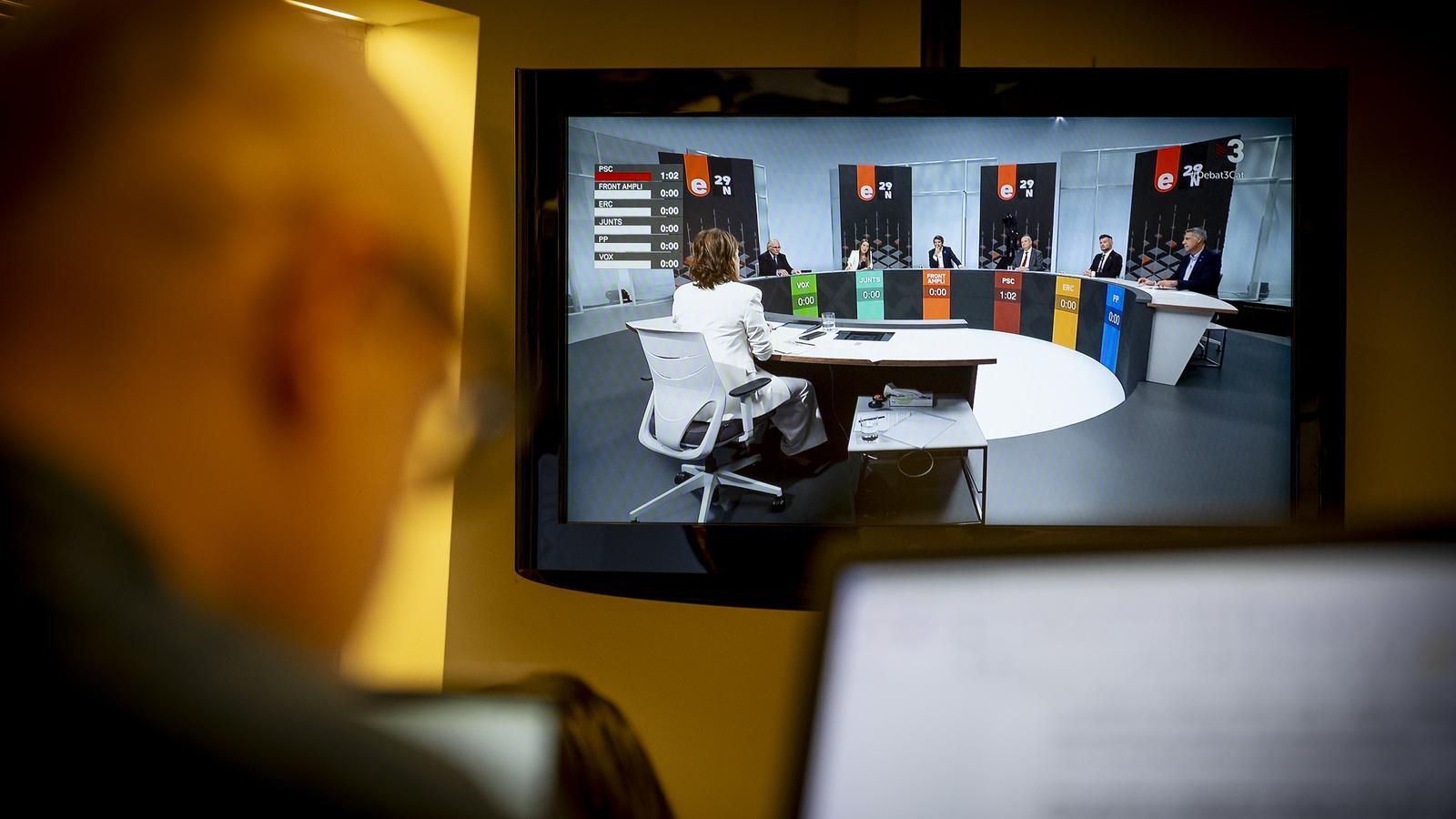

BarcelonaOne thing united all the candidates in the 3Cat debate, and that is highlighting that the November 29th elections are not just any election. This was emphasized very vehemently by the head of the PSC list, Jordi Hereu, afflicted by hoarseness that gave a more dramatic tone to his interventions: “These are transcendental elections, not a simple alternation. The PP and Vox represent a threat to the social model of progress and self-government that we have all built together”. And he then called for a “broad majority for the Socialist Party”.
The PP candidate, Xavier García Albiol, also agreed on the importance of a majority, asking for enough strength for a sole government by Feijóo, before admitting that if there is no other choice they will make a pact with Vox: “Because we believe that a change is needed”, he said. From there, what unfolded were multiple cross-battles. The most notable was that of the left-wing bloc against the right-wing one, yes, but the duel between Míriam Nogueras (Junts) and Gabriel Rufián (ERC) was also especially poignant.
Nogueras started by poking Rufián over his alliance with the “pro-Spanish” Podemos, and the republican hit back: “You have voted 44 times with the PP and Vox, all of them social issues. And I feel proud to represent my country, even people who are not pro-independence,” he said, anticipating possible attacks from that flank. Nogueras showed off her boxing knowledge to avoid being cornered with the PP and Vox bloc, where the left-wing candidates were pushing her. “Are we worse off or better off now regarding housing?”, she asked herself to respond to the invectives. The reality is that the debate led her to confront the left more than the right.
The “engine” of the government
The candidate for the Broad Front, Ernest Urtasun, and the one for Vox, Juanjo Aizcorbe, dedicated themselves to positioning their messages as key forces for forming a government. “What is at stake is a government with a Broad Front engine or one from Vox,” proclaimed Urtasun. Aizcorbe recited the usual far-right arguments against immigration and defended the so-called “national priority,” but gave it a Catalan touch to seduce the Aliança Catalana electorate. Aizcorbe said that Catalonia had to return to being “rich and full,” that they had to open “factories and workshops,” and that it was necessary to prevent “bell towers from becoming minarets,” in a tone that recalled the NO-DO documentaries.
“More irregular people are entering Meloni’s Italy than Spain,” intervened Hereu. “You won't throw anyone out, because if you do, perhaps you will have to work yourselves,” commented Rufián mockingly. “I do it in Badalona,” said Albiol, defiantly, in his role as sheriff which has yielded such good results for him in his city in the municipal elections.
“Catalonia must be able to have control over immigration,” insisted Nogueras, criticizing the policies of the PSOE and the PP and seeking a balance between the two blocs: “Neither all out nor all in.”
Two opposing blocs
Jordi Hereu insisted again and again on his theory of the two blocs, and placed Junts with the right. In fact, the socialist fired with real bullets from the very first moment against Nogueras, questioning her about Carles Puigdemont's interview in El Mundo. “When ERC and the CUP do interviews in El Mundo, nobody says anything,” the Junts candidate tried to defend herself. Hereu shouted at the top of his lungs to warn of the danger of a PP-Vox government every time he intervened. “Are you going to let all of Africa in here, yes or no?” Aizcorbe asked him. “Don't be such a demagogue,” Hereu replied.
“We will never confront the working class, because the right has a problem with poor migrants. But I admit that there is a problem of multi-recidivism...”, said Hereu, a moment at which Albiol and Nogueras pounced on him. “But our solutions are not the same as yours. We will not go against the weakest,” he concluded.
Nogueras attacked Hereu over social policies. “Public services are not sized for the Catalonia of more than eight million inhabitants.” “That is why more progressive policies are necessary,” Hereu replied. “Yes, that is why we are demanding the tax agreement,” retorted Nogueras.
Rufián, very relaxed and with the polls in his favor, played at interrupting his opponents. “Can you be quiet for once? You are whispering in my ear!” complained Albiol while Rufián laughed, slyly. The debate did not have the drama of those at the Spanish level, confirming that Catalonia is still different. The presenter, Ariadna Oltra, highlighted this from the start.
The one who made the most effort to ‘Spanishize’ the debate was, of course, Aizcorbe, rubbing salt in the wound of the PSOE's corruption at the Ministry of Transport, which he linked to the poor functioning of Rodalies. “This is unacceptable,” shouted Hereu from the other end of the table. Urtasun took advantage of this to boast about transport discounts.
Rufián-Nogueras squabble
Rufián ironized about the “magic and fantasy” of Junts when criticizing ERC’s agreements with the Spanish government on issues such as the transfer of Rodalies. “Magic is investing Sánchez and Illa in exchange for nothing,” said Nogueras, knowing that this would ignite Rufián. “I do not allow you to ever say "in exchange for nothing", when ERC got people from your party out of prison, it is a national shame,” he exclaimed.
“Catalans pay first-class taxes and receive third-class services,” insisted Nogueras. “But it has never been invested so much,” defended Hereu. “A government that can approve budgets is the best solution for Rodalies,” interceded Albiol, hinting that the PP would stop the transfer to Catalonia: “This is not the problem,” he said.
Ernest Urtasun saw the opportunity to introduce climate change into the debate, citing the DANA in Valencia and reaffirming his opposition to the airport expansion. “They covered up Mazón, and that is a great shame,” helped him Rufián, in one of the Republican's favorite topics.
The debate ended without clear winners, as everyone managed to convey their messages, but it did serve to define the two blocs in dispute and for Junts to make a place for itself in the middle of the great battle. In barely three days, the ballot boxes will decide the final verdict.
