Nanni Moretti fills Venice with romanticism
Thirty-seven years after his break with the festival, the filmmaker presents the masterful ‘Succederà questa notte’
-
CAT -
CAST
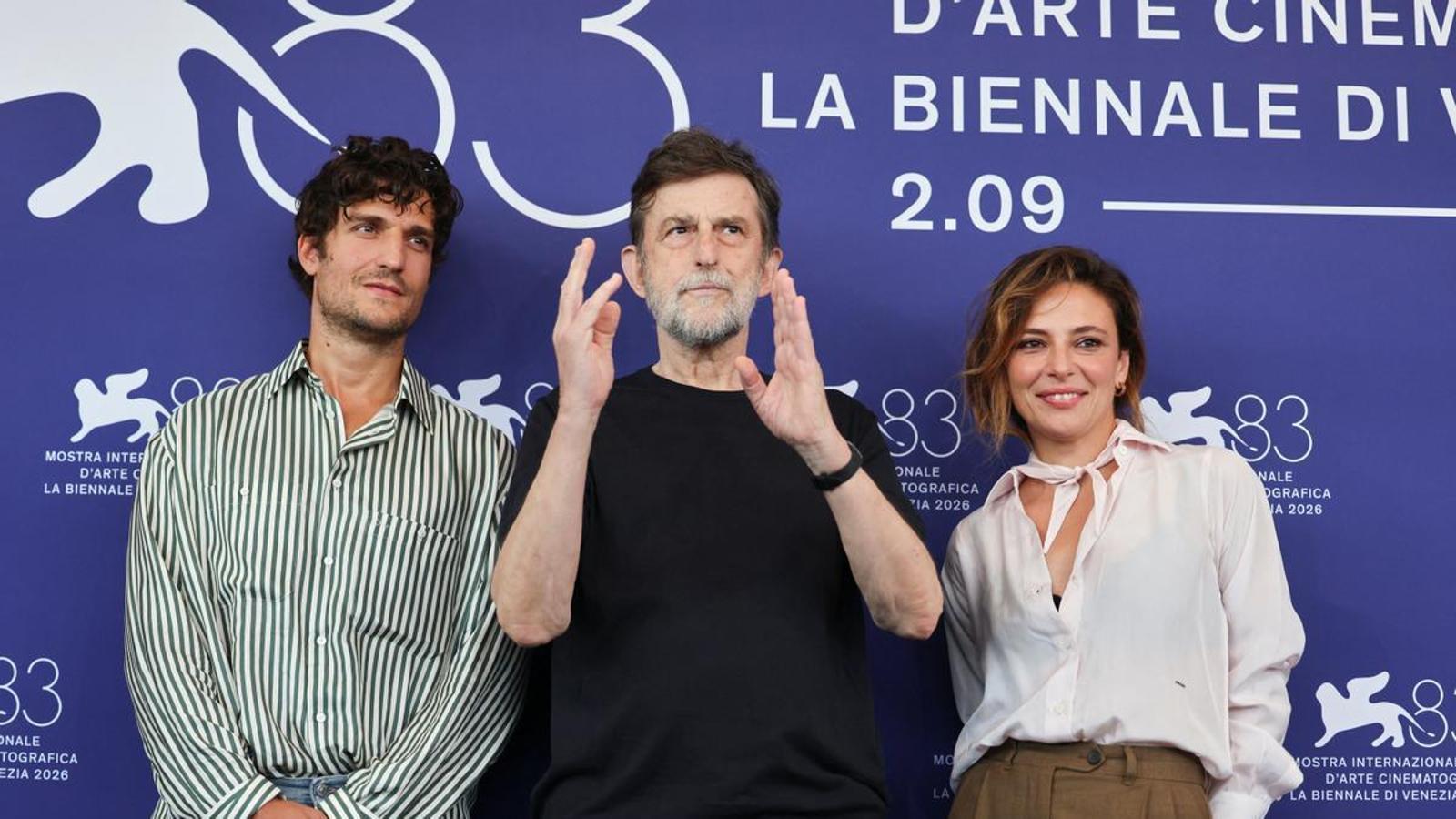
VeniceThe Venice Film Festival dressed up this Saturday and enthusiastically applauded the return of Nanni Moretti, one of the great Italian filmmakers of the last few decades. It had been thirty-seven years since the director of Caro diario had stepped onto the historic stage, since 1989 when his film Palombella rossa –which offered an acidic portrait of the bewilderment of the Italian left– was excluded from the Official Selection supposedly for political reasons; the film ended up being presented in a secondary section of the festival, the Critics' Week. However, Moretti has not shown any resentment during the presentation of Succederà questa notte, which is competing for the Golden Lion this year. In fact, the filmmaker wanted to downplay his almost four-decade distancing from the festival: “It is not true that I had anything against Venice; simply, in all this time, my films were never ready in the summer, which is when the festival is held. This time, instead of filming in the spring, I did it in the autumn and, therefore, it seemed natural to present the film there”.
Beyond the historical dimension of Moretti's return to Venice, it is worth highlighting the greatness of Succederà questa notte, a film that would deserve to take home the festival's top prize. Based on the book Legami by the Israeli writer Eshkol Nevo, the film follows the adventures of a man and a woman (a stellar Louis Garrel and Jasmine Trinca) who, over the course of a decade, cross their destinies in a prodigious narrative game of coming together and drifting apart. Avoiding all grandiloquence, Moretti builds a dense mosaic of human experiences that expands like a literary saga as much as it contracts into delicate moments of pure cinema: a romantic encounter that seems taken from a classic Hollywood comedy, imaginary digressions that refer to Fellini, a musical number to the rhythm of Like a Rainbow by the Rolling Stones, or a kiss through a glass that rectifies the anguish of a mythical scene from L'eclisse by Michelangelo Antonioni. “Many years ago I said a somewhat silly phrase: 'I would like to always make the same film, but each time a little better' –noted Moretti–. With the passage of time, I have recanted those words, and now with my co-writers Federica Pontremoli and Valia Santella we have made this quite intense love story."
Behind the scenes of trash TV
At the antipodes of the humanistic dimension of Moretti's cinema, the Mostra also hosted this Saturday the presentation of Primetime, a sordid fictional chronicle of the production of the reality television program To Catch a Predator, aired on the American network NBC between the years 2004 and 2007. In this reality show, journalist Chris Hansen –brought to life by Robert Pattinson– hunted pedophilic sexual predators in the act. “When I think about To Catch a Predator, I refer to my experience as a documentary filmmaker,” explained Lance Oppenheim, the director of Primetime, a production by the label A24, in Venice. “With that reality show, Chris Hansen built an incredible television artifact that mixed a certain reality with the purest artifice: actors pretending to be children and houses that were conditioned to function as traps for sexual predators.”
At the beginning of Primetime, an intertitle places the action in the year 2006, when NBC decided to promote To Catch a Predator in the prime-time television slot. However, from a cinephile perspective, the film refers back to 1976, when Hollywood decided to exorcise the moral crisis of the Yankee nation with titles like Taxi Driver, by Martin Scorsese, or Network, by Sidney Lumet, a work that also focused on the phenomenon of media populism. In fact, the shadow of Scorsese permeates the entire footage of Primetime. The camera lunges at the characters with a psychotic energy; the action is usually presented from multiple points of view; the music energizes the accelerated pace of the narrative; and the editing fragments the action with violent ellipses. Beyond the aesthetic question, the breath of the author of Raging Bull extends through the satirical, grotesque, and openly amoral tone of the film. That said, the great problem with Primetime is that it fails to transcend the morbid interest generated by the true story behind the film. When it comes to building a captivating and self-sufficient narrative, the film gets lost between the redundant denunciation of sensationalism and a set of innocuous subplots.
