Josep Maria Miró: "If we had a much more orderly country, all the farmhouses would be heritage"
The playwright and director premieres 'El Cadell' at the TNC, with Mercè Aránega, Rosa Renom and Marc Tarrida
-
CAT -
CAST
BarcelonaPlaywright and director Josep Maria Miró (Prats de Lluçanès, 1977) says that, somewhat unintentionally, with his works he does nothing more than accumulate minorities. Through theater, Miró—one of the most international Catalan authors—has spoken about the issue of gender, identity, and language. And now, with his latest production, El Cadell, he delves into his peasant origins. Starring Mercè Aránega, Rosa Renom, and Marc Tarrida, the play will be performed from September 30 to November 1 at the Sala Petita of the National Theater of Catalonia (TNC).
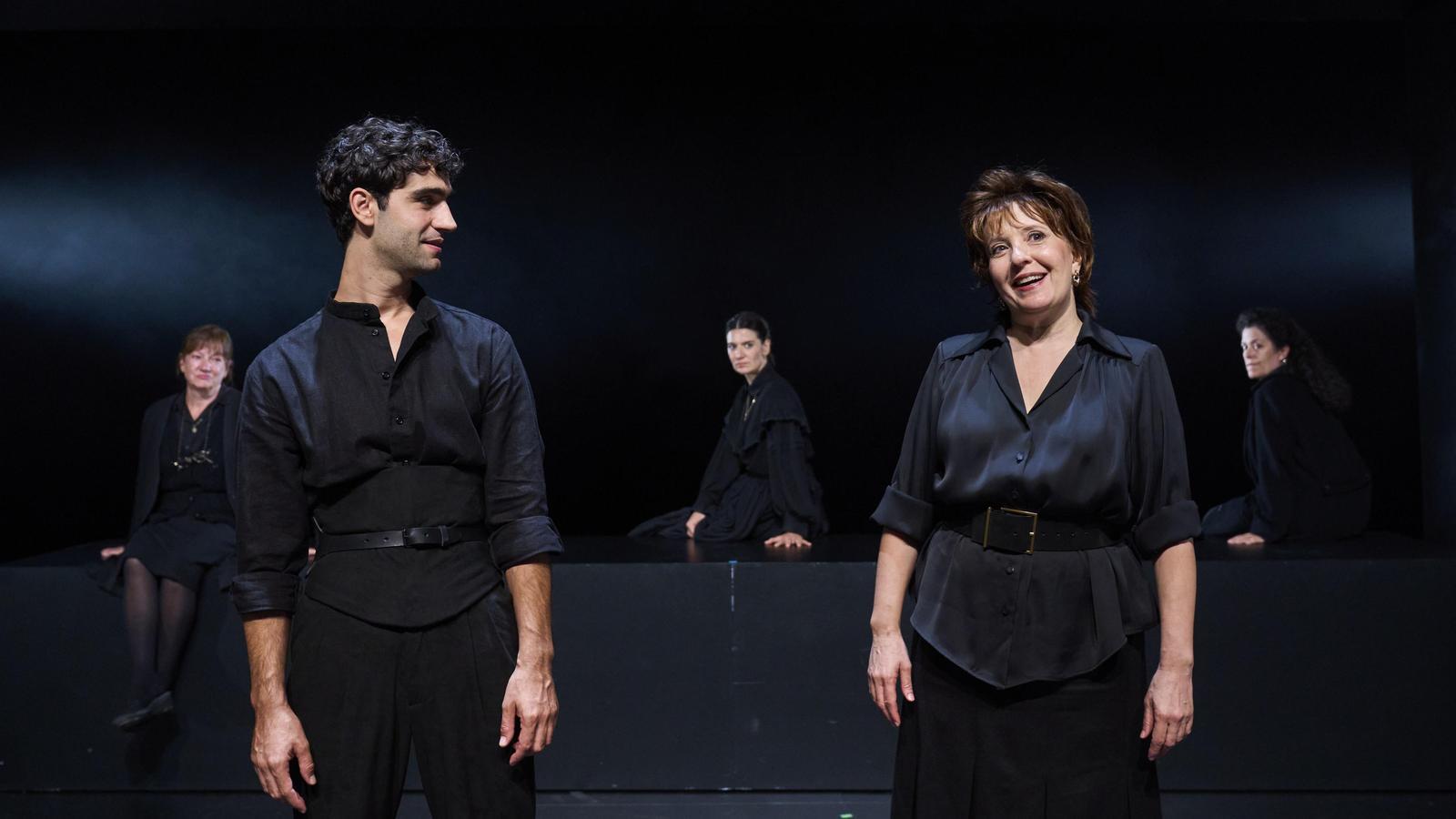
"I speak of legacy, of tradition, of the heir, and of the memory of the stones. All houses and farmhouses are architectures charged with emotionality. When a room is moved or the house ceases to belong to the family, our entire emotional world is shaken," says Miró, who also directs the play. The farmhouse is, in fact, the central core of the show and is even embodied by an actor, Marc Tarrida. He gives voice to the home and also to the three male characters in the story, who will inherit it over the course of a century, from the beginning of the 1900s. "They are three men from three different generations. We have fled from the stereotype of the alpha male, rural man and have worked on the violence, the harshness, and the lack of empathy from a place that was not clichéd," points out Tarrida.
Despite the title, the great weight of El Cadell falls on the various women who shape this family generation after generation. Miró traces a thread from the first women, two sisters played by Alba Pujol, to the last one, brought to life by Mercè Aránega. "She has the most contemporary character. She realizes that her world is ending, that she would like to die in the house but that she will not be able to. She is aware that the generation following her does not know what to do with a farmhouse. In what way are we giving them away to the nouveau riche from outside? What do we do with the forests and the fields? If we had a much more orderly country, all the farmhouses would be heritage," states Miró.
Women deprived of their name
One of the peculiarities of the work is that only the male characters have proper names. The women are baptized by one of the men with nicknames that refer to some of their circumstances or attributes. Màrcia Cisteró is the Stranger because she is a woman who reads, Àurea Márquez is the Ferret because she likes these animals, Lourdes Barba is the Petals because when the man seduces her she does not know whether to say yes or no, and Rosa Renom is the Aunt, who decides not to get married of her own free will. "The heir eliminates the women's identity; with the name he gives them, he brands them like livestock. It is a very great act of violence," underlines Alba Pujol. The cast is completed with Roberto G. Alonso, who plays the Uncertain one and who has also been in charge of the movement of the piece.

The staging of the production stands out for its risk: Miró has chosen for both the costumes (Albert Pasqual) and the set design (Alejandro Andújar) to be completely black and very essentialist, although the characters' clothing does refer to the eras in which they live. "The scenographic challenge was to conceive an artifact of theatricality, a kind of black box that would collect the phantasmagoria of the play and allow for a play of light and shadow that has been in the charge of Toni Ubach. He has illuminated black on black," the director highlights.
In fact, El Cadell is a play about ghosts because all the women who appear in it are dead. "Ghosts exist, they are wounds in our memory," says Miró. In a formal sense, the show is twinned with previous pieces by the playwright such as the first two parts of the Trilogia de l'Epifania: The Most Beautiful Body Ever Found in This Place (2021) —which is about to arrive in New York— and The Housekeeper (2025). The third part, The Maimed One, is pending release.
