Àlex Rigola: "It's a dirty trick that your father dies before you're 20, and, smoking three packs, I was on my way"
Theater director and owner of the Heartbreak Hotel

-
CAT -
CAST
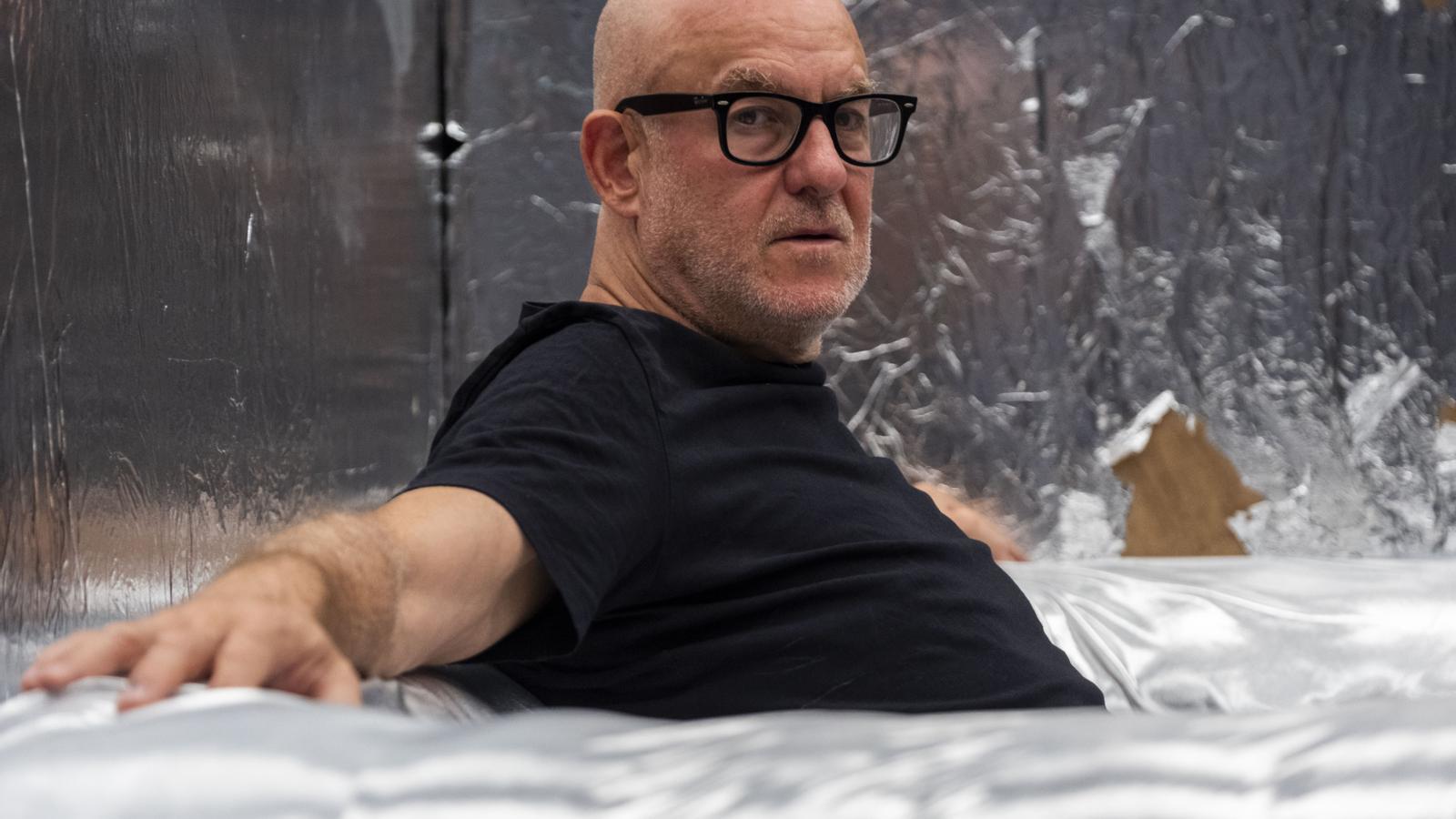
BarcelonaHis WhatsApp shows him looking at Palestine. With his back turned, in black: it is an Àlex Rigola with a certain longing for solitude and disconnection. It has been three seasons since he set up the Heartbreak Hotel theater, a place to visit in transit with the vocation of a healing refuge: you enter with a broken heart and leave with your heart equally broken, but full of questions that perhaps hide the tools to begin to heal it. Or, at the very least, make it scar over.
You directed the Lliure at only 33 years old. The Venice Biennale followed, the Teatros del Canal in Madrid... How did you decide to retreat to a small 72-seat hall?
— I was increasingly worried about the acting aspect. When we did many shows and went on tour, it was very difficult for the actors to stay alive on stage with a hundred performances behind them. Normal: the subconscious goes in search of saving effort. Then things end up becoming formalized and there is little substance left inside. I also realized that observing actors from 40 meters away makes no sense. I wanted the close-up, I wanted to zoom.
But large spaces, large budgets.
— Yes, what we have to do here will always be much more essential. For me, the most important thing is what is happening to the person who is transmitting, not what was happening to the author. Because when you are alive on stage, which is the hardest thing, the power of abduction is absolute. And that is why I needed a small space.
Likewise, there must have been vertigo in taking the step.
— The vertigo was there. Furthermore, the first thing we did was schedule a four-month show and we bit off more than we could chew. But I felt that it was what I needed. I had been very lucky. They had given me the direction of the Lliure at 33 years old: I no longer needed to prove anything to others or to myself and all that ego nonsense. I wanted to be at home and work with small groups, with similar sensibilities.
Are you betting money on it?
— Yes, I had some leftover money to put down as a deposit for a premises, which was also a product of everything the theatre has given me. If the money ends up leaving with the theatre... well, we'll see what we do afterwards. I also like the field of pedagogy; I can always have an outlet there.
But is it a sweet moment?
— It is authentic happiness. The work is stressful because there are few of us and, due to the number of seats, we cannot have more staff than the four of us. I work many hours a day. My life is this, because my children are already coming out of adolescence. They say: you have no life! And I reply: yes, yes, my life is this and I have no problem with it. There were two specific weeks when I had to cover a leave of absence and I worked 90 hours each week.
Which part do you enjoy the most?
— Especially the first fifteen days of table work. I have been working on the text for months and rediscovering it then with the actors is exciting. We have gone through very strong emotional things. I had an actress whose daughter had died. During a rehearsal, in the piece she had to explain that her daughter dies and the real name of her own came out. That is being present. And it is very difficult to achieve and, for the moment, neither AI nor robots can achieve it. There are many things that will disappear before theater, which is always going extinct, but never quite manages to do so.
Poor health of iron!
— Theater is something for older people, says the cliché, and it is true. A 20-year-old kid is meant to go jumping in a space where there is music loud enough for the energy and hormones they carry. Unless you have had a cataclysm, at 20 years old it is not common to ask yourself about the reason for life. You want to enjoy yourself, relate to others, open yourself to the world. To take action. Only afterwards does reflection arrive, when you see the wolf's ears and try to find a meaning for it.
Do you think about the wolf a lot?
— I think about it in the sense that, on the curve of life, I am already on the way down. And the descent is accelerating. It is impossible that at 20 years old I would have been interested in Chekhov. I was more interested in Shakespeare, because those are plays that have more action, they talk about breaking power structures. On the other hand, Chekhov asks himself much more “what am I doing in the world?” And it is more normal to ask yourself these questions after 40 than at 20.
Does theatre provide the best answers?
— The theater won't give you the answers! It is a question stimulator. If the theater gives answers... ugh, dangerous.
Let's return to the actors. Do they adapt enough to your method?
— The fewer formats there are, the better, but above all you depend on their real desire to play. Working as I ask is doing it unprotected. The main rule we have is: reproducing emotions is prohibited. They can arrive, as I was explaining to you, but the falsification of emotions puts me off the whole theatrical act and, on the other hand, it has been for centuries one of the backbones of the acting system.
Out of every ten shows you go to see, how many do you think: meh, this one is reciting.
— It's just that I can't even get this to work 100% with my own people. It's like trying to search for absolute truth. In the end, there is a text that someone had to memorize... But the search is exciting. And the moments that are found are worth it. It's like when you go to a museum, maybe you've walked through three rooms in a minute, but suddenly there's a painting that you are amazed by and it keeps you there for twenty minutes. In the end, it's the ability to be present.
Do you find it hard to be present?
— Like many artists, I have an enormous capacity for distraction; creativity makes ideas pop up... and dissolve within five minutes. I have never been tested for ADHD or anything like that, but any of those things could turn up for me.
And is it a pleasure or an anxiety?
— From 40 onwards, a pleasure. The 40s, for me, were wonderful. It was when I left the Lliure. I learned to accept myself and to live with myself. In some way, I was continuously taking action, perhaps so as not to have to analyze myself.
It was also when you gave up the three daily packs of tobacco.
— It was a consequence of having children. It's a mess when your father dies before you're 20, and I, with three kids, was on my way. I have a job that I have accepted, and it is to accompany these kids during a stage of their lives. I became aware of this. And I learned to tolerate myself much more. To know that perhaps I wasn't guilty of everything that was happening around me.
I'll finish with a frivolity, or maybe not. How many black t-shirts do you have?
— The wardrobe is quite funny because, effectively, it is all black. I am into simple lines, quite Bauhaus, and the same happens to me with color. I suppose I am looking for neutrality. I could give you the excuse that, in certain stage boxes, you have to disappear like technicians do. But the truth is that I also feel the need to disappear outside the theater, on the street. To disconnect from everything and be alone. To leave the noise and find peace in solitude.
