How to catch the spirit of a river
The visual artist Anna Dot delves for the first time into narrative in 'El Ter. A biography'

-
CAT -
CAST
- Anna Dot
- La Magrana
- 300 pages / 22.90 euros
Not long ago, the English writer Robert Macfarlane, a true authority on nature non-fiction, published a book titled Underland (Angle), in which he proposed the possibility, studied by him and by other writers and environmental activists, of treating the elements of nature as living beings and, therefore, opening an infinite field of new questions and possibilities: what should this treatment be like? Do they have rights and duties? Can we protect them with laws, as we do with vulnerable groups? They certainly have a birth, and a death, and they have been on Earth for several millennia, long before us as a species.
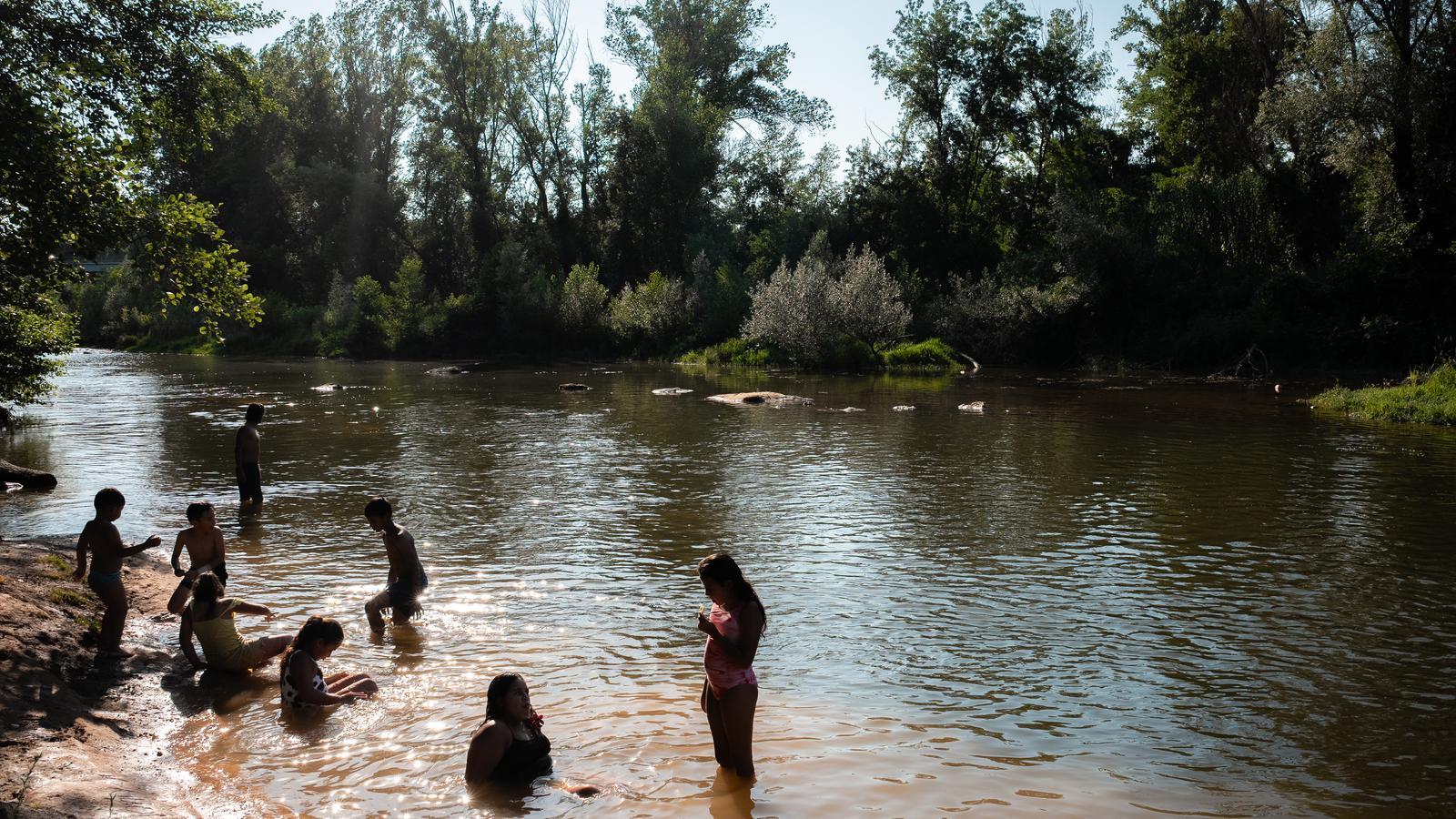
It is a whole trend to which the visual artist Anna Dot (Torelló, 1991) subscribes, who for the first time delves into narrative to try to capture something that may be unreachable: the spirit of an element of Nature. The approach is beautiful and avoids conventional narrative: a narrator, who baptizes herself as Biographer, travels on foot along the entire banks of the Ter, from the birth of the first springs in the Pyrenees to the death (or mouth) of the river in the Empordà, narrating and describing everything she sees. But she does not engage in landscape painting, nor does she rely only on the weapons of literature, but rather grafts it with historical analysis, scientific knowledge, and a certain philosophical flight. Thus, encounters with living and dead people, insects and spirits follow one another, and the contracts that regulate the use of water are reviewed at the same time as legends and customs are explained to us, such as the tradition of calling the morning mist of the Vic plain 'Tinyosa'. Everything exudes a kind of vital pantheism that dialogues very well with the historical moment we are living in, loaded with uncertainty, urgency, and a certain apocalyptic spirit.
Listening to the voices of the stones
Before starting, the author undergoes a spell to which she invites the readers and which will allow her to listen to the voices of the stones, the peaks, the trees, and the animals that she will encounter along the way. Besides visiting water treatment plants and mountain shelters or ski resorts (Vallter 2000 is right at the source of the river), the Biographer will suffer a kind of temporal hallucination that will turn her into a witness of episodes as distant in time as a childbirth in the Roman era by the water's edge or the inauguration of a mountain shelter in the nineteen-forties, which will contribute to completing the past of the Ter. She will also suffer visual hallucinations: she will be visited by a seraph-man with wings with whom she will move from holm oak to holm oak through the plain of Vic, amidst the stench of slurry and disquisitions on the attitude of Pasolini or the actions of Perejaume. She will be swallowed by the very waters she wants to biographize, and will suffer a flood that will turn her into just another molecule, to wake up, at the very end, lying on the beach of the Gola del Ter, where her work as a Biographer ends.
Anna Dot has written a book that aims to act as a link between the footprint that humans leave on our natural environment and the often irritated response of this environment. At times it is a bit confusing, because it lacks narrative elements to prop it up a little more, but it is full of discoveries and one must applaud its intention and spirit: “There is an exchange, a continuous flow. As in every origin, this end is also dialectical, a permanent tension of possibilities”. It is in this permanent tension of possibilities that we all move, readers and writers.
