Good interpretations in a somewhat disappointing Autumn Flash
Eglė Jackaitė and Rodrigo Bolzan and the cast of 'Navegar por el Neva' shine in the second edition of the theatrical cycle
-
CAT -
CAST
BarcelonaWith the 1992 Olympic Games, Barcelona gained a worldwide reputation that turned it into a tourist destination celebrated by some and condemned by others. But, in addition, it lost what had been a cultural celebration for four years of the highest international level thanks to the Autumn Festivals directed by Mario Gas and the Olympic Arts Festival. Since then, Barcelona raised the curtain without any special relief beyond the more or less charming proposals of public and private theater.
And that was how it went until last year, when under the guidance of the production company Bitó, responsible for the success of the Temporada Alta in Girona and Salt, the Flaix de Tardor was created in Barcelona, looking at what was once an attempt at an Autumn Festival under the name of Memorial Xavier Regàs (1982-1988) and which proved to be a total success. We would say, however, that in the second edition closed on Thursday with the premiere at the Library of The holy, directed by an old acquaintance of the Temporada Alta, the Lithuanian Oskaras Koršunovas, the performances of the actresses and actors have shone above the stylistic or thematic innovation of the proposals, and above all of the theoretically most exciting show, Mirror neurons, commissioned by choreographer Sasha Waltz and the indefinable director Stefan Kaegi. And the fact is that under the guise of a neuroscience analysis of the masses, in this case the one filling the stalls of the Fabià Puigserver hall at the Lliure, they offered us a behavioral experiment with a trap (there were dancers infiltrated among the audience and a group of volunteer spectators) to make the spectators dance and play with balloons like in a soirée in an all-inclusive in Cancun. A costly production with good video, well-chosen music and a huge screen to shock the bourgeoisie and with very little dance. A failed experiment.
Conversely, and as we were saying before, it has been the performances that have impressed us. For example, at the Biblioteca, that of the Brazilian Rodrigo Bolzan in Deserto, by the Brazilian company Polifônica, with direction and dramaturgy by Luiz Felipe Reis and based on texts, interviews, and memories of Roberto Bolaño. Also more than interesting at La Villarroel was the play on the construction of gender by four good actresses in Petróleo, by the Argentine company Piel de Lava: a good show that we saw in 2022 at Temporada Alta and about which we noted that it is “a charming and verborrheic comedy sown with textual and gestural humor in a fresh and uninhibited proposal that has minutes to spare but represents the best of an Argentine theater capable of surprising and entertaining”.
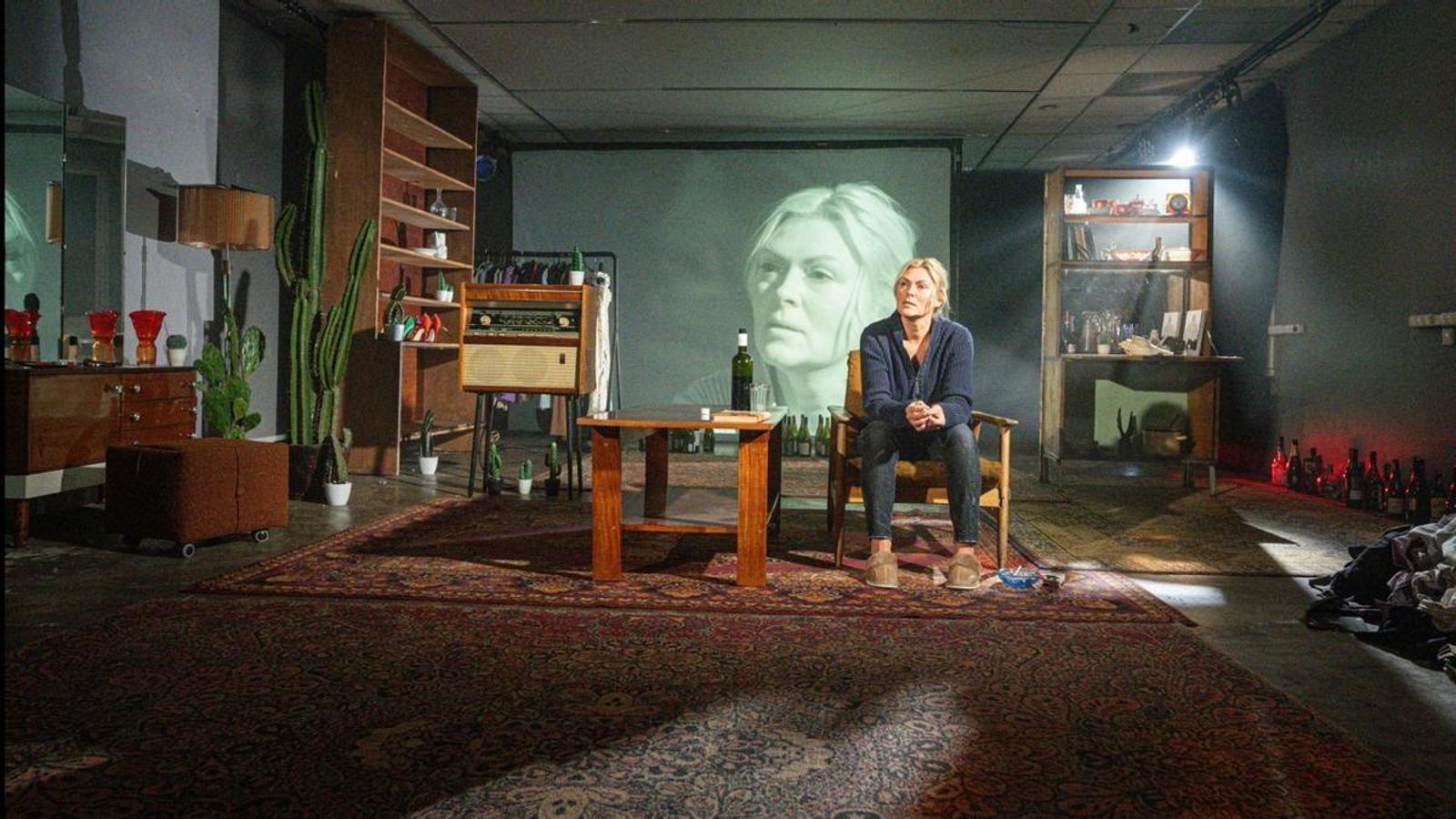
A good show also, and above all, magnificent female performances in Neva, by Guillermo Calderón, at the Lliure. A creation that recovered the original from thirteen years ago, modified in large part by new texts and by the new reality of one of the actors, who suffered a kind of stroke. A text about Chekhov and his wife staged with the sole illumination of the light from an electric heater. And, finally, a great performance by Eglė Jackaitė in La santa, a very partial reinterpretation of the life of Saint Mary of Egypt (344-422) that serves the Lithuanian actress as an exorcism of her own childhood tragedy and Koršunovas to demonstrate an exquisite mastery of the staging, the conception of the sound space, the image projected live, and the gestural organicity of the stupendous actress.
In the end, a set of very correct but artistically unambitious shows of a rather small format that I do not know if they set trends in the current panorama of international theater.
