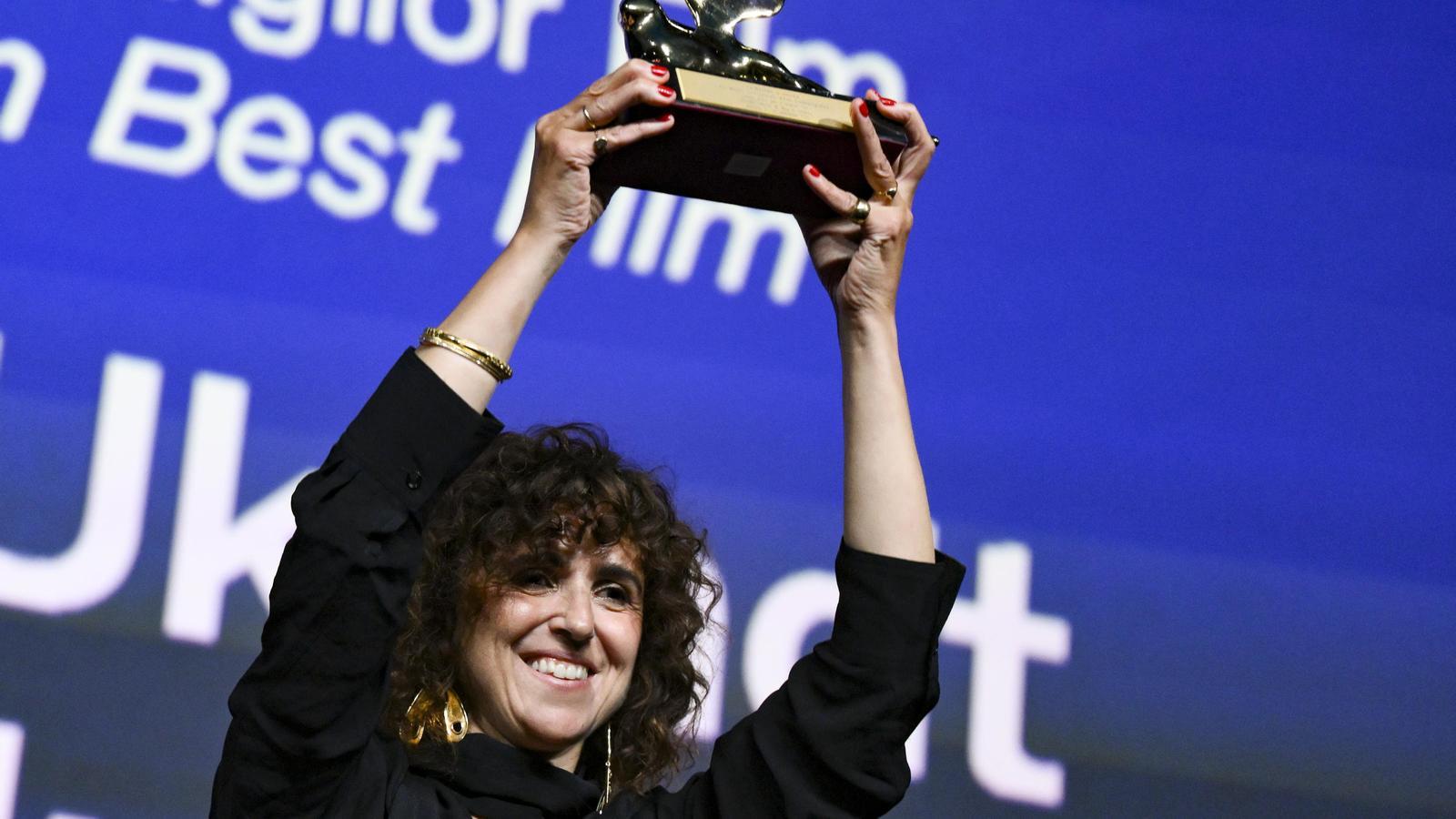
Golden Lion in feminist key for the Danish filmmaker May el-Toukhy
Israelis Yuval Abraham and Rachel Szor receive the Special Jury Prize for 'Naza' with the audience standing
-
CAT -
CAST
VeniceThe 83rd edition of the Venice Film Festival opened with some juicy statements in which American director Maggie Gyllenhaal –in charge of presiding over the Official Section jury– expressed her discomfort at the scarce presence of films directed by women in the competition for the Golden Lion. "We have finally discovered that women simply make worse films than men," quipped the director of The Bride! and The Lost Daughter with irony at the opening press conference. And it must be said that, before the start of the Festival, the landscape was bleak. Of the twenty-two films in the Official Competition, only two had a woman at the helm, and Kvinde ukendt (Woman unknown), by Danish filmmaker May el-Toukhy, was the only one directed solo by a woman –the other case was the documentary Naza, co-directed by Israeli Rachel Szor alongside Yuval Abraham–. Well, what began as a fair complaint has ended in a full-blown vindication, since the jury presided over by Gyllenhaal decided to award the Golden Lion to Kvinde ukendt, a film that portrays the harsh life odyssey of a woman who tries to rebuild her life in Denmark after the Second World War, when the Nordic nation was trying to clean up its image by brutally persecuting those who had collaborated with the Nazi regime.
On the stage of the Sala Grande of the Festival, May el-Toukhy –of Danish mother and Egyptian father– explained that Kvinde ukendt is about "the way in which the female body has become a battlefield and a public matter". Posed as a period film that is placid and somewhat academic on the surface but agitated by strong internal currents, Kvinde ukendt finds a balance between the celebration of the dignity of its protagonist and the exposure of the savage violence suffered by many women who became intimate with Nazism in order to survive. "These are women who have been made invisible and silenced by history," claimed El-Toukhy with the Golden Lion in her hands. And then, addressing the president of the official jury, she vindicated a feminist struggle: "Thank you, Maggie, for shedding light on the lack of opportunities for women in our industry."
A political winners list
Alongside the reception for May el-Toukhy, the other great ovation of the night was for the Israeli filmmaker couple Yuval Abraham and Rachel Szor, winners of the Special Jury Prize. The audience present at the Sala Grande, including festival director Alberto Barbera, stood up to honor the courage of the directors of Naza, who in their new documentary –after No other land– expose the death machine set in motion by the Israeli army to commit the genocide in Gaza. "The harsh reality is that, in the ten days this festival has lasted, six Palestinian children have been killed in Gaza," stated Abraham. "These murders are part of a systemic machinery, which we have been able to learn about thanks to the courage of many Palestinian journalists." "200 of them have died in Gaza," concluded Abraham, who, together with Szor, has built his film with the chilling testimonies of twenty-four soldiers and members of the Israeli intelligence services.
The strong political weight of the Mostra's programming was evident throughout the awards list. The Grand Jury Prize went to the magnificent Netflix production Possible love, directed by the South Korean master Lee Chang-dong. The film analyzes the destruction of the working class through the study of the relationship between two marriages, one working-class –hit by layoffs in a large industry– and one privileged, in which the wife wants to film a documentary about the labor crisis in the Asian country.
Meanwhile, the Best Director Award went to the Russian dissident Ilya Khrzhanovskiy, who in the monumental DAU, at 210 minutes, offers a free approach to the figure of the Soviet physicist and Nobel Prize winner Lev Landau, who participated in the nuclear bomb construction project and suffered the oppression and authoritarianism of the Soviet system. The collection of awards for socially-oriented films culminated with the Best Screenplay Award for Stéphane Brizé, Coralie Amédéo, and Olivier Gorce, responsible for the script of Un bon petit soldat, a work that portrays the moral fall of the human resources manager of a large insurance company.
The Volpi Cups for best actors went to John Malkovich, who brings to life a CIA agent with a guilty conscience in Wild horse nine, and Mathilde Arcel F. for Kvinde ukendt. And, finally, the Marcello Mastroianni Award for Best Young Performance went to the French actress Malou Khebizi, who embodies a girl locked in a juvenile psychiatric unit in the emotional 15/18 (A place to heal) by Cédric Kahn.
