From sandbags to NASA software: innovations at the Sagrada Família
Gaudí was already a pioneer in the introduction of concrete and in the design of a new structural system, and his successors have had the collaboration of the UPC and international experts

BarcelonaWhen Antoni Gaudí obtained his architect's degree, the director of the School of Architecture, Elies Rogent, dedicated a well-known phrase to him: "We have given the title to a genius or a madman, time will tell," said Rogent. Although Gaudí's academic record was not among the most brilliant, he already showed a very unique talent, and later revealed himself as a true innovator. In the final stages of the Sagrada Família works, the debate about the advisability of its continuation still persists. But beyond tastes and theories on how to intervene in heritage buildings, it is undeniable that the temple's successors are leaving a great legacy of innovation in the field of incorporating new technologies into construction.
Gaudí himself was an example of always wanting to go further: the one being built is the third version of the basilica. The first project was neo-Gothic, and Gaudí reinterpreted it in a second parabolic version and a third based on paraboloids and hyperboloids. "Gaudí was an innovator in many aspects: from a structural, constructive, and material point of view. He had an idea and tried to make it possible. And many times he had to innovate, to find solutions never before done, never created," states the architect director of the Sagrada Família, Jordi Faulí. "In the field of structures –explains Faulí–, which is the important part, he investigated how to build buildings with the minimum possible material. This can be seen in the catenary model of the church of the Güell colony made with sandbags, in how he shored up the first two floors of Casa Batlló, and in how he created the stone curtain wall at La Pedrera".

"Gaudí was innovative in the introduction of geometry in architecture and in the project development system: he first worked in 3D with models and then made the plans; he was a man far ahead of his time", emphasizes the head of technology and innovation of the basilica, Fernando Villa. "This drive continues to this day, because all of us have this DNA of innovation and of always looking a little further ahead", underlines Villa. Furthermore, at the Sagrada Família one can also see how he innovated with the use of color, the innovative trencadís technique, and how he managed to bring light into the buildings.
Gaudí, a pioneer of concrete
Gaudí innovated with materials: he began the works for the crypt and the apse wall with traditional methods, but in the last stage of his life, when he was working on the Nativity facade, he introduced concrete, specifically at the terminal of Barnaby's tower. Before that, he had used it in some auxiliary buildings of the Sagrada Família workshop and in previous works such as La Pedrera and Park Güell.
From oblivion to the resumption of works
After the ravages of the Civil War, the works were resumed in 1952. Ten years later the Gaudí Chair was created, and in 1965 the famous letter signed by great figures from the national and international cultural world appeared in La Vanguardia against the continuation of the works. In 1976 the controversial apartment block was built on Mallorca street, 20 metres from the Glory facade. Currently, the neighbours are working to reach an agreement with the Construction Board and the Barcelona City Council to determine how many flats will be demolished and how the staircase above Mallorca street imagined by Gaudí will become a reality. According to Gaudí, it was to reach Diagonal, but the initial agreement with the City Council, to redefine, places the opening only up to Valencia street.

The calculations to lift the ships
A few months after taking office as director of works, in 1985 Jordi Bonet hired architects Joan Margarit and Carles Buxadé, both professors of structures at the Polytechnic University of Catalonia (UPC), to perform the calculations for the naves to be covered. They were delivered two years later, with the addition that they incorporated the requirements of current regulations so that the work would withstand winds of 200 km/h in the highest parts and resist seismic movements. The greater resistance of steel and concrete made it possible for Gaudí's sections to comply with regulations that appeared about ninety years later. The first section of the vaults, corresponding to the west choir lofts, became visible at the beginning of 1993. And Bonet continued collaborating with the structures department in the UPC's architecture to create the computerized drawing of the temple's nave vaults.
With NASA software
In 1979, a key figure joined, the New Zealand architect Mark Burry, who collaborated until 2016. The challenge Burry faced was to interpret, systematize, and continue Gaudí's work with digital tools, using fragments of models and drawings that survived the fire at the Sagrada Família workshop in the summer of 1936. Burry explained that there was no specific software and they had to use the same program used to design the Boeing 777. "We used NASA's design program, CAD 5; Mark Burry recommended it to us, and we worked together," recalls Josep Gómez Serrano, emeritus professor of structures at the UPC. After working with Margarit and Buxadé, Gómez Serrano continued working on projects for the basilica. From the late nineties to a few years ago, the UPC and the Sagrada Família have collaborated on about thirty projects related to different aspects of the basilica. "Initially, we used computers to calculate the structure, but not to draw the plans," he recalls.
Cement that imitates Montjuïc stone
The construction of the Sagrada Família began with stone from Montjuïc, and when Gaudí took over the project, it continued with this material. But decades later, when work on the Passion façade began in the mid-fifties, Montjuïc stone became very scarce, and in 1957, quarrying stopped. At that time, stocks from different quarries were purchased, and stone from works such as the renovation of the Olympic Stadium began to be recycled. A few years later, the Construction Board opted for construction with prefabricated elements to speed up the works. The Escofet company has been crucial in this process, as it led the creation of a cement that imitates Montjuïc stone, thanks to the incorporation of red and brown sands and beige and silica calcareous marble aggregates into white or gray cement. Their pieces are found from a height of 17 meters, and they have also made them for the towers of the Virgin Mary and Jesus. Another of their contributions are the wings of the tetramorph that crown the four towers of the evangelists. These are elements 9 meters high and weighing 15 tons, molded in polished white concrete.
The intensive production of prefabricated elements
Major works require major solutions: two years before the Pope's visit, the head of works for the Sagrada Família, Ramon Espel, feared that they would not finish in time for the consecration scheduled for November 2010, and in 2008 he started a plant for the production of prefabricated parts on an 11-hectare plot of land in Galera, in the municipality of Gaià (Bages). The first parts produced there were three structural elements for the tower of the Virgin Mary, and later parts were made for the towers of the evangelists. This method of precast and reinforced parts allows for faster, more precise work with fewer risks. One of the sheds houses the stone tensioning machine, where resin is injected between stainless steel bars and stone blocks so that they work together. This is a process specifically designed for the Sagrada Família and applied almost daily. But all this has an insurmountable requirement: the parts, or fragments, must be able to pass under the road bridges.

The exceptional structure of the Virgin Mary's tower
The construction of the six central towers – those of the evangelists, the Virgin Mary, and Jesus – has been one of the major challenges of the works, as they do not touch the ground but are supported by internal columns called "structural trees," as explained by the assistant architect of the Sagrada Familia, David Puig, located above the crossing and the apse of the basilica. At the crossing, these columns are supported by deep reinforced concrete foundations, but the apse area posed a significant challenge for the technicians, as the columns rest on the crypt, which is declared a UNESCO World Heritage Site. It was possible to reinforce the foundations, but the columns could not be reinforced because it would have severely damaged the crypt. The towers of the evangelists could be built, but the one of the Virgin Mary, which was initially located elsewhere, required a different solution: the technicians developed a new structural system of tensioned stone without concrete, the development of which, from the initial idea to the validation of the prototype, took three years. The result was a lighter and more resistant structure, capable of supporting the loads without compromising the crypt's columns.
All of this has an explanation: "When Gaudí decided to build the building in parts, this also included that each part has its own foundations and is built at the appropriate time. He, in fact, only built the foundations for the Nativity facade," recalls Faulí. Thus, the foundations were built according to the calculations, regulations, and possibilities of each moment, except for the Virgin Mary tower, which is an exception. "This tower was placed on top of the crypt that Gaudí largely built – he adds – but only after the foundations had already been laid. Therefore, we encountered the passage of time and, consequently, the change in regulations. But also the fact that the lantern tower in Francesc de Paula del Villar's project was much smaller. So, here we did have to refound the crypt so that it could support the vaults of the apse and the Virgin Mary tower."
Caring for the basilica with drones
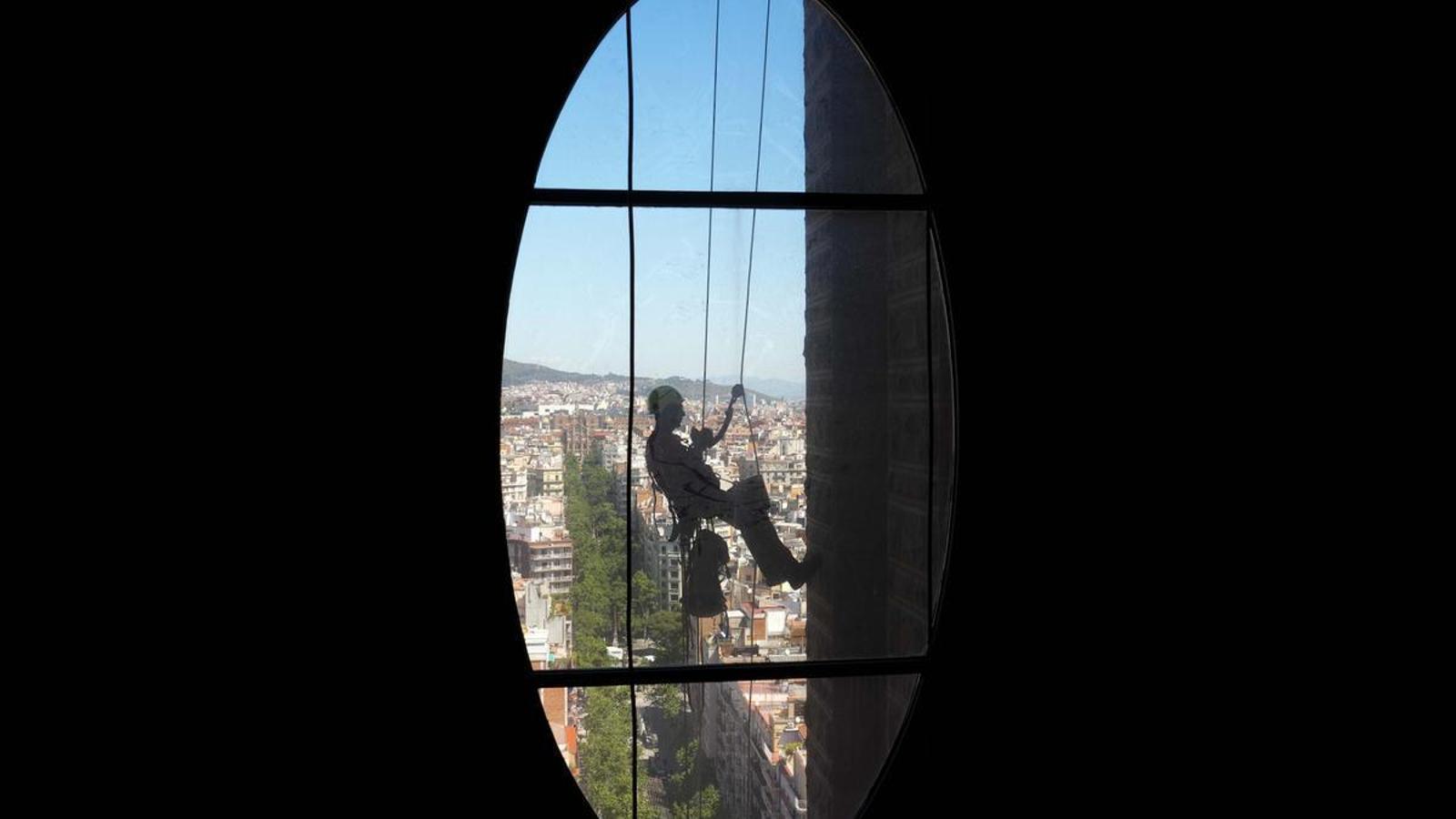
In parallel with the advances in the construction of the temple, the built part must be preserved, especially the Nativity facade, which is classified as a UNESCO World Heritage Site. There is also innovation in this area: "The inspections we used to do with climbers, we now do with drones. But the climber and the drone will coexist, because, once a pathology is detected, those responsible for the building's conservation will be able to say if it is necessary for a climber to intervene –explains Villa–. When we have all the pathologies located, they will be cataloged and we will incorporate them into a fully digitized information flow. And when a climber repairs them, they will also bring a camera to record in high-resolution video everything they do. Therefore, we will be able to trace the pathology, what needs to be done and how it needs to be done".
