33 things you might not have known about the Sagrada Família
From the origin of the cult of Saint Joseph to the controversy of the AVE

-
CAT -
CAST
BarcelonaOf the Sagrada Família, which these days is the protagonist because the Pope will commemorate the centenary of Antoni Gaudí's death on the 10th, many books have been written. Almost everything is known or studied, but there are some curiosities that perhaps not everyone knows about the great temple that has now become the most emblematic image of Barcelona. We have selected 33, a symbolic number that appears in the magic square of the Passion facade, in which, by cheating a little, all the numbers in the grid, in any row, column, and diagonal, add up to 33, which is Christ's supposed age when he died.

Why the Sagrada Família is not called Sant Josep
Throughout the 19th century, in a context of both liberal and workers' revolutions, and a rise in anticlericalism and scientific positivism, the Catholic Church promoted the cult of Saint Joseph as a model for Christian working families. In 1870, Pope Pius IX declared Saint Joseph patriarch of the Church, and in 1955 another pope, Pius XII, decided that May 1st would be celebrated as the feast of Saint Joseph the Worker to counteract the socialist labor day. In Catalonia, from the beginning the cult had much devotion and at the initiative of the Spiritual Association of Devotees of Saint Joseph, created in 1866 among others by the bookseller Josep Maria Bocabella, a plot of land was purchased in 1881, for 172,000 pesetas of the time, in the municipality of Sant Martí de Provençals to build an expiatory temple for the sins of men that would be paid for with alms and donations. It would be dedicated, however, to the entire Holy Family, as had already been requested years before by Father Josep Manyanet i Vives, whom John Paul II made a saint in 2004.

The first architect
The first stone of the temple was laid on March 19, 1882, Saint Joseph's Day, with the blessing of the bishop of Barcelona José María de Urquinaona (the one from the square). The architect at that time was Francesc de Paula del Villar, who since 1877 had made several versions of the project, the last of which included a bell tower of about one hundred meters. He resigned in 1883, among other things because he lacked materials to reinforce the columns of the crypt, but above all due to disagreements with Bocabella's advisor, Joan Martorell, architect of the Palau de Pedralbes, who recommended Antoni Gaudí, his disciple and collaborator with whom he had made a failed project for the cathedral facade, to continue the works.

The crypt
In 1883, at 31 years old, Gaudí became the architect of the Sagrada Família, to which he dedicated 43 years of his life, the last twelve exclusively to the works of the temple. When he took over the work, only the crypt had been started, in which he immediately made changes. He dug a trench to let in natural light and changed the access from the center to two lateral spiral staircases.

Mass has always been celebrated here
The Sagrada Família has always been under construction, but it has also almost always been used for worship. Even with the crypt half-finished, in 1885 Gaudí finished and enclosed a chapel, that of Saint Joseph, so that masses could be held there from the very beginning.
The great donation
In 1890, a large anonymous donation was received for the temple which encouraged Gaudí to change the project and dedicate the money to the construction of the Nativity facade. According to the writer Julià Bretos, author of the novel La dama sense rostre, who made the donation of more than half a million pesetas was Isabel Bolet, the widow of a merchant from the Sants neighborhood.
7.5 meters
The temple has as a base module 7.5 meters, which is the separation between the columns of the side naves and the twelfth part of the 90 meters of the interior length. All the main dimensions of the temple are multiples of this base module. And this is also the case with the height of the central towers, such as that of Jesus, which is 172.5 meters (23x7.5) or those of the evangelists, which is 135 (18x7.5).
Temple orientation
Traditionally, churches are built with the apse facing east, which is where the sun rises and also the direction of Jerusalem. In the Sagrada Família, something that did not please Gaudí, the apse faces north, but he made the most of it by having the east facade, that of the Nativity, receive the first light of the day and the Passion facade, to the west, the last. Thus, the sun illuminates the various parts of the temple in a symbolic way as well. The stained glass windows inside emphasize this symbolism.
1926-1936
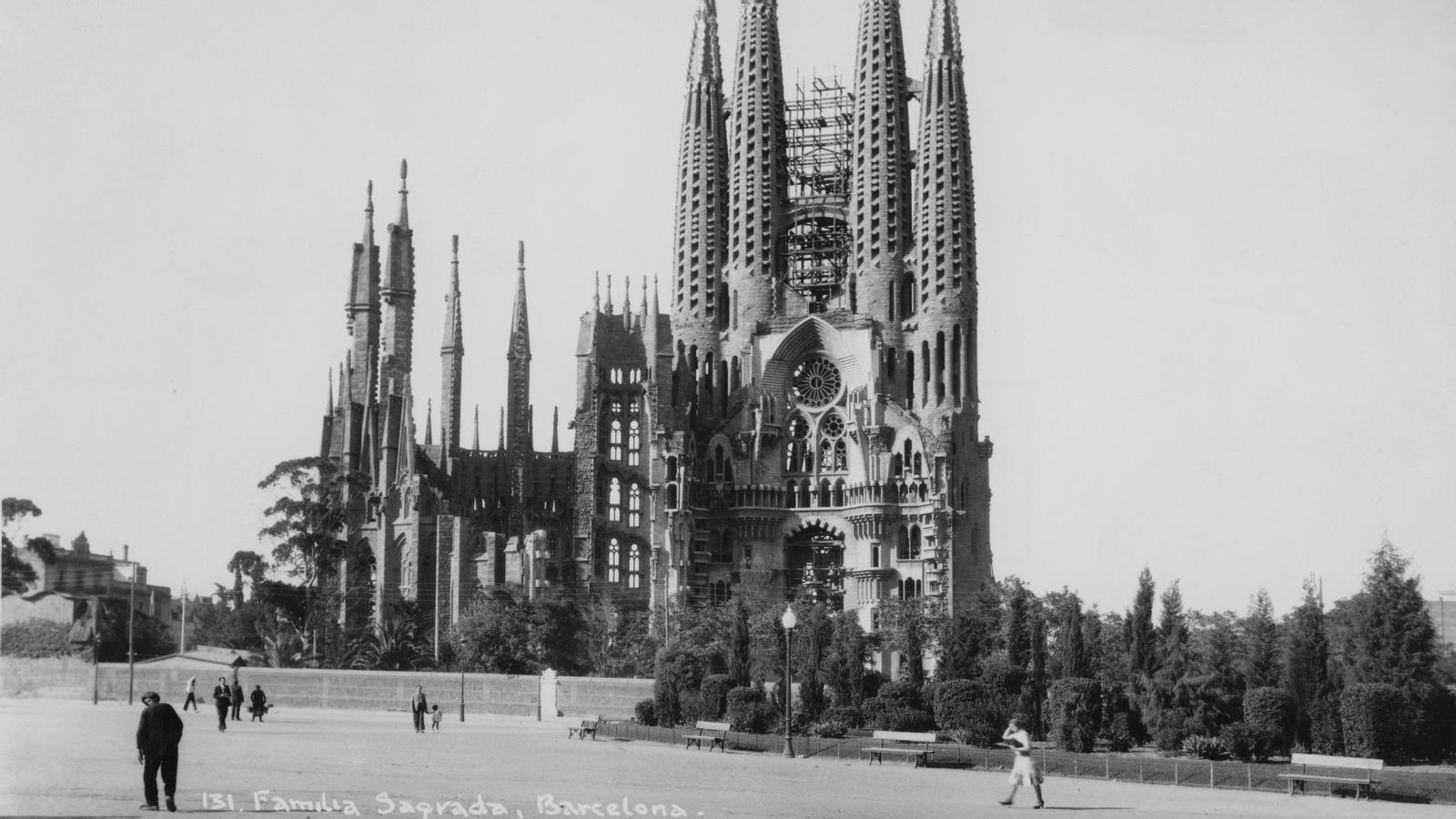
When Gaudí died on June 10, 1926, only one of the four towers of the Nativity facade, that of Saint Barnabas, had been completed. He had left plans for the entire work and, above all, many models of different parts that served to explain how he intended to continue the temple, even though he was making modifications as he went along. In 1936, an anarchist squad vandalized the temple and Gaudí's workshop, burning documents and destroying models. Thanks to the intervention of Companys' weakened government, the temple was saved in extremis from demolition, a fact that George Orwell lamented in his Homage to Catalonia.

The continuation
How was the work continued? Thanks to the remains of the models that were saved and the photographs that had been taken of them before. From the beginning, the plans, drawings and photographs of the work were published both in the press and, above all, in the magazine El propagador de la Devoción de San José, which in 1948 was renamed Temple and is still published and has a web version in the form of a blog. Gaudí's disciples and friends also published, during his lifetime and after his death, transcriptions of his conversations, since he had only published one article – a critique of an exhibition, in 1881 – and no direct interviews are known either.
10 new architects so far
The Sagrada Família. Cathedral of light,
150 employees on payroll
Although the number varies, according to the lead architect, around 150 people work on the temple complex, of which about fifty are in the architecture department and the rest are in construction and management. According to Chiara Curti in the book La Sagrada Família. Catedral de la llum, while the crypt was being built, 200 workers were employed, but between 1914 and 1917, due to lack of income, only 27 people were on the payroll. However, the workers who are involved in one way or another are hundreds. Nevertheless, if we count those who work indirectly, contracted by external companies, such as cleaning and security services, the number reaches 1,600 workers.
From Etsuro Sotoo to Medina Campey, sculptors
Although there are more than twenty sculptors documented who have worked on the Sagrada Família in one way or another, among the most notable are Llorenç Matamala, a collaborator of Gaudí on the Nativity facade; Etsuro Sotoo, the Japanese sculptor who has worked on the doors and other elements of the same facade and in other parts of the cloister, with more than 500 interventions; Josep Maria Subirachs, who made the Passion facade and also the doors of Glory and the interior Saint George; and Xavier Medina Campeny, who has made the representation of the four evangelists that have been installed on their towers.

The stained glass windows that are kept
Joan Vila-Grau spent almost twenty years making the stained glass windows of the Sagrada Família, using the technique of trichromy and leaded glass, according to what his disciples had collected that Gaudí wanted. Thus, at the bottom there are stained glass windows with more vibrant colors and at the top they have no color to allow sunlight to pass through. In the Nativity section, they are blue and green to capture the morning light and in the Passion section, yellow and red to capture the light of sunset. The designs for the stained glass windows of the Nativity facade, yet to be made, were also designed by him before he died in 2022 and are stored awaiting installation.
Bell towers and bells
Gaudí imagined the Sagrada Família also as a great musical instrument, both on the outside – the towers would have tubular bells, about eighty, which would play like a large carillon that could be heard throughout the city – and on the inside, where he designed the layout of the organ and the choir that surrounds the entire nave to ensure the best acoustics. There is only one bell, it is not known if it was a test, on the tower of Saint Barnaby. But the sound that is heard now is a recording. The bells are planned to be placed once the work is finished. Inside, the acoustics have been tested in various celebrations and on June 10th it will be played again in the Pope's mass with the participation of 600 singers.

The Barcelona lighthouse
Gaudí foresaw, as he explained to his followers, that the temple should also be a kind of large lighthouse. Thus, there would be two spotlights on the four towers of the evangelists, one that would go towards the ground and the other towards the tower of Jesus, which would also illuminate and send rays of light to the entire city on great occasions. At the same time, the star that crowns the tower of the Virgin Mary, more humble, has already been illuminated on special occasions.

Working generations
In some cases, temple workers are family. This was the case of sculptors Llorenç and Joan Matamala, and also of architects Lluís Bonet and Josep Bonet, in both cases father and son; but also of sculptress Mercè Riba, whose great-grandfather was a sculptor on the Nativity facade, or of Laia Vinaixa, head of the temple's documentation center, who is a direct descendant of Josep Maria Bocabella, who was the father of her great-great-grandmother.
The trades
As befits the advocation of Saint Joseph, whose symbol is a saw (which, together with the mantle of Mary and the cross of Jesus, form the symbols of the Sagrada Família), the temple pays homage to crafts in various parts. Even the cradle of Jesus on the Nativity facade is a stonemason's basket. There have been many anonymous artisans, and others who in recent times have played an important role in some aspects, such as Jordi Barbany, for the stone treatment, Toni and Guillem Cumella, for the interior mosaics of the nave and towers, or Enric Pla Montferrer, for the forged elements.
172.5 or 175.5 meters?
On February 20 of this year, the Sagrada Familia officially became the tallest religious building in Europe, reaching a height of 172.5 meters. This is if, as its special master plan does, the zero level of the temple is considered to be the interior pavement of the nave. As explained on X @efemarq (Architecture Ephemerides), if the street level were taken into account, which is how most buildings are calculated, the height would be 175.5 meters because the nave is on a three-meter platform. And if sea level were taken into account, the height would be 207.5 meters because the level of the area where it is located is approximately 32 meters above sea level. In other words, relative to sea level, the Sagrada Familia is taller than Montjuïc, which is 177.7 meters high.
From Maragall to Margarit, the poets
Many writers have been inspired by the Sagrada Família, but possibly the closest are two Joans. The first, Joan Maragall, a friend of Gaudí and one of the main defenders of the temple. In his Oda nova a Barcelona, from 1909, he writes: "On the east side, mystical example / like a giant flower blooms a temple / amazed to have been born here. Amidst such a sullen and wicked people / who laugh and blaspheme and quarrel and boast / against all that is human and divine. / But, amidst the misery and rage and smoke, / the temple (it doesn't matter!) rises and prospers / awaiting faithful who are to come". The other Joan is the poet Joan Margarit, who as a structural engineer calculated its foundations and directly participated in the construction of the main nave of the temple; in some of his poems his professional experience is very present.

Gaudí, the first guide, and always in Catalan
Gaudí was the first guide of the Sagrada Família. There is evidence that he greatly enjoyed showing it to both children and illustrious visitors, such as the papal nuncio Francesco Ragonesi. However, it was difficult for him to switch languages. To King Alfonso XIII in 1904 as well as to Miguel de Unamuno in 1906, he spoke only in Catalan. The meeting with the Basque writer, both with a strong but divergent religiosity, was tense, according to chronicles. One saying “no me gusta, no me gusta”, the other replying “no li agrada a cap castellà”.
Saint Philip Neri
On June 7, 1926, Gaudí was run over by a tram on Gran Via, near Bailèn street, when, having finished work at the temple, he was walking, as he did every day, to the church of Sant Felip Neri. In this church in the Gothic Quarter, he had his confessor and his religious community, the Oratorians. His friend Lluís Millet was the director of the chapel where Gregorian chant was sung. The devotion to this Italian saint, who is also present in the Sagrada Família, was reflected in two paintings by Joan Llimona in which Gaudí posed as a model for the representation of the saint.

Gaudí portrayed in the Sagrada Família
Just as Gaudí used local people or his workers as models for the sculptures on the Nativity facade, Subirachs was inspired by Gaudí's photograph from the Corpus Christi procession – one of the best known of a man who was not at all fond of photographs, with only about thirty in existence – to depict him on the Passion facade, in the sculptural ensemble of Veronica.
A strange cloister
The protest against the continuation of the Sagrada Familia, always latent, had a peak moment in July 1990, when the magazine
The famous Orsini bomb
The famous figure of the young man with an Orsini bomb, the one that exploded in the Liceu attack, is well known, represented on the Roser portal, the interior facade that from the Nativity faces the cloister. On the other hand, however, there is another representation of temptations: a young woman with a bag of money. Anarchism and prostitution, two of the evils that they wanted to atone for in the temple. In 1936, the Roser portal was among the most vandalized by anarchists.

The first capture
After the Civil War, the works of the Sagrada Familia were paralyzed, at a minimum. In March 1955, however, the first collection was made, a campaign to collect donations to contribute to the construction of the temple, which later became an annual event, usually coinciding with March 19th, Saint Joseph's Day, when there was also usually an open house to show what had been done and to encourage donations. In a diffuse way, at the end of the 90s, due to the increase in visitors driven by the Olympic Games, the collection as such disappeared. Today there are no longer collections, but tickets continue to be constant contributions to the works. And the open houses are now usually held coinciding with La Mercè, with tickets that are raffled among Barcelonans.
Civic protest against the continuation
The protest against the continuation of the Sagrada Família, always latent, had a peak moment in July 1990, when the magazine Artics, directed by Vicenç Altaió, convened a civic protest in front of the Passion facade in which a whole series of city personalities climbed onto a stage to insult or criticize the sculptures that Josep Maria Subirachs was making. Years earlier, in 1965, the same sculptor had been one of the signatories of the manifesto against the continuation of the works, published in La Vanguardia, which had also been signed by Tàpies, Bohigas, Le Corbusier and Joan Miró, among others.
Accidents, few
Despite the scale of the temple's work, there is, at least publicly, little record of accidents at the construction site. The most serious occurred in 1994, when in the temple's museum a child touched a plaster mold of a capital, weighing about 200 kilograms, and it fell on him, causing his death. Less serious, because it happened at night, was the fall of two enormous stones on a workshop while the central part was being built. In that case, in the year 2000, there were no injuries. In 2011 there was also an intentional fire in the crypt that did not cause serious injuries.
The growth
In 2002, Gaudí Year was celebrated to mark the 150th anniversary of the architect's birth. It marked a turning point. In 2001, the board's budget was €10.2 million and the number of visits was 1.5 million people. By the end of 2002, visitors had increased by almost 30% and revenues also grew proportionally. In 2025, 4.8 million visitors were reached and revenues were €134.5 million.
The falcons
Since 2003, a pair of peregrine falcons has been residing in one of the towers of the Sagrada Familia as part of the reintroduction project for this species that the Barcelona City Council, together with Galanthus Natura, launched in 1999. There is a camera through which you can follow live what happens inside the nest. Currently, eight pairs of falcons have been identified breeding in the city of Barcelona. In fact, within the framework of the species' reintroduction project in the city, 250 chicks have been born to date, 56 of which in the towers of the Sagrada Familia.

World Heritage? Not all of it
In 2005, seven of Gaudí's buildings were declared a World Heritage Site: Park Güell, La Pedrera, Casa Batlló, Palau Güell, Crypta Güell, Casa Vicens, and Sagrada Família. However, only the part built during Gaudí's lifetime was included in the temple, basically the crypt and the Nativity facade. The declaration implies controls that the construction board wanted to avoid. Since 2014, entities or those responsible for these buildings, and others not on the UNESCO list, have been integrated into the council for the promotion and dissemination of Gaudí's work, Consell Gaudí, an advisory body of the Department of Culture of the Generalitat de Catalunya, which has promoted the celebration of Gaudí Year 2026.

Foundations, before the high-speed rail tunnel
When the decision was made to run the AVE high-speed train tunnel through Carrer Mallorca, there was a lot of controversy because it was feared that it would shake the temple and, above all, that it would prevent the construction of the Glory facade. As a precaution, the foundations of the facade and the nave were already in place, but in addition, a physical barrier of 120 piles was made to separate the foundations from the area where the large tunnel boring machine would pass, which was located at almost 30 meters deep. The temple tried to stop Foment's tunnel in court, but lost and in 2013 it entered service without incident.

137 years without a building permit
Although it may seem strange, the Sagrada Família has gone 137 years without a building permit. It had been requested in 1885 from the now-defunct municipality of Sant Martí de Provençals, but it was never processed. After years of controversy, the situation was regularized in June 2019 when, after agreeing on a special plan for the temple, Ada Colau's government agreed to grant the license in exchange for 4.6 million euros. In addition, it had to compensate the City Council for urban planning and transport expenses with €36 million to be paid over 10 years.
The square of Rubió invented in 1977
In front of the Nativity facade, a circular square is being completed on Marina street, between Mallorca and Provença, which recovers the idea of landscape architect Nicolau Rubió i Tudurí from 1977, also the author of the adjacent Gaudí square, which is landscaped. His uncle had been a collaborator of Gaudí's at the Palma cathedral and accompanied him on a quick trip to Maó, where he was received by Marià, the landscape architect's father. The renovation is part of the action plan for the Sagrada Família High-Traffic Area (EGA), which includes a set of municipal actions to decongest public space.
