Kurti wins again in Kosovo, but without a majority to close the crisis
It has lost support and will have to negotiate with the opposition to unblock the election of the president
-
CAT -
CAST
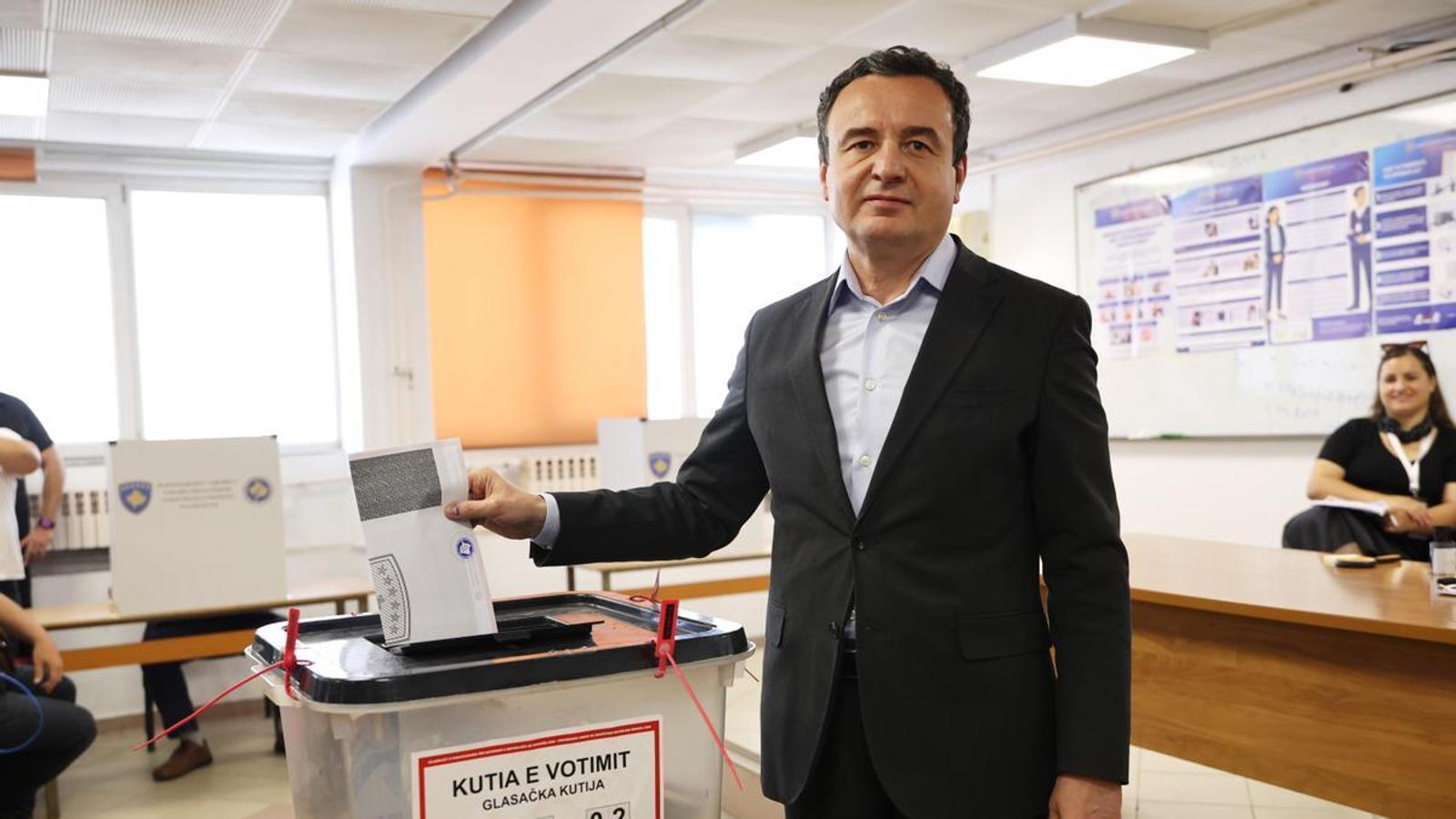
BarcelonaPrime Minister Albin Kurti's party has won Kosovo's parliamentary elections this Sunday, the Balkan country's third in just 18 months, but has fallen short of the majority needed to end the political crisis. The youngest country, and one of the poorest in Europe aspiring to join the EU, has been without a functional government for much of the past year. Deep divisions in parliament have blocked the election of a speaker and a new head of state.
Kurti's Vetevendosje (Self-determination) party obtained 43% of the votes. This represents a worsening of its results compared to the previous elections, held in December, when the ruling party won with 51.1%. At that time, however, it failed to agree with other parties on a candidate for the largely ceremonial presidency. This deadlock led to the dissolution of parliament in April and another early election.
Therefore, Kurti will again need coalition partners to form a new government, and will have to negotiate with rivals to secure the two-thirds majority needed to elect a new president. The main opposition parties, the Democratic Party of Kosovo (PDK) and the Democratic League of Kosovo (LDK) came in second and third place, with 21% and 17.6% respectively.
Kurti has shown himself open to speaking with all parties that have obtained parliamentary representation: "In the coming weeks, we will meet and cooperate with all parties, because the most important thing, above all else, is the public interest," he declared this Monday.
Economic discontent
Kosovars are eager for the political blockade to end, while demanding higher wages and more affordable products to benefit from a growing economy. “The political class must be willing to reach an agreement. In recent years, a very deep division has been created, and this must end,” a voter, Fatos Selimi, told Reuters.
The EU has urged politicians in Kosovo – which declared independence from Serbia in 2008 with the support of the United States and the EU – to create strong institutions capable of driving the reforms needed to join the bloc.
Kurti's party first came to power in 2021 with a more nationalist and welfare-state-focused agenda. Like all parties in Kosovo, it has a pro-Western orientation. It also opposes making further concessions to Serbia, with whom relations remain tense. There are about 2.1 million registered voters, a figure higher than the 1.6 million residents in Kosovo due to the large diaspora, mainly established in Western Europe, which tends to support Kurti's party.
