An extraordinarily vivid mosaic of the new Catalan comic
Finestres publishes 'Vinyetari 6', an anthology that gathers the best comics from the 6th ARA Comic Award

-
CAT -
CAST
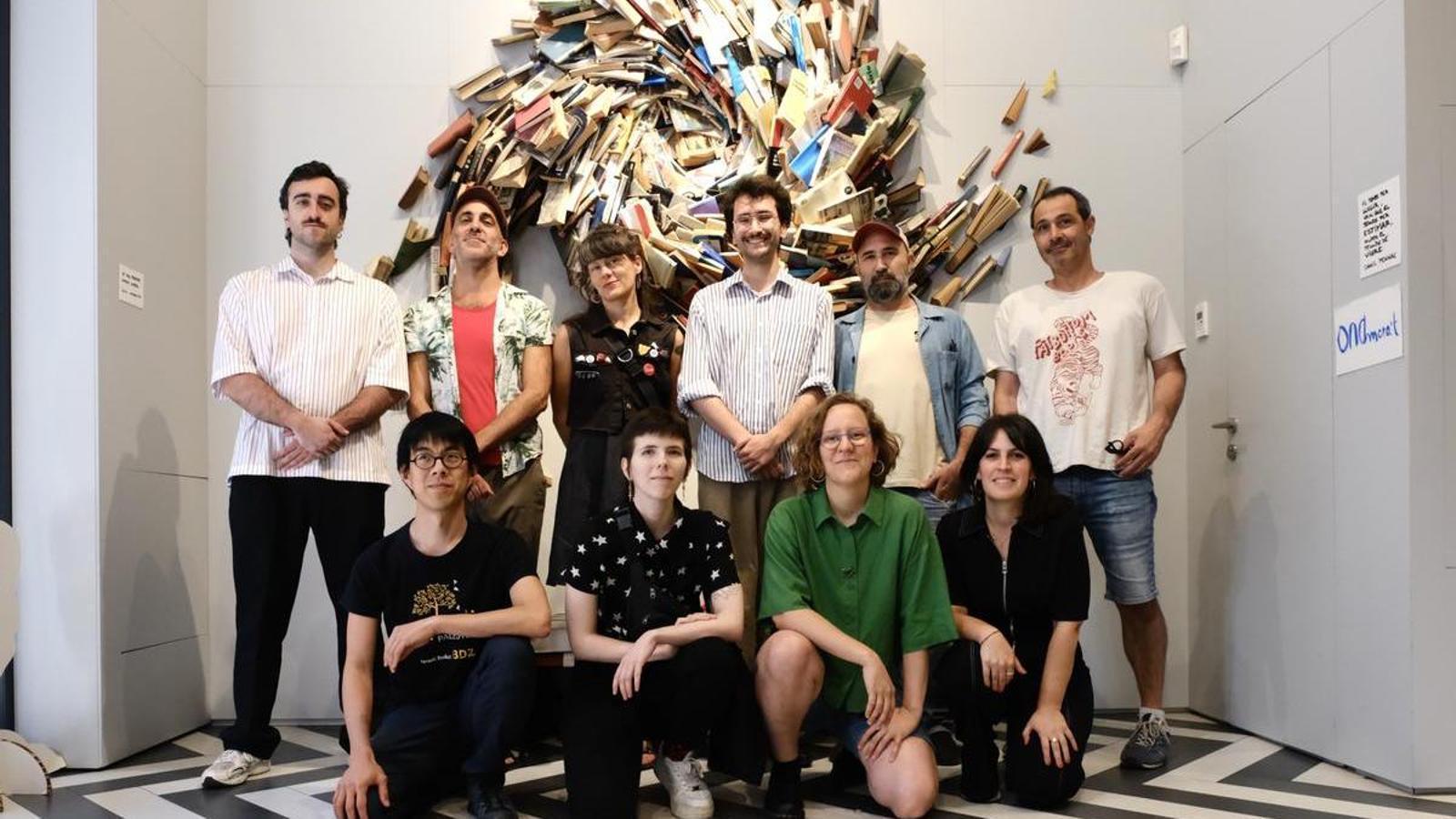
BarcelonaOn June 21, 2021, Vinyetari (Norma) arrived in bookstores, an anthology that collected the best stories presented at the first edition of the Premi ARA de Còmic. Since then, neither the award promoted by this newspaper with the support of Language Policy nor the volume that compiles the best works of each edition has missed the annual appointment. This week, Vinyetari 6 (Finestres) has arrived in bookstores, the sixth installment of a project offered to readers as a great mosaic and showcase of the new Catalan comic, which has served as a debut for many of the authors called to renew the landscape.
With the 12 stories and 200 pages of this volume, there are now over 1,000 unpublished pages of Catalan comic published in the Vinyetari series, a total of 67 short non-fiction stories ranging from historical memory to autobiography, journalism, essays, and experimentation. As Marta Cartu points out in the original illustrated prologue of Vinyetari 6, comics are a banquet with many dishes and flavors, full of “lively stories that touch and dialogue” and share artistic concerns and ambitions.

The youngest winner of the Premi ARA
At just 22 years old, J. Lobo Hispano López won the latest ARA Comic Award with an incisive and lively comic strip that reflects on his own experience of living in a tiny fifteen-square-meter studio. “It makes you a bit more humble,” the young cartoonist, who is studying his second year of a master's degree in international governance and diplomacy in Paris, explained to ARA. In 15 square meters, the author revisits the modern city model based on utopian projects by Fourier, Le Corbusier, or Ricardo Bofill. “Designing a utopian city is a project doomed to failure, because the appeal of cities is, in part, the movement generated by the existence of a center and a periphery,” argues Hispano López, who had already entered the ARA Award in 2024 with the comic strip Tourism and Utopia. Among his projects is the publication of his first graphic novel, which he is already working on.
Wandering through the plain of Vic
Last summer, German illustrator Marlene Krause (Wanne-Eickel, 1984) had an artistic residency at Can Grau, an old textile factory in Osona converted into a creation center. She was able to bring her daughters, and when they went out on excursions, she discovered that the rivers were not suitable for swimming and she suffered the olfactory and auditory impact of pig farms. With an apparently naive drawing of deep colors and precise rhythm, Krause portrays in La plana the "oppressive atmosphere" around a swamp and the complex relationship between the pig industry and the ecosystem, but she also reflects on her condition as a foreigner and that of many slaughterhouse workers. "I have a European passport and I am white and therefore privileged, but I cannot stop talking about the shit that is uncovered when you investigate the issue of pigs and water," she says. The author imbues the comic with an acidic and fine humor that she already showed in works such as Momento móvil (Apa Apa, 2019) or À un autre endroit, published in 2013 by the emblematic French publishing house L’Association. By the way, pigs will reappear in her next work: a fanzine about wild boars that she is preparing with Evin Collis, author of the fanzine Litterpig.

Growing up in a Chinese restaurant
which they called Chikito Nakatone; it made my blood boil”. The drawing of Jo, xinès is his attempt to "understand the why" of those racist situations that still bother him. "The comic is a concentration of experiences, but back then racism was everywhere, even on television – he recalls–. Like that character from 'Un, dos, tres' who was called Chikito Nakatone; it made my blood boil". The drawing in Jo, xinès is minimalist and in black and white, far from the colorful works for which many people know Pang the illustrator. "I wanted the reader to be moved by the story, not by the colors, and to strip the drawing down to the bare minimum," he says. In the comic, Pang reflects on the impact of words ("xinito", "panda") on a child's consciousness, but also on the odyssey of his father, who fled communist China by swimming to Hong Kong. His story and that of his mother, who fled the Cambodia of the Khmer Rouge, is the subject of a comic the author has been working on for fifteen years. "In reality, it will be a comic about silence, because my family never talks about these issues," he points out.
The great tarot lie
As explained in the prologue of Arcans, Arcans, Anna Ferrer –who signs her comics as Annadiplosis– shared an apartment with a witch. “Before moving in, she told me, she had purified the room of energies and bad vibes – she recalls–. I was stunned. I wasn't interested in the esoteric at all, but I tried to open myself to her world without prejudice and she introduced me to tarot”. Curious, Ferrer began to inform herself about tarot and its origins and has ended up dedicating a very well-documented and incisive comic strip to it that investigates and humorously debunks many of the clichés surrounding the universe of tarot. “There are people who say there were hidden arcana in the pyramids and that it is a millennial tradition, but as you inform yourself you realize that, although there is a certain historical basis, it is all a lie and each source tells you radically different things – she points out–. Most of them are historians who have one foot in esotericism, and it's very curious and fun to see what thread each one was pulling”. Ferrer, who has three participations in the Vinyetari and has published a series in ARA, is already preparing the comic strip she will present at the ARA Award 2026.
Caldes de Montbui, center of the universe
The cartoonist Ferran Vidal, son of Caldes de Montbui, follows Dalí's maxim “the ultralocal is the most universal” and establishes himself as the incorrect chronicler of his town in a comic strip that boasts of speaking only “about what you can't find on Google or Wikipedia”. That is to say, a portrait between the anecdotal and the human bestiary that includes the geek who peed in the municipal pool through a hole in a testicle, the postman who is “an absolute sudoku god” and the one who has seen Dirty dancing. “This time I wanted to escape from current affairs and the big topics,” he assures. Vidal will publish the graphic novel Vinyetari. “This time I wanted to move away from current news and big topics,” he assures. Vidal will publish the graphic novel Miller in February 2027 and is working with Kiko Amat on a book of illustrated biographies of cursed artists, a project that began to see the light at l’ARA.
Grandpa's workshop
When Jordi Gamon was little, his grandfather was ill with kidney problems and, as he explained, he cured himself by eating limes because they were "a natural antibiotic". The lime tree he later planted in the farmyard gives its title to Gamon's short story, in which spaces and objects release a family memory that serves as a link between generations. The lime tree is the first comic published by Gamon, who in 2011 already won the Mostra’t award in Gandia with Laudanum.
Sewing at the Montjuïc shacks
While preparing a more extensive project on the historical problem of access to housing in Barcelona, which will be released early next year, Anna-Lina Mattar and Marta Sabaté shaped one of the real stories they discovered during their research on shantytowns in the sixties, that of a mother living on the mountainside surrounded by misery who does not dare to ask for work as a seamstress. “It’s a kind of spin-off of the other comic, a small anecdote that we found fun, tender, and beautiful, perfect for adapting to the short format of the Premi ARA,” explains Sabaté. Miquel Cartisano, who shares memories and facts about Barcelona on the blog Tot Barcelona.” told them the anecdote. “Miquel lived in the shantytowns and has many stories to tell,” points out Mattar, who with her fragile and delicate stroke defends the power of small stories to speak of collective and universal memory. “Deep down, all my stories work like this,” adds the author of L’anell de la serp (2024), winner of the València graphic novel award, who in 2024 already published the short comic Vinyetari 4 in Ulla.
Poetic chronicle of a pop concert
On June 10, 2025, El Petit de Cal Eril kicked off the tour for the album Eril Eril Eril in an inflatable igloo at the Centre d’Arts Ideal in Barcelona, and Joan Codina traveled from Guissona to see that concert where, about halfway through, the igloo disappeared and a visual spectacle made the songs fly even higher. Vent, vent, vent is the comic strip that Codina drew based on that experience, a chronicle that is more poetic and experiential than informative, attempting to translate the group's music into images, rhythms, and colors. The cartoonist, who had previously entered the Premi ARA, states that for him, "it's an interesting exercise to make non-fiction comics," because his approach to comics "is always poetic." Codina, who is the brother-in-law of Joan Pons (El Petit de Cal Eril), lives in the same Teatre de Ca l'Eril, the group's operations center: "There are always bands rehearsing or concerts, and that made me think about interpreting the sensations of music in the language of comics, but by creating a kind of diary of the concert day, talking about what I felt but also about the journey from Guissona." It's not the first time Codina has translated other disciplines into comics: in 2022, he reinterpreted Diàlegs de la incomunicació in the comic strip of Poemes de la incomunicació, by Guillem Viladot.
When your house is for sale
The metastases of the housing problem extend to the daily life of a couple who, shortly after renting an apartment, begins to receive visits from clients interested in buying the property. The wear and tear caused by the constant drip of intrusions into privacy and the anxiety of not knowing how long you can live in your home are the subject of The fly behind the ear, the comic strip with which the Galician Hadrián Jamardo recounts his own experience with the help in dialogues and color of fellow cartoonist Pau Esparó. “We wanted to talk about the housing drama from a more emotional point of view, trying not to be melodramatic, but conveying what you feel when you go through this experience,” says Jamardo. With a very lively drawing that may recall masters of the Nouvelle BD like Sfar and Blain, the comic captures the situation with humor and empathy, but towards the end it becomes steeped in sadness to explain how the protagonists are expelled from the apartment and, burned out and tired, end up separating. Jamardo recalls writing these scenes with a “feeling of rage”.
Conspiranoia, REM and pop culture
In 1994, the group REM released What’s the frequency, Kenneth?, the first single from the album Monster. Behind that song lies a well of paranoid delusions and conspiracy theories that began in 1983 with the beating that a disturbed William Tager gave to Dan Rather, the CBS anchor. Marcos Prior and Danide explore the real events and connections with pop culture of this strange and fascinating story. “I wanted to build a kind of puzzle that also touches on genres like thriller and science fiction and allowed me to talk about REM,” says Prior, who wrote the script with Danide in mind, with whom he had already collaborated on landmark works of modern Catalan author comics such as Fagocitosis and Potlatch. “It was hard for me to draw, because it has a somewhat complicated tone between tragedy and humor, it has a lot of black humor and that critique of United States culture and the media that is very characteristic of Marcos,” says Danide, who alternates a hyperrealistic style for television textures and psychedelic experiments for Tager's fantastic delusions.
Activism with teeth and nails
“The fear of war has accompanied me all my life”. It is the first sentence of70, 230 i Manolo García estem bé has been able to talk about a personal and collective “feeling of powerlessness.” A particularly effective detail of the comic is the color palette of red, green, white, and black, the colors of the Palestinian flag. “It was a decision somewhat due to the little time I had to do the coloring, but I've liked simplifying things and breaking away from realistic drawing for a long time,” he explains.
Living in fear of war
“The fear of war has accompanied me all my life.” This is the first sentence of Waiting for the Barbarians, and the confession made by the author, Pol Guillen, who as a young man was forever marked by a trip to Bosnia at the end of the Balkan conflict. “I was very struck by the everydayness with which war was lived, and there I realized that there were no good guys or bad guys,” recalls Guillen, who, although he was tempted to dedicate the comic to his experience in Bosnia, preferred to articulate a kind of first-person essay on the strange relationship we have today with war, from a fragile sense of distance and security that can be shattered at any moment. “I am not a philosopher, but I like political philosophy and I wanted to make a very personal reflection on the warmongering that dominates current society,” explains Guillen, for whom the interest in dialoguing with the world through drawing runs in the family: his father is Joan Guillen, a set designer and satirical illustrator who did graphic humor in 70s magazines like Tele/eXpres and Por Favor. The son will soon debut in long-form comics with The Voice of the People, an adaptation of Ibsen's play An Enemy of the People which Guillen sets in the Empordà region of the early 20th century, when the Commonwealth created the Costa Brava brand.

