From Gaza to plush brides: photojournalism resists in Perpignan
The Visa pour l'Image festival reaches its 38th edition and stands as a trench of on-the-ground and rigorous journalism
-
CAT -
CAST
BarcelonaLike a true trench of resistance in defense of on-the-ground, independent, and rigorous journalism. This is how the 38th edition of the Visa pour l'Image festival in Perpignan presents itself, taking place from August 29 to September 13. In the presentation manifesto, the director and founder of the exhibition, Jean-François Leroy, warns about "the growing precariousness of the sector, the concentration of media outlets, and the political pressures that threaten press freedom." Leroy also points out the disinformation generated by artificial intelligence (AI) and gives as an example the viral fake image of Venezuelan President Nicolás Maduro handcuffed and escorted by twomarines north Americans. Faced with this, he raises the paradox that AI inexorably needs the rigor of photojournalists to feed on real data and questions whether the agreements between big tech companies and historical publications represent a financial solution or a "deal with the devil".
"The real photographs of Maduro in New York, with handcuffs on his wrists, do exist. They were taken by professional journalists and published by media outlets that adhere to standards and rules that may be outdated, but are very important. These "}old means share with us, the old festival, this orthodoxy that we continue to defend and celebrate", says the founder of the photojournalism festival.
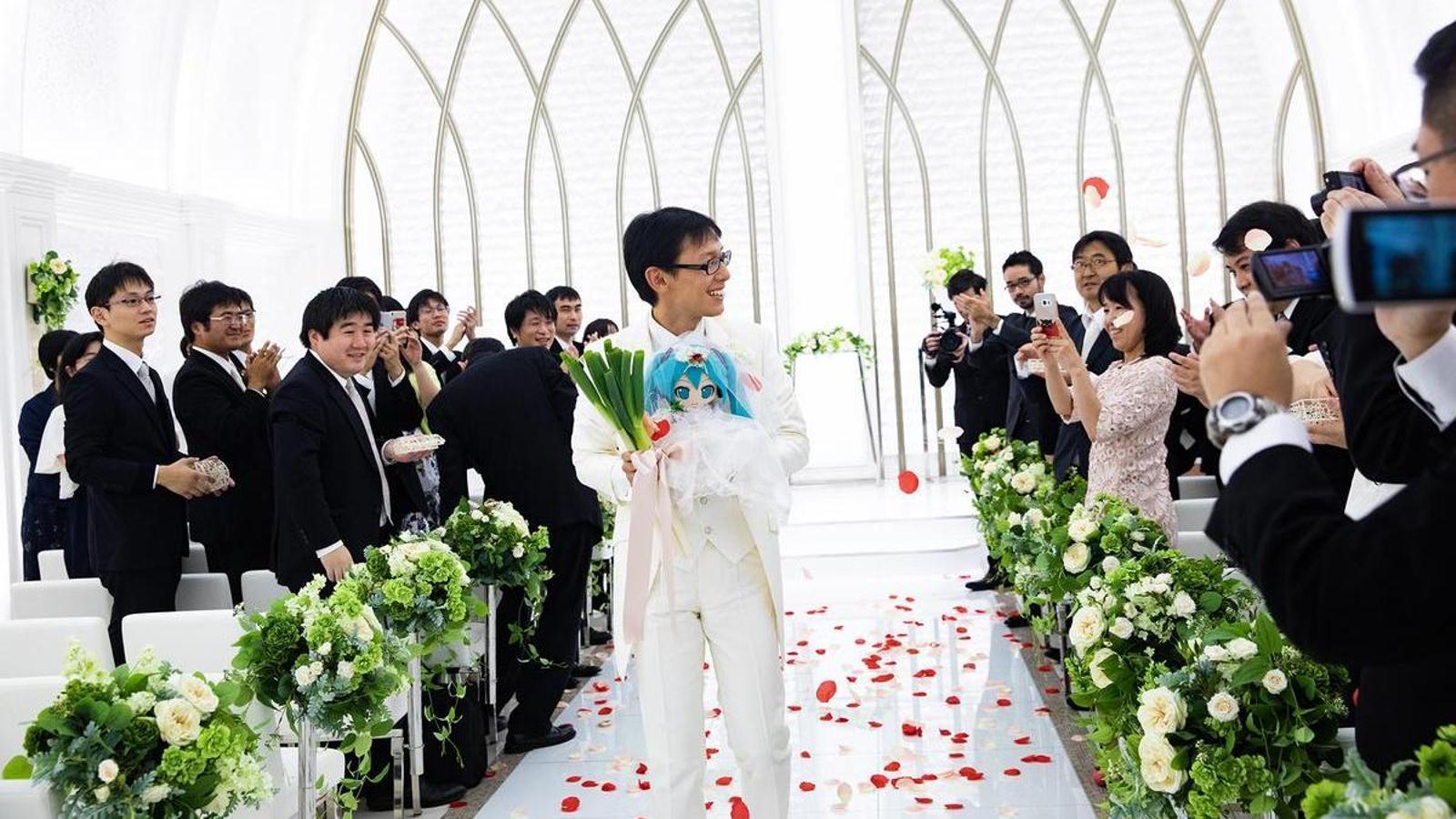
This reflection on AI directly connects with the work of French photojournalist Jérôme Gence, who delves into the digital world and new forms of social isolation. After documenting, three years ago, teenagers' addiction to screens, Gence presents an investigation at Visa pour l'Image into marriages between real people and fictional characters. It all began in 2018, when he gained exclusive access to the wedding of a 35-year-old Japanese man, Akihiko Kondo, and a virtual singer, Hatsune Miku.
Virtual love and marriages with a plush toy
"The marriage had no legal recognition, but it was celebrated in Tokyo in front of about forty guests, both human and dolls, and it cost the young groom around 15,000 euros. For Kondo, Hatsune Miku had saved him from a deep depression caused by years of bullying at school and at work," explains the photographer in the exhibition text. Akihiko Kondo is not the only person in Japan who has feelings for a fictional character: like him, 3.5 million people between the ages of 20 and 39 claim to have romantic feelings for characters fromanime or video games. The dimension of the phenomenon is reflected in the volume of business it generates: in 2023, the market for merchandise related to anime moved around $6 billion and could nearly double by 2033.
"In 2025, I returned to Japan to do a report on how these virtual marriages had evolved. I attended several weddings and visited the homes of these people to document their daily lives and their intimate relationships with their virtual lovers. One of the things I observed is that 2D marriages are no longer limited to Japan," explains the photographer. For example, Lucie, who is French, married Mami, a manga character, in December 2025. "Although this topic may seem strange, it raises very current issues about contemporary societies: loneliness, social pressure, economic difficulties, the growing role of the virtual world, and the changing nature of partnership and, perhaps, even family," concludes Gence.

The festival, held in Perpignan since 1989, is also a great window through which to observe conflicts around the world. One of the great contemporary massacres is what is happening in Palestine, and the Palestinian photographer Khames Alrefi has been awarded the Visa d’Or Humanitaire from the International Committee of the Red Cross (ICRC) for the project Civilians: the first victims. His work documents the daily lives of the population in Gaza between January 1, 2025, and May 1, 2026, showing children fleeing explosions, long queues for food, and families gathered around fires in completely devastated areas.
Three decades documenting Chernobyl
For his part, German-American Gerd Ludwig shows a body of work spanning over three decades (1993-2026) on the Chernobyl nuclear disaster. During this period, he has traveled fourteen times to the exclusion zone. "The result is a personal journey through a landscape forever transformed, as well as a terrifying testimony of environmental catastrophe, human suffering, and desolation," explains the photographer. Throughout this project, he managed to gain access inside reactor number 4. Dressed in protective gear and accompanied by a specialized team, he penetrated a place few people have seen and even fewer have been able to photograph. "This project aims, above all, to give a voice to the people who continue to suffer," states Ludwig.
Frenchman Hervé Lequeux documents the exile route of young people from Guinea Conakry, from the dangerous artisanal gold mines where they work in inhuman conditions to exhaustion to finance their journey, until their arrival in Paris. Lequeux portrays their passage through Tunisia, where they survive under improvised tarpaulins, without regular access to water or medical care and suffer police aggression, the crossing of the Mediterranean, and police harassment in the French capital.
For his part, American David Guttenfelder covered the violent clashes and police repression in Minneapolis earlier this year. In the North American city, federal agents used tear gas, rubber bullets, and pepper spray. In response, tens of thousands of residents organized to confront them, following the agents' movements and trying to boycott their operations to protect undocumented neighbors.
The exhibition, which includes the work of many photographers spread across different spaces in Perpignan, also showcases the work of Frenchwoman Elise Blanchard on the drama of child marriage in Afghanistan. "As a mother, I cried a lot, but I knew my husband had no other option," says Gul Bobo speaking about her two and five-year-old daughters, who are already betrothed. "They will probably be beaten, but I can do nothing about it. And when they are fourteen, they will be pregnant," she explains in the report.
The festival also delves into the marine depths, with Frenchman Laurent Ballesta, a scientist and pioneer of extreme underwater photography. Among other achievements, Ballesta, who has explored marine depths where no one had previously accessed, has photographed the coelacanth, a very rare species 400 million years old that until 1938 was believed to be extinct, and has documented the nocturnal hunt carried out by hundreds of sharks, perfectly organized, in Polynesia.

