Ermomir and Riquil·la: the 10th-century magnate couple who appeared intact in Castellar del Vallès
The tomb in the church of Sant Esteve may provide new information about the moments before the construction of feudalism
-
CAT -
CAST
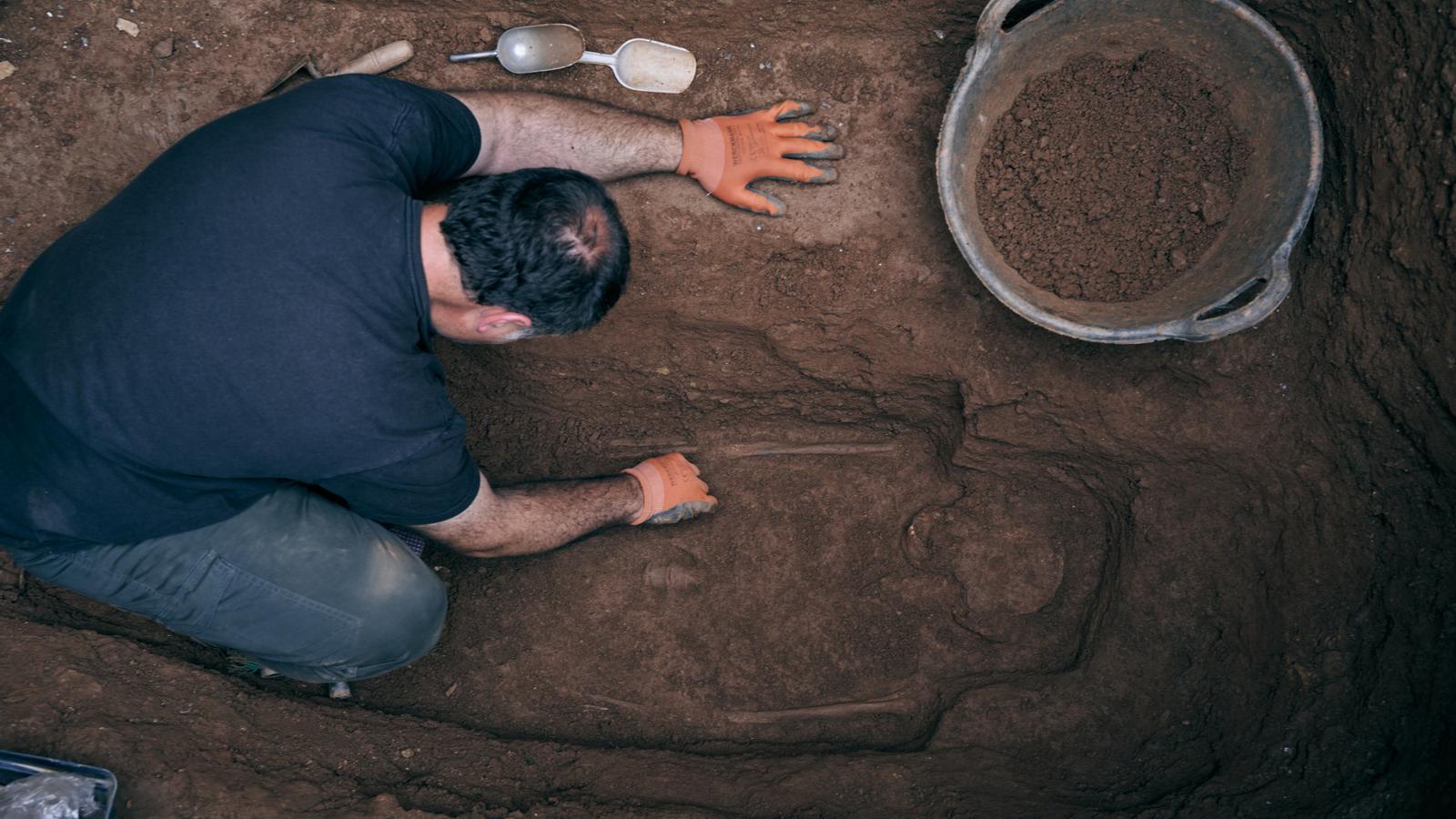
Castellar del VallèsErmomir and Riquil·la were buried with great care in the year 966. The intention was clear: that no one could violate their eternal rest. To achieve this, a structure was designed that today we would describe as an impregnable tomb. Almost three meters deep, in an anthropomorphic pit, the couple was deposited naked, only wrapped in shrouds.
"Above the bodies, they placed stone slabs and, afterwards, an immense volume of earth to fill the pit. On the surface, they built the monumental part with stones, mortar, side walls, and an apsidal arch that served as a fitting for the marble tombstone," explains archaeologist Jordi Roig Buxó, head of the archaeological excavations at the Castellar Vell site, in Castellar del Vallès. The strategy against looting worked for a millennium, until the latest campaign at the site, on a hill a few kilometers from the urban center and where the church and parish of Sant Esteve is located, has brought the remains to light in an exceptional state of preservation.
The exceptionality of the case is that we can know who they are and that their remains can be related to documentary information. In the eighties of the last century, the tombstone was found – also quite unique, because there are not many for civilian figures – which identified them: "Beneath these rocks rests the body of Ermomir; may he go to his rest with Christ's benevolence. He died on the 2nd day of the calends of October (September 30th) in the year of our Lord 966". The tombstone had been kept in the church of Sant Esteve, but until now it had not been possible to relate it to any tomb.

Ermomir and Riquil·la were surely members of a rural elite with great economic capacity and political connections. A document from 965 places them making donations of estates to the church of Sant Miquel de Barcelona, which confirms their status as magnates linked to the orbit of the county of Barcelona. At that time, nobility was in its infancy.
The couple lived through a moment of border transformation. "We know that there had been a Carolingian fortification here, but by 966 the border with the Muslims had already shifted 60 kilometers south, to Penedès," explains Ramon Martí, professor of medieval history at the UAB. "When military defense was no longer necessary, the ancient castrum was transformed into the parish church of Sant Esteve, of which Ermomir would have been one of the founders. Curiously, the magnate died only ten days apart from the count of Barcelona, Miró I," adds Martí. The analysis of the remains can provide more details about who Ermomir was or the moments prior to the consolidation of feudalism. For example, Martí highlights, it will be possible to know "if he was a warrior or an ecclesiastic".
A mine of information for science
The site does not end with the couple. So far, and in different campaigns, 223 tombs and about fifty silos functioning as time capsules have been exhumed. "Having a collection like this is what all universities would wish for. We will be able to know what diseases they had, their eating habits, their movements...", points out the excavation team. Furthermore, the silos have revealed a treasure of utensils, coins, and tools that explain the day-to-day life of that era.
Castellar Vell maintained its administrative and economic function –collecting tithes from the peasants– until 1773, when the center of the town moved to the plain and the parish was abandoned. Thanks to the civic initiative of the Amics de Castellar Vell in the late seventies, the space began to be dignified. Today, the Castellar del Vallès City Council has an ambitious goal: with only 20% of the site excavated, the intention is to continue research and museumize the space.

