A dinner among architects at the Three Chimneys
Turisme de Barcelona brings a string of international journalists to the epicenters of the city's transformation

-
CAT -
CAST
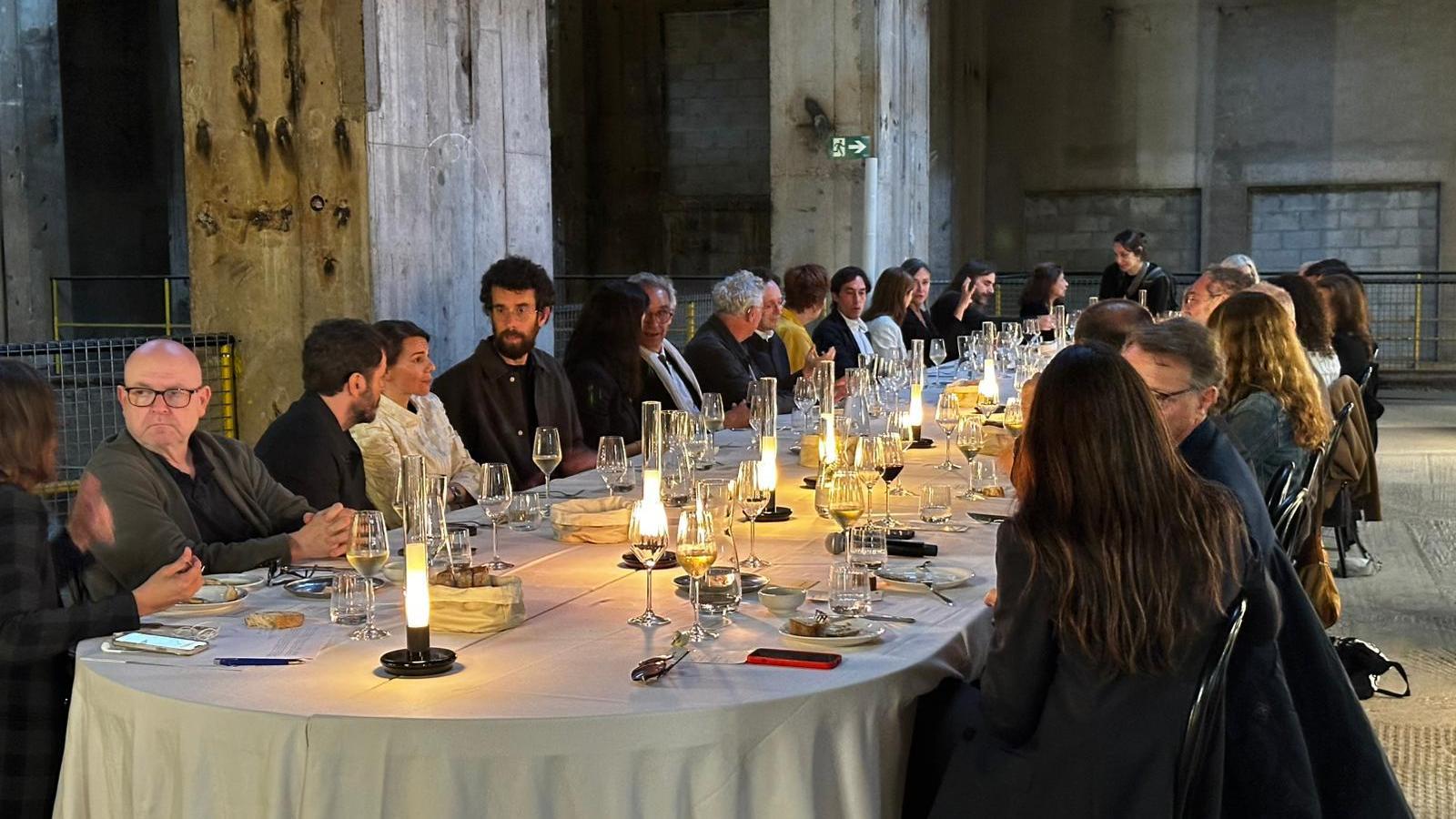
Sant Adrià de BesòsMore than ever, architecture is now Barcelona's most recognizable emblem nationally and internationally; from Barcelona World Capital of Architecture and the World Architecture Congress to the placement of the cross on the Jesus Christ tower of the Sagrada Família. It is also a time of major projects, including the transformation of the Tres Xemeneies building in Sant Adrià de Besòs into Catalunya Media City. For this reason, this concrete giant hosted a dinner a few days ago with about thirty guests organized by Turisme de Barcelona, with some of the most prominent Catalan architects and national and international journalists from generalist media and others specialized in architecture, including ARA. Among the international journalists were editors from The Times, The Guardian, Le Monde, Art Newspaper, Monocle, Giornale dell'Architettura, and Wallpaper. The dinner was part of a three-day program that also took them to places like the Casa de l'Arquitectura, at the old headquarters of the Gustavo Gili publishing house; to the exhibition Seny i rauxa at Dhub; to the Casacuberta Marsans collection; to the expansion works of Fira de Barcelona, and to the Mies van der Rohe award exhibition. Another of the notable activities was being able to observe the renovation of La Rambla from the viewpoint of the Columbus Monument. Among the institutional guests were representatives from Barcelona Regional and from the companies Roca and Santa & Cole. "We work to bring good tourists to Barcelona, and we don't just think about the city of Barcelona, but about the metropolitan area," said the general director of Turisme de Barcelona, Mateu Hernández.
The event began with a presentation of the Catalunya Media City project by two of its authors, Jordi Garcés and Daria de Seta, who drafted the project together with their partner Anna Bonet and their colleagues from the Marvel studio. "The Tres Xemeneies are truly unique, they are almost a geographical landmark; they form a triangle with the other two vertices in Montjuïc and the Sagrada Família," Garcés added.
During the dinner, many other topics related to current city affairs were discussed. Two of the curators of the next UIA congress, Maria Giramé and Pau Sarquella, pointed out the paradigm shift of their project compared to that of the 1996 congress, which was led by a string of star architects including Norman Foster, Peter Eisenman, and Jacques Herzog. Precisely, the Tres Xemeneies will be one of the main venues for the congress. "The architecture of the future is a plural architecture, a collective architecture; an architecture that is not only made by architects, but is made from economic, political, and many other disciplinary ecosystems that we share to truly think about what we will do with this planet," said Pau Sarquella. In this vein, Sarquella believes that architects must be more aware of the impact of their work on citizens, at the neighborhood and global level, and that the relationship between architecture and people should be strengthened with measures such as giving it more prominence in political plans.
The renovation of La Rambla
Regarding the reform of La Rambla, Garcés was part of a reflection group on the future of this avenue after the reform ends, and he recalled an idea he shared with Beth Galí: "We proposed, as an urgent, immediate measure, and with little time to implement it, to clear the central promenade of private activity. What does this mean? Regarding the terraces, we proposed the Paris model, where the terraces of all the cafes are attached to the facades of the establishments," explained Garcés, who is considered one of the deans of contemporary architecture. "We thought that Barcelona could be the standard-bearer of a model opposed to the current one, because now there are many eyes on Barcelona. This does not mean neglecting tourism, but it is very important that the congress influences administrations and politicians." At the other generational extreme, among the younger architects, was Lucía Millet de Ferrater, one of the six partners of Cierto Estudio, the authors of the green axis of Consell de Cent and one of the public housing blocks in Glòries. And Marcos Parera, from the Mesura studio, known for works such as the Javis' house in Madrid, the Casa Batlló Contemporary exhibition hall within Casa Batlló itself, and Casa Ter in Empordà.
Among the guests was also the Madrid architect based in Barcelona Fermín Vázquez, known for the new Encants market, and also for collaborating with Jean Nouvel on the Torre Glòries project, while he is now working with the Japanese Toyo Ito on the expansion of Fira de Barcelona, where the gigantic Hall 0 stands out, which is larger than the Palau Sant Jordi. "Despite being a Barcelona architect, I was defined as a young Catalan architect, when I was neither young nor Catalan – Vázquez said jokingly–. But I do belong to the generation that considered the continuation of the Sagrada Família a mistake. I was one of those who thought it was a mistake to reinterpret Gaudí and move forward with what at the time seemed to us a more or less successful pastiche of his genius," he warned. But now he has a different opinion of the basilica. "Now we observe, contrary to what has seemed evident to me for years, the strength of the result. The Sagrada Família is unique, there is nothing like it. Paradoxically, and I am happy to admit it, I think it was a success to continue it. In the end, despite everything, it was a good idea," Vázquez concluded.
