The collateral damage of Barça's new credit with Goldman Sachs
The club has renegotiated the contract with Limak to ensure that the roof of the Camp Nou will be finished within the established deadline

-
CAT -
CAST
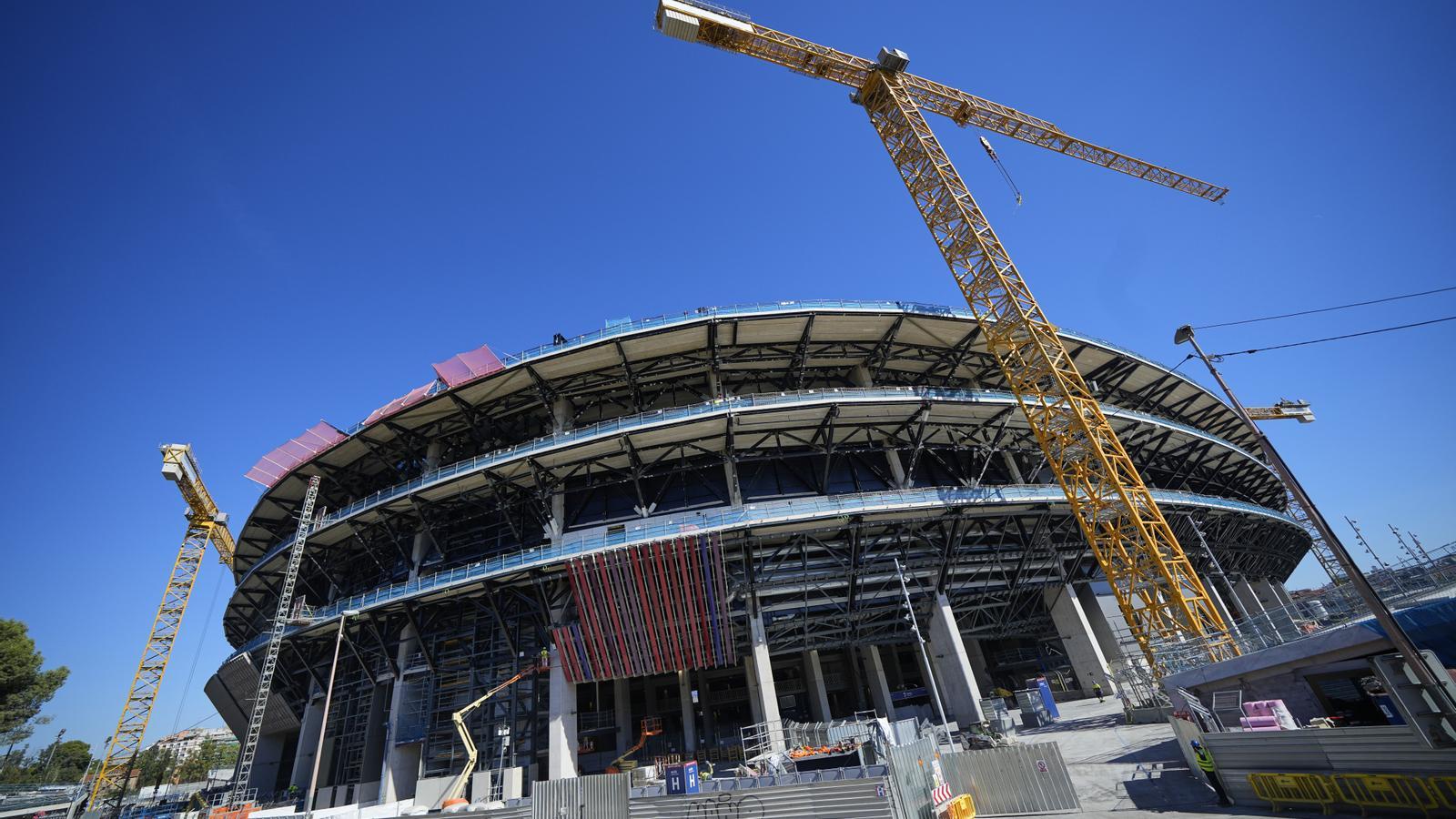
BarcelonaWhen in a few years the Camp Nou is finished and operating at full capacity, it is very likely that all the delays and setbacks that have occurred in the remodeling will be forgotten. Or that they will be remembered as mere anecdotes. But to reach that point, there is still a long way to go. Not even now, in what is theoretically the final stretch, is there any sense of tranquility at a club that cannot afford any more delays in this last phase of the renovation.
Money is the key to it all. The money that Goldman Sachs has lent and now wants to recover, with the corresponding interest. The American creditor trusted Barça at a moment of maximum complexity, after the pandemic and with a large-scale economic crisis affecting the club's finances. It did so because, in part, the board of Josep Maria Bartomeu had already paved the way previously with an initial negotiation in 2019 and 2020, and because it believed in the definitive business plan presented by Joan Laporta's board in 2022. An initial investment of 1.5 billion that has proven insufficient, and which is expanded to 1.8 billion after the general membership gave its approval at the last assembly of representatives.
However, this credit expansion has not come for free. Goldman Sachs willingly agreed to lend more money to Barça because the financial firm knew that if the Camp Nou remained half-finished, it would lose out. Nevertheless, it used its position of strength to change the conditions for the repayment of the credit. Now they are the ones who get the first money that the stadium generates and, once their fees are satisfied, the rest remains in the club's coffers. A detail that is not minor, considering that at least half of the 2026-27 season will be played at Montjuïc, with the jolt to revenue that this entails. Put another way, the American bankers have covered their backs.
Given the current context, with an attractive Barça on the pitch and thousands of tourists willing to buy tickets at a premium price, Goldman Sachs has absolutely nothing to worry about regarding its money, even if the figure increases year after year to significantly exceed 100 million per season –including both the principal capital and the interest–. Those who are suffering are the members of the Culer treasury, who live on the edge, balancing budgets that depend on the maximum commercial exploitation of the stadium. The fact is that the promised turnover of more than 400 million will not arrive until the works are finished. That is why it is essential that Limak scrupulously complies with the set calendar, as new delays could mean new millionaire losses.
Goldman Sachs has put pressure on Barça and Barça has transferred it to Limak. Outwardly, the board has not spared praise and kind words for a Turkish construction company that, back in the day, received the worst technical score among the companies that bid for the remodeling. In the end, the day-to-day has prevailed. "Trust has been lost and there is concern about the technical deficiencies, construction solvency, and delays," admit sources from the club's noble offices a few months before starting the most complex part of the work: the roof. Distrust that is explained by gestures like the one made by Limak, which has asked for advice from companies like FCC –one of those that were discarded in the controversial tender to award the remodeling of the Camp Nou and which is in charge of the Nou Mestalla– on how to proceed.
Not everyone sees it clearly, to the point that the possibility of Barça breaking the agreement with Limak and finishing the work with another construction company has been put on the table. This week, La Vanguardia has reported that the club has issued an ultimatum to the Turkish company and stated that, if it does not finish the new store on time (January) and 70% of the boxes vip (March), will dispense with his services. Although official sources from Barça do not want to comment on this news, they admit that the contract has been renegotiated to have more guarantees: the famous clause of one million daily for delay –which Barça would rarely have been able to collect– has been eliminated in exchange for adding new ones linked to the fulfillment of future objectives. "It is a strategy, a way of remembering what is at stake and ensuring that deadlines are met," point out sources from the president's inner circle.
Finding an alternative to Limak, an option on the table
At the club they maintain that the intention is to go with Limak until the end and they detail that the construction company has already completed 99% of the contracting for the roof. However, precedents weigh heavily and that is why it cannot be completely ruled out that an alternative to the Turkish company might end up being sought if, in accordance with the new contract, they are not fully confident by the spring. "The Barça-Limak link was supposed to be the construction company's gateway to Europe. They cannot afford to leave through the back door, it would be a major discredit, also for a board of directors that risked it all with such a risky bet," points out a critical voice from the Camp Nou offices.
The calendar foresees returning to Montjuïc to be able to carry out the big lift –an Anglicism that defines the lifting of the roof structure– between June and November 2027. The second part, covering it, can be done while matches are being played there. Even so, they would not play at Camp Nou again until February 2028, as the stadium will need to be re-equipped –seats, playing field– and, most importantly, the City Council's permits must be obtained to legalize the 103,000 square meters of the third tier. Any delay would be catastrophic.

