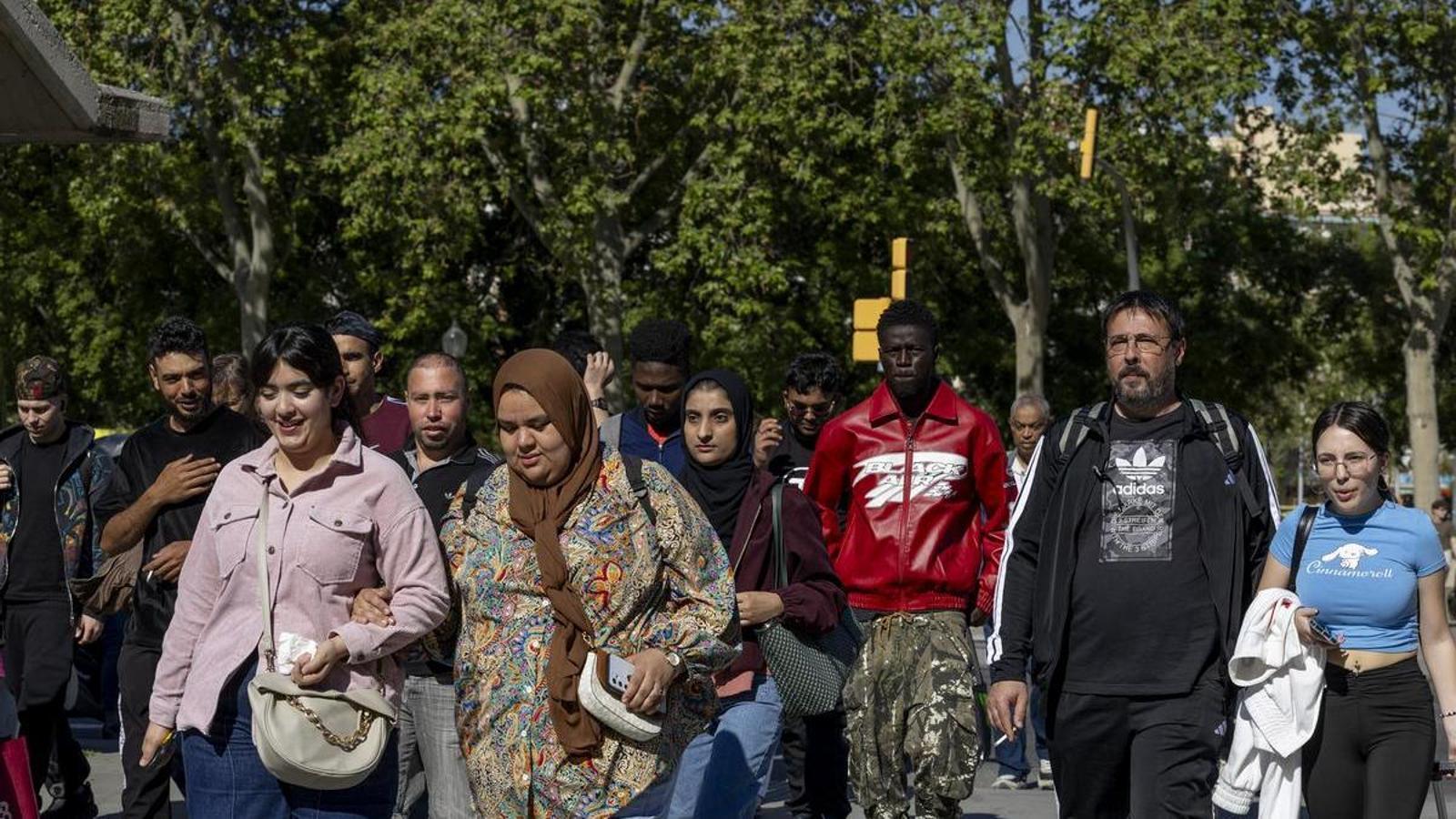
Catalonia, born of immigrants
-
CAT -
CAST
BarcelonaFirst, the data. Back in the 17th century, one in five Catalans had been born in Occitania and other parts of France. That's a long time ago, agreed. Let's jump ahead: in 1930, the same was true for 27% of the population. And at the end of the 20th century, only 25% of people had all four grandparents born in Catalonia. In recent years, especially since the failure of the independence process and coinciding with the global wave of the far-right, exclusionary discourses have taken hold. The old guard of Catalan politics, especially former president Pujol, but not only him – also the heirs of PSUC and PSC, or Pujol's own historical rival, Raimon Obiols–, continue to defend welcoming and inclusion, but who listens to them?
In Un origen buit (L’Avenç), Josep-Anton Fernàndez analyzes the Catalan migratory phenomenon with a historical and cultural perspective. He places Jaume Vicens Vives as the architect of "immigration as a foundational myth of the Catalan nation", with "mestizaje as a constant force" and with the idea of a "transit point" conducive to the mixing of populations. But at the same time, Fernàndez warns that Vicens himself, under the influence, for example, of the father of Catalan demography, Josep A. Vandellòs, warned of the moral and psychological dangers of mestizaje. As we see today, this ambivalence has continued to weigh heavily despite the work of demographers like Anna Cabré and Andreu Domingo, who have emphasized immigration as a key factor in the dynamism (alternative to low birth rates, labor force, etcetera) of Catalan society.
Forging a "shared social memory"
Specifically, Domingo calls for forging a "shared social memory" that encompasses all origins and sensitivities. It is here that Fernàndez seeks voices in cultural expressions that contribute this diverse heritage: Najat El Hachmi, Laila Karrouch, Agnès Agboton, Pius Alibek, Saïd El Kadaoui, Salah Jamal, Patrícia Gabancho and Silvana Vogt, but also Montserrat Roig, Maria Barbal, Francesc Serés, Jordi Puntí, Sergi Belbel, Julià de Jòdar, Julià Guillamon, Bel Olid and Vicenç Villatoro.
The same Josep-Anton Fernàndez has dedicated a good part of his energies throughout his life to "reflecting on what it means to be Catalan when one's own origin is foreign". He knows what he's talking about, then. A reflection that leads him, guided by sociologist Salvador Cardús, to distance himself from the axiom of the well-known cry sung by Raimon: "He who loses his origins, loses his identity". In fact, he replies: "Losing one's origins is an integral part of the migrant experience; it is the condition that grants access to the possibility of rewriting one's own identity". To integrate, in large part, means to disintegrate.
The author's personal experience: despite living for a handful of years in England, he never wanted to be English, even though that possibility would have been within his reach. Instead: "When I was a teenager and still only spoke Spanish, I was very clear that I was Catalan, that I wanted to be Catalan. I didn't integrate to Catalan society, because it was there; rather, I became appropriate of Catalan identity, I made it my own".
On the other hand, the work of the host society requires renouncing "the fantasy of an ethnically pure Catalonia". In this double game, Fernàndez postulates "Catalan identity as radically open to its construction and redefinition by all those who feel addressed by it, regardless of their origin". That is to say, "}that "the others" become part of "us", which requires us to shed real or fictitious fears, requires facing with a spirit of "promiscuous love", or simply of citizenship, the difficulties of coexistence and welcome. Either that, or ethnic-linguistic fracture.
In fact, the author remarks that the authentic differentiating factor of Catalan society is being a "nation of immigrants". "We resemble Argentina, Australia, Canada, and the United States more than Sweden, Portugal, and Italy". The desire to be a single people cannot and should not mask this palpable reality today and throughout history. A history that has been successful: amidst great social and economic difficulties and the persistent, cyclically dramatic mismatch within Spain, Catalonia maintains its course and uniqueness. Perhaps the most logical outcome would have been disappearance and assimilation into Spanishness. By the way, on this subject, a clarification: the historian Martí Marín already debunked the false cliché of Francoism, which allegedly intentionally sent immigrants to Catalonia to dilute its identity and denationalize it; on the contrary, the dictatorial regime hindered the movement of population from the countryside to the city to avoid revolutionary movements.
And the language, what about it?, you will ask. Fernàndez has a realistic formula. He says we should not deceive ourselves: the language of social cohesion or lingua franca is Spanish. For Catalan, he reserves the role of "common language", which is something more: "The historical function of Catalan has been to turn people from outside into people from here in the simplest, cheapest, and most democratic way possible. Catalan is, therefore, a crucial piece in the nation of immigrants that we are [...]. It has the legitimacy, the symbolic value, to become the language that unites us [...], the language that removes the label of immigrant and dissolves the distinction between native and immigrant".
"The incorporation of new Catalans into our society is not a closed process; it is part of our history and our future," he concludes. But, of course, without more evenly distributed wealth and prosperity, without a social elevator that truly works, immigrant-nation Catalonia has no future.
