Raimon Obiols: "The message of civil unity from 1976 is more necessary today than then"
Former deputy and former First Secretary of the PSC

-
CAT -
CAST
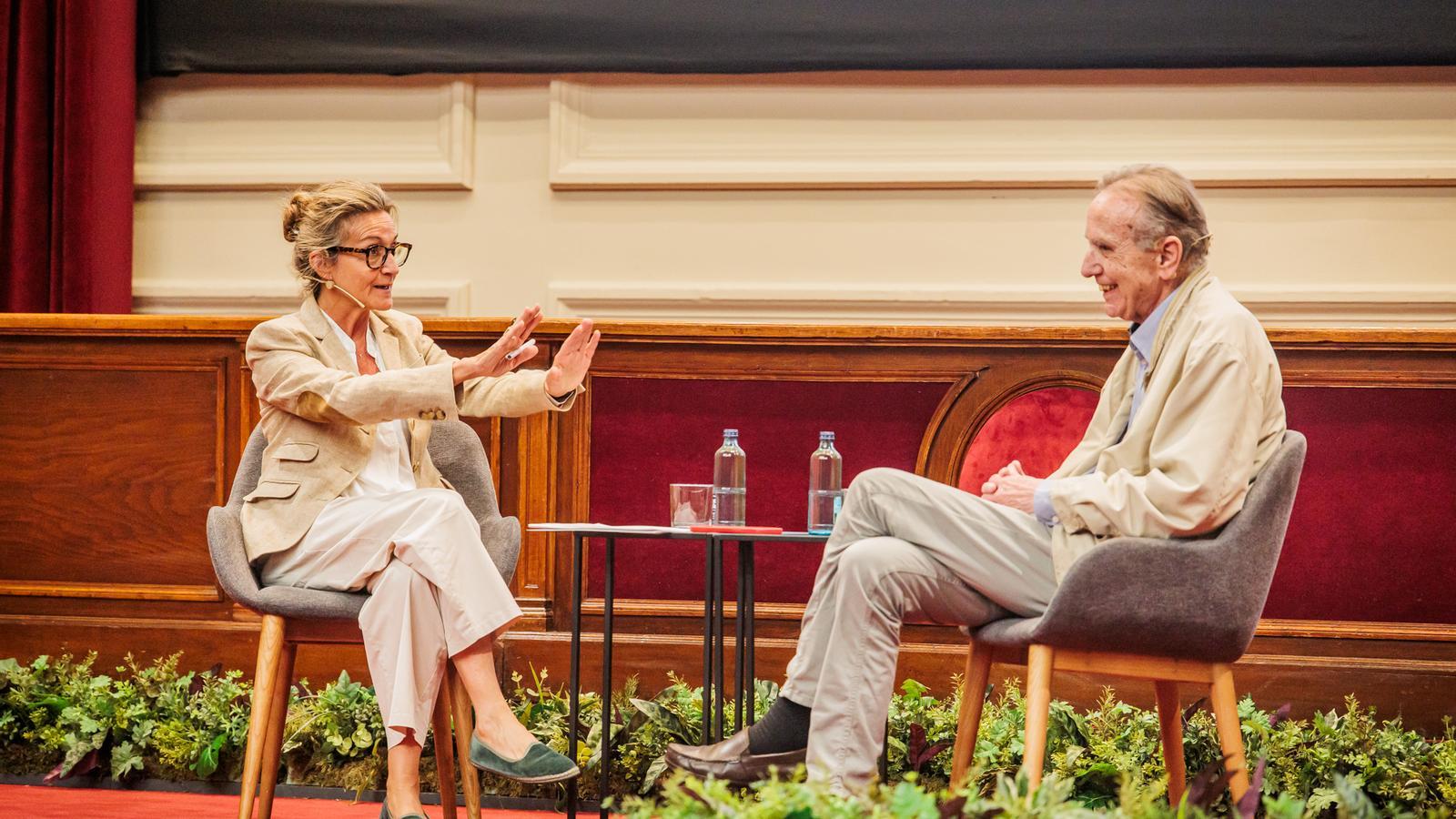
BarcelonaFranco had just died, Arias Navarro was still president and the country lived between hope and fear. In this context, fifty years ago, the Rally for Freedom was held, the first major democratic political event authorized in Catalonia since the end of the war, which boosted the PSC and gathered 15,000 people. Raimon Obiols (Barcelona, 1940) was one of the participants and this year the Government, through the Directorate General of Democratic Memory, and the Rafael Campalans Foundation paid tribute to him at the Barcelona Bar Association.
When he enters the Palau Blaugrana, on June 22, 76, what does he think?
— It was a surprise. I didn't imagine so many people, so much enthusiasm, or so much collective memory. That day we measured the country's temperature and it was one of hope, which is a very powerful political force, but it must be managed well. If it's overstimulated, disappointment follows. There were many political groups, between one and two hundred in Catalonia. But the PSC had deep roots: the project of a great labor, socialist, and Catalanist party that Francesc Layret, Salvador Seguí, and Lluís Companys, all three assassinated, represented. The references to them made us feel that their project was present there with us. Of the parties that were born or rebuilt at that time, Esquerra Republicana and the PSC are the ones that are still alive. With mistakes and successes, but without having to disown their trajectory.
What was the key to unity between workers', republican, Catalanist, and socialist traditions?
— There was a shared awareness that the norm had to be broken and an exception built. Pasqual Maragall put it very well: normality is for the right to govern, for those at the top to rule, and only exceptionally do those at the bottom achieve a majority and govern. In Catalonia, there had been a lot of popular struggle and a highly developed unitary culture. The Assembly of Catalonia was its clearest expression. This awareness made it possible to do something exceptional, with patience, tenacity, successes, and errors.
What was more important: what was said from the stage or the fact that so many people shared that moment?
— The true protagonists were the attendees. From there, not only a strong party could emerge, but a party with more weight from the people below than from the people above. Then come the elections, the money, and the established powers. And it must be done well, because when the left makes a mistake, the rule is imposed again.

He quoted Pasqual Maragall. They have always been very different. He used to say that you were Noucentista and he was Modernista. Is that a fair definition?
— It is rigorously exact. Everything that Pasqual had of expansive, imaginative, and creative had to do with the modernist tradition. I am the son of one of the last pictorial exponents of Catalan Noucentisme. Politically, we were also very different in this regard.
What is the best and worst that the PSC has done in these fifty years?
— I wouldn't know what to choose from the worst. There is a certain embarras du choix. I prefer to focus on the best: having preserved the original hope. Every year articles appear saying that "this PSC is not the PSC of before", that it is not that of Reventós or that of Pallach. Illa's PSC, adapted to very different circumstances, retains the same common thread as Reventós's PSC: the same virtues and also the same improvable defects. This continuity is important. There has been no break with the original hopes, even though some have wanted to present it that way.
The agreement with the PSOE to run together in the 1977 elections was a fundamental decision. What is your assessment of it?
— That decision came from much earlier. Already in the constitution of the Socialist Movement of Catalonia, in Toulouse, in 1945, it was said that it was necessary to unite Catalan socialism and establish a federative agreement with the PSOE. The balance is very positive. Catalan socialism has made a very important human and political contribution to the governability of the State. We have had a Minister of Defense who, if he had been Minister of Justice, perhaps we would not have the problems we have now. We have also put up a dignified opposition in Catalonia without contributing to breaking the country, which was what concerned us most: the possibility of an ethnolinguistic fracture.
Salvador Illa recently thanked the role of Convergència and Jordi Pujol in the construction of the country...
— It seemed fine to me. I read the fine print more than the headlines. And what Illa said, I would have signed with a clear conscience. I know Jordi Pujol very well, but he doesn't know me very well. This is a disadvantage for him, and an advantage for me. Carl Schmitt used to say that the weak know more about the powerful than the powerful know about the weak. Conservative nationalism has often wanted to label us, to reduce us to a certain image. But we were not what they said we were. We are something else.
What did Jordi Pujol understand about Catalan society to govern for so many years?
— The Coca-Cola formula: Jordi Pujol equals Catalonia, equals Generalitat. A very powerful symbolic identification between the nation, the institution, and the person. This can be very effective, but also dangerous. The fundamental criticism that would be made of the years of conservative nationalist hegemony is the insistence on the idea that Catalonia could die, be suffocated, or lose its personality. You should never tell a people that. Firstly, because it's not true; and secondly, because it can create monsters. The message of civil unity, pluralism, and respect from 1976 may be more necessary today than then.
Is the far-right a danger to this idea of Catalonia as a single people?
— Naturally. But I wouldn't want to be pessimistic. Catalonia has an admirable quality: it has known how to make people born in Andalusia, Murcia, Aragon, and Castile into Catalans. Without these new Catalans, I don't know where we would be. This is not improvisation: it is popular wisdom and collective memory. But I am not naive. I see the wave of radical right-wingers and national populisms around the world. Catalonia is not an island.
He said that in politics it is better not to make mistakes than to have great successes. Does this idea define him?
— The success of the PSC has been tenacity and slow politics. We have not been a party of fast politics, but of simmering. For years I argued with the party apparatus. Now I have reconciled with it. Faced with so much pyrotechnics, so much personalism and so much commercialization of politics, solid organizations are essential. Hyper-mediated politics tends to entrust everything to leaders, and this is a great imprudence.
And is it capable of adapting to the future?
— The political parties of the 21st century are yet to be made. In large part, they have structures from the 19th century and programs from the 20th century. The challenge for new generations is to build organizations adapted to the digital world and contemporary society.
In these fifty years there is a period that we cannot avoid: the Process.
— We said it from the beginning: false hopes cannot be encouraged. At a certain point, a very short question was formulated: “What if yes?” What if, by pressing a button, independence is achieved? This is what I call the button theory. If there were a button that could be pressed without war, without confrontation, and without economic or social setback, many people would press it. But the problem was not “what if yes?”, but “what if no?”. That was the question that needed to be asked.
Today the Generalitat is presided over by a socialist. What freedom is left to gain?
— In the 21st century, freedom and progress are not achieved by giving a speech from a balcony: they are achieved by working hard, being smarter, and not yielding on what is essential. I value that today Catalan can be spoken in the Courts and that it has become a normal occurrence. Changes are not made overnight. They must be worked on with tenacity and awareness of historical time. Catalonia's maximum national program has not been realized, but it will be realized through the path of federalism of facts. We will have more capacity to decide, more resources, and more freedom to be what we want to be, sharing sovereignties where necessary. Those who are in more of a hurry will have to be patient. We cannot live on illusions and fantasies. We must live by intelligence and tenacity to achieve our goals.
