The centenary of Aurèlia Muñoz has been declared an Official Commemoration by the Generalitat. The inaugural event will take place at the Macba on April 25th and will include the presentation of the publication Aurèlia Muñoz. Additionally, there will be activities throughout the country, in museums such as the Museu Molí Paperer de Capellades, the Centre Grau-Garriga d'Art Tèxtil Contemporani, and the Museu del Disseny de Barcelona, as well as an international symposium. On the other hand, the centenary has the collaboration of Casa Batlló and Sagrada Familia, stemming from Muñoz's admiration for Gaudí and her friendship with architect Jordi Bonet, who was the director of works at Sagrada Familia.
Art
Aurèlia Muñoz: the centenary of a textile art visionary
The artist's major exhibitions are approaching, who would have turned one hundred years old this Monday, at the Reina Sofía Museum and at the Macba
12/04/2026 - 22:54 h.

4 min
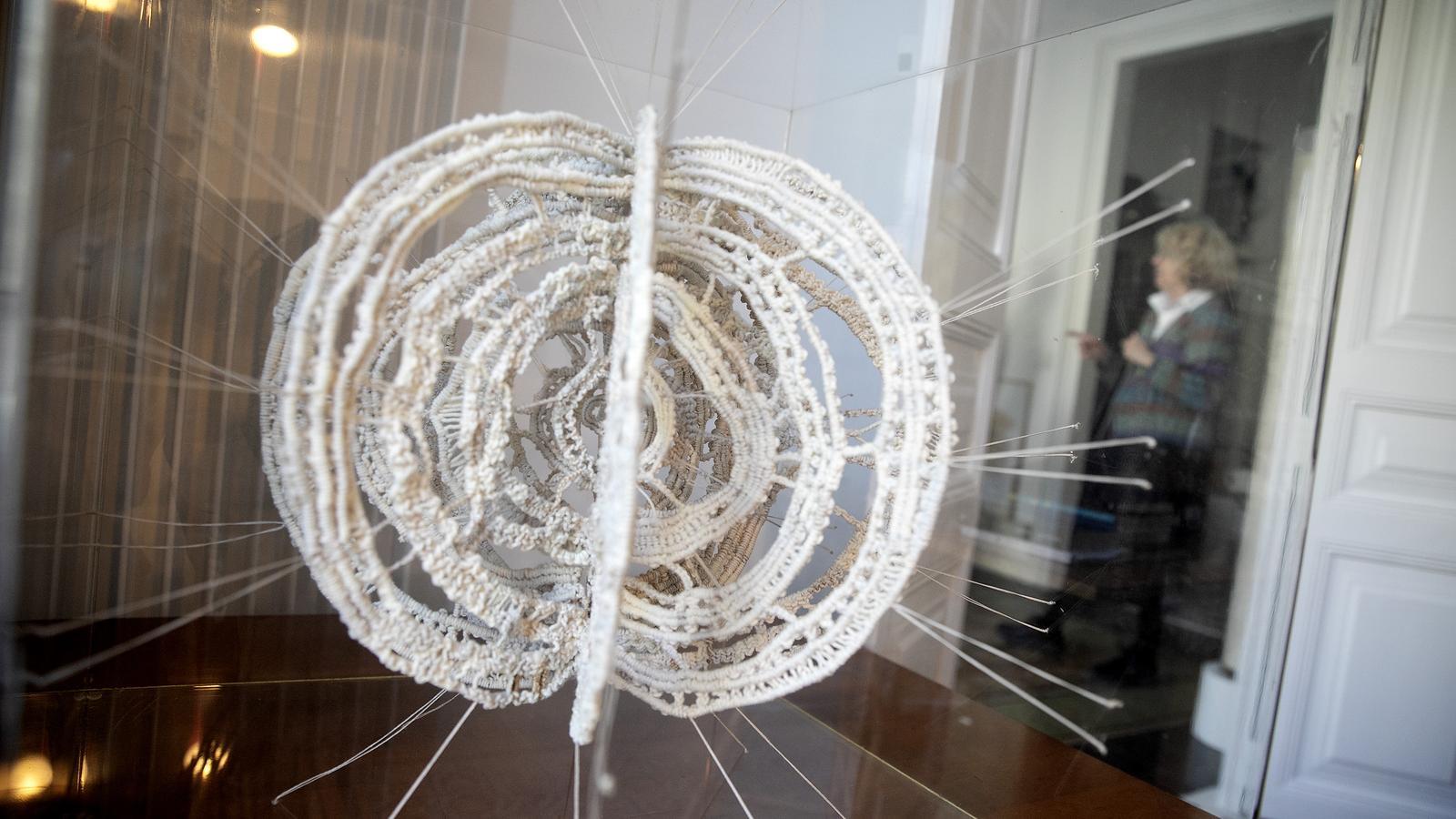
BarcelonaFor Aurelia Muñoz (Barcelona, 1926-2011), art was like "a small miracle", as she herself said. “You don't know what's happening, but it's done. Even when you've been looking at it for a while, you say: «How did I do this?» You can't even explain it”, explained Muñoz, who would have turned a hundred years old this Monday. After decades in a certain oblivion –Catalonia is a country with a very short memory for its artists–, she returned to the forefront when the MoMA in New York bought three of her works in 2018. This fact consolidated her as one of the key figures of textile art in the second half of the 20th century and as a pioneer who expanded its limits with sculptures that transform the space where they are located and that propose a sensory experience.
This year, Macba, the Reina Sofía Museum, and Einaidea (Eina Foundation) have joined forces to dedicate a major exhibition to her, Aurelia Muñoz. Ens, which can be seen at the Reina Sofía Museum from April 29 and will arrive in Barcelona on November 5, where it will be presented expanded. In fact, the exhibition is one of the key projects for the museum's 30th anniversary.

Coinciding with the centenary, three reconstructions of sculptures from the series Birds-stars can now be seen in the atrium of the Macba, which were previously exhibited at the Crystal Palace in Madrid and at the Drassanes in the 80s. "I am very interested in space, I have always been interested in it, and I believe that it increasingly offers more possibilities for working within it. Many of my works are, in reality, three-dimensional and present the same problems, or similar ones, as a sculptor. I think the technique and texture are different, as are the materials, but in reality we are all heading towards the same goal," said Muñoz. He also liked to know the public's opinion, especially that of children, because they do not have "prejudices" when it comes to saying what they think.
Living day to day surrounded by art
The artist's daughter, Silvia Ventosa –emeritus curator of textiles and fashion at the Design Museum of Barcelona and member of the exhibition's scientific committee–, recalls that they lived with her mother's works at home and talked about them "in a very natural way", as if they were present. These are the "ens" to which the exhibition's title refers. "They had dinner and ate with us. I was studying philosophy –explains Ventosa–, I was reading Marx, and in Das Kapital there is a series of characters, or entities: some who own the labor, who are the artisans, and others who do not, who are the workers. She liked that very much, and we looked for the different entities that emerged, such as the communal, the religious, the historical..."
The curator and member of Einaidea Rosa Lleó also collaborated. For Cirauqui, Muñoz is "a medium" and "a visionary of the anthropocene".

Even so, the beginning of Muñoz's career was not easy. But very soon she found her place. "Immediately, she was selected at the Lausanne Biennial, and she became part of a group of artists who are the most well-known: the Colombian Olga de Amaral, the American Sheila Hicks, and the Polish Magdalena Abakanowicz," explains Ventosa. "They were very close, even though each had their own projects. They advanced the discipline a lot, and the requirements for each biennial were very demanding. That biennial gave her a lot of momentum and many contacts, because museum directors, gallery owners, and art critics gathered there. If she exhibited all over the world, a large part of it is thanks to that biennial."
Sílvia Ventosa moved into her mother's apartment a few years after her death and receives el ARA before sending some works from Muñoz's entire career, which are scattered throughout the apartment, to the Reina Sofía Museum. The scientific director of the project, Manuel Cirauqui, began working with Aurèlia Muñoz's legacy in 2023 with a project at the Centre Grau-Garriga d’Art Tèxtil Contemporani in Sant Cugat. The curatorship of Aurèlia Muñoz. Ens has also involved the curator and Einaidea member Rosa Lleó. For Cirauqui, Muñoz is "a medium" and "a visionary of the anthropocene."
With the works in the family apartment, one can appreciate the richness of Aurèlia Muñoz's universe, which also draws from popular techniques and wisdom, as well as the natural world. “On the project side, I worked alone, but in the manipulation of fibers, María Jesús and Josefina helped me, with whom I maintained a constant and important dialogue,” says Ventosa. One can also see how, later, in the eighties, she abandoned textiles and began to work with papers she made herself. “Then she entered the world of water and the marine world, perhaps also because she was getting older and paper is lighter.”
Aurèlia Muñoz missed recognition. “She continued working, recognition did not interest her. Perhaps it wasn't so public, but she had her clients, her projects, and collectors didn't leave her,” concludes Ventosa.
An official commemoration
