Patrick Radden Keefe makes the death of a 19-year-old boy a story of London's moral decay
The author of 'Say Nothing' and 'The Empire of Pain' exposes a family tragedy and Scotland Yard's negligence in his new book, 'London Falling…'

-
CAT -
CAST
LondonIn February 2024, the writer and journalist Patrick Radden Keefe published an article in The New Yorker –he has been writing for it since 2006– titled A teen's fatal plunge into the London Underworld (La caiguda mortal d’un adolescent als baixos fons de Londres). With his usual style, which blends the rigor of the best journalistic investigation with writing that captivates the reader, Radden Keefe addressed the death, in November 2019, of a 19-year-old boy, Zac Brettler, the second son of a well-off family in West London.
That text from The New Yorker
is the basis for the acclaimed Keefe's new book, London falling. A mysterious death in a gilded city and a family's search for truth (La caiguda de Londres: una mort misteriosa en una ciutat daurada i la lluita d'una família per la veritat), which has just been published in its original English version (in Catalan, it will be published by Periscopi in the autumn). In the book, with a title reminiscent of The Clash's song London calling, the American writer turns Brettler's death into a window to highlight what he considers London's moral transformation in the era of global wealth and opaque money.
The circumstances of the death have never been clarified. The police investigation determined a "possible suicide" but it was an "open conclusion". It is not known why he jumped. "I don't think Zac committed suicide, but I also don't think he was murdered in a conventional sense," argues the author. Rather, he believes that "he jumped from that balcony because the idea of risking a jump into the Thames was a better alternative than what awaited him inside the apartment", a £4.5 million apartment on the north bank of the Thames, directly opposite the headquarters of MI6. The cameras of the British intelligence services recorded the events. Zac was alone on the balcony. But not in the apartment, as can also be seen in the images.
Rachelle and Matthew, Zac's parents, embarked on an obsessive quest to piece together what happened that night. In the process, they discovered that their son was, for the most part, a stranger: over the years he had built a double life at school based on "compulsive lies." He posed as the son of a Russian oligarch, claimed his father wasan arms dealer and said he had £200 million to invest. That fantasy was part of a personality that overflowed reality. In fact, one day the school warned the parents that Zac had arrived in a limousine. When asked why he had done it, he replied: "I wanted to see what it felt like to burn money."
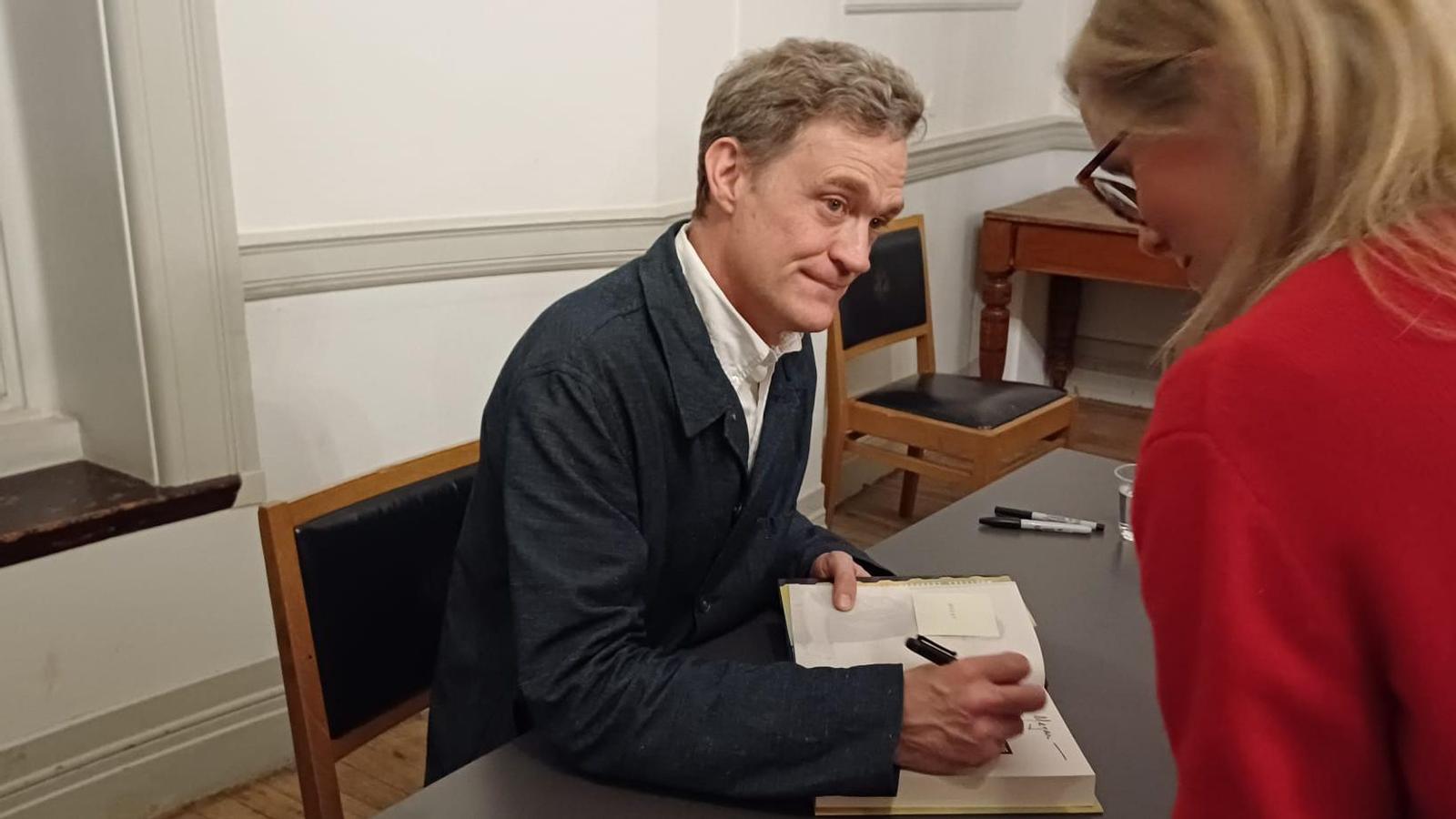
Preceded by the fame and success that some of his previous texts have brought him (The Empire of Pain or No Digas NadaNo Say Anything, for example, also published in Catalanby Periscopi, like the rest of his books), Patrick Radden Keefe appeared before a legion of readers on Tuesday evening at the Royal Geographical Society in London, with tickets sold out for months (the cheapest at 25 euros). He was introduced by one of the big names in British media, Emily Maitlis, the journalist, then at the BBC, who precipitated the downfall of the already former Prince Andrew in the famous 2019 interview about the Epstein case.
In an email account accessible to everyone through his website, Patrick Radden Keefe receives numerous proposals to delve into one topic or another. What makes him decide on a specific one? "For me, a story must always have an element of human drama," he said. Zac Brettler's short life and tragic end have it. The drama is amplified because it holds parents up to a mirror. "Adolescence can be a great challenge for them; they can often wonder not if they should intervene, but how to do so; and they may even wonder if they truly know their children." From this point of view, London falling is also a story about fatherhood and motherhood. It's no coincidence that Patrick Radden Keefe has two teenage sons.
The book has a moral dimension that connects the London of the super-rich with Zac Brettler's ordeal. Radden Keefe uses the story to highlight the transformation of the British capital from the 1980s onwards. Margaret Thatcher and her financial deregulation brought American bankers; twenty years later, Russian oligarchs arrived. London and its City thus became "an entry point for massive flows of international capital." In this context, "an adolescent may come to desire not only wealth, but also an identity associated with this extreme wealth, even if it is the product of the imagination of a compulsive liar," whose favorite film is The Wolf of Wall Street, by Martin Scorsese.
London's fall into this abyss is also manifested in the police's "spectacular failures" in carrying out the investigation. If Scotland Yard treats "a wealthy, well-off family with resources with disdain, what might happen to others?" the author wondered.
The Metropolitan Police does not plan to reopen the investigation into Zac Brettler's death. "I think they should. But I never have many expectations for the work I do and the accountability it can generate. I limit myself to doing my job, which is to expose the truth," he admitted.
The documentation is exhaustive, but even more so the "distillation" he does. As he already did during a visit to ARA two years ago, while enjoying an international residency program from the Centre de Cultura Contemporània de Barcelona, Patrick Radden Keefe explained his method to the readers gathered in London: "I try to be ruthless with myself." That is to say, "writing is distilling, distilling and distilling." The reader appreciates it. And in this case, Zac's parents, too. They accompanied him to the event. "I know there are some details in the book that may have made them uncomfortable, but I didn't remove them for that reason," he said.
For Radden Keefe, the key is not only to understand how Zac Brettler died, but also why he wanted to reinvent himself in this way. His story thus becomes a three-level metaphor: that of a growing adolescent, "with a brain as powerful as a Ferrari engine, but without brakes," that of a family in shock before the unknown that is the son, and that of a city that has reinvented itself in the last forty years.
