Andrea Mastrovito: The divine lamb will have human suffering embedded in its glass flesh
Artist, author of the lamb of the tower of Jesus of the Sagrada Familia
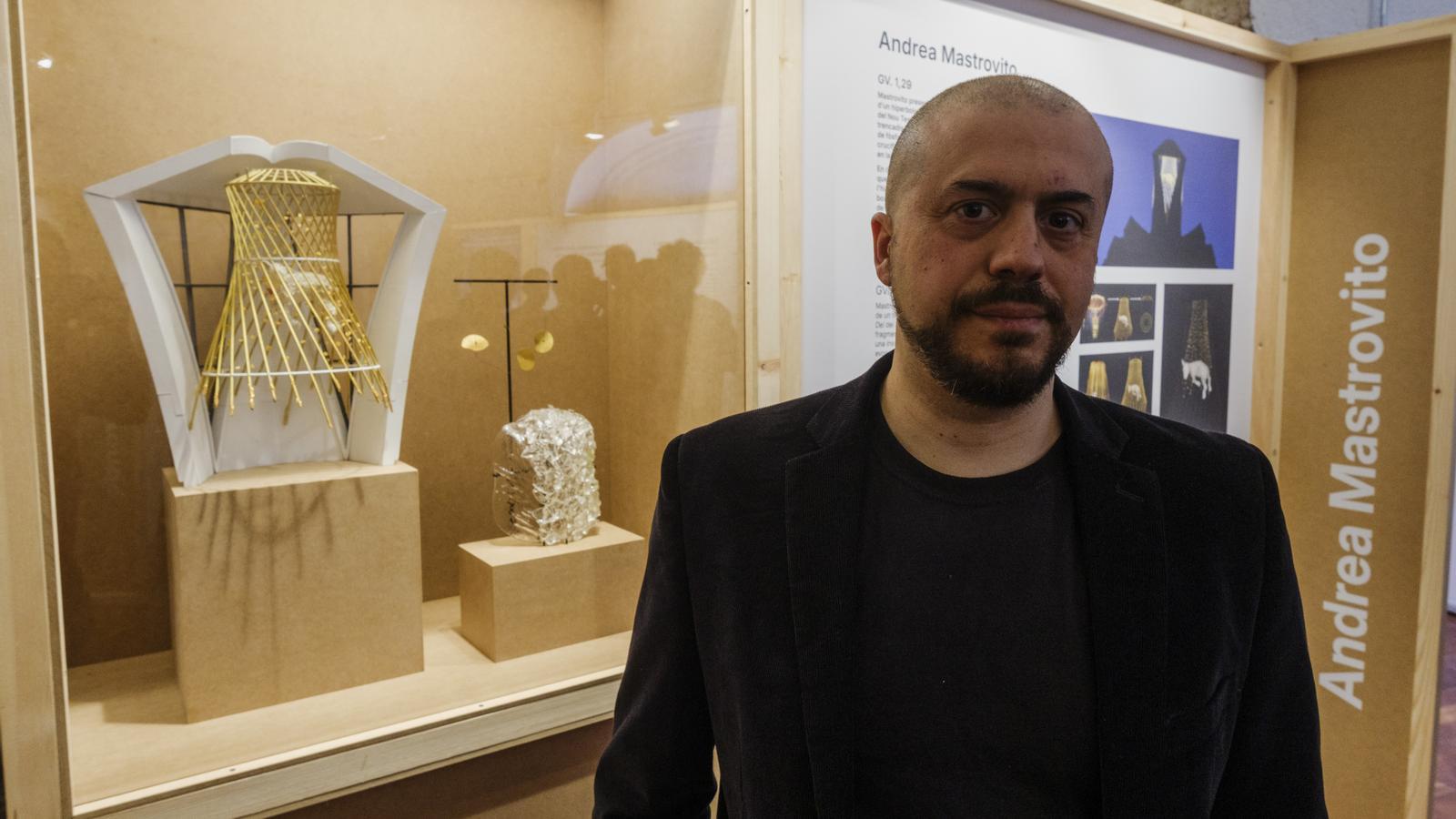

BarcelonaThe crowning of the cross of the Jesus tower of the Sagrada Família, which the Pope will consecrate on the 10th, has paved the way for the installation inside of the lamb by the Italian artist Andrea Mastrovito (Bergamo, 1978). Based between his hometown and New York, Mastrovito is increasingly recognized for how he has brought his drawings into other fields such as installations, animated film, as is the case with Nysferatu – Symphony of a century, and public works, often of a sacred nature.
He won the competition to create the lamb with an unusual proposal: you were the only one who suggested making it out of glass.
— I made this decision because I know one of the best artisans who work with glass, who is Lino Reduzzi, from the Reduzzi studio. We had already collaborated before and I was sure that for the lamb competition, thanks to him, we could make a great proposal.
Glass lets light pass through. On the other hand, the lamb is surrounded by a hyperboloid formed by 24 light beams with quotes from the Agnus Dei from the New Testament. And the lamb has a luminescent inscription from John 1:29: "The next day John saw Jesus coming toward him, and said, 'Behold, the Lamb of God, who takes away the sin of the world!'" Explain the symbolisms of this work to me.
— I used glass, gilded metal and light because more than a century ago Gaudí considered that the ring could be a sign of light. So I wanted the ring to be like a kind of light.
Did he know Gaudí's work well, or did he have to study it?
— I knew Gaudí, of course, everyone knows Gaudí and Barcelona, but I had to study a lot. I must say that I read some very good books, and Jordi Faulí's book on the Sagrada Família seemed very interesting to me because there were many clues and explanations about architecture and geometry. Geometry was fundamental for me because I found the shape of the hyperboloid there, this solution with the hyperboloid, which is in fact essential for the work. And I went to Barcelona many times; I observed the trencadís and, in fact, I applied the trencadís to the light, because the ring is made of blown glass, but it is covered with thousands of fragments of broken glass, glasses, bottles, any other type of glass. So Gaudí was very present in my thoughts.
Was there any other source that the marquis?
— The focus was on Gaudí's work, especially on decoration, which was very important. And then there was another book that was very important to me, Lo spettacolo del cielo [The spectacle of the sky], by astrophysicist Marco Bersanelli, who had collaborated with the Sagrada Familia on the shape and meaning of the Jesus tower, and when I read this book, by chance, I discovered a new scientific idea about the birth of the Universe. Then I went to Milan, I met him, and he told me that it is impossible – that it will probably always be impossible – for human beings to truly understand the beginning of the universe, the moment it began. But he explained to me that we are getting very close to it, that we are getting closer and closer. And in his ideas, in his theory, there were rays, particles, let's say the collaboration between rays and particles, between microwaves and particles, that created matter. Matter was created in this way. That's why I created this structure around the light: because light ascends to heaven, God returns to the Father, and this structure is a hyperboloid. It is a tribute, obviously, to Gaudí, but it is made of rays — rays of light — which we can think of as the first form of energy. And between the hyperboloids there are also particles, which I call golden chips, gold particles, which are a metaphor, a symbol, of microwaves and particles, of the theory of the beginning of the universe.

What role do you think a work like the lamb, and artists, play in such turbulent times as the present?
— Now the most important role is that of politicians, not artists, because if they make a wrong decision – not if they get it right, but if they get it wrong – it will be a very, very serious moment for everyone. As an artist, I just try to give shape to this moment.
In what way do you shape the current moment?
— For example, I started thinking about the lamb two years ago, in parallel with everything that has happened in the world. The lamb is made of light, so it is a symbol of light, a symbol of hope and faith. But if you look at it, you will see all the scars, all the wounds that we are living now at this moment, because I have always said that Jesus Christ on the cross is the one who suffered the most, because he carried all the sufferings of the world, all the wounds of the world, all the sins, and he suffered for all of us. So the wool of the lamb is made of broken glass, with very sharp little pieces, and I placed them in such a way that they cannot be touched. This is also a symbol: they are embedded in the lamb itself, forming part of its body of light, as if all the sufferings that billions of people live and have always lived, and the sufferings that we are living today, that we are experiencing today, and that all men have always experienced were embedded in its flesh.
One of the features that distinguishes him is that he works on the border between sacred and profane art.
— As an artist, I have always worked wherever: in galleries, museums, with the public, with the world of sports, with that of music, with the Church, with fashion, whatever was needed. I don't mind working in any field, but, of course, I have always thought that religion and churches are the main places for artists. Since the Renaissance, or even before, churches were the place where artists began to have ideas. There were limits, many limits, many boundaries, but artists always pushed those limits. And if the Church asked for something, they gave it. Likewise, I always start from a humanist, human point of view, more than humanist. I am Christian and Catholic, but all my work, not just sacred, religious work, is centered on man. Nature does not interest me as much, I focus mainly on the human being.
Man and the place he occupies in the world.
— I am also interested in the world of ideas, of course, but above all in man and his suffering, the subtle line between life and death has always been at the center of my work. Christ is a figure that returns constantly, not only in the works I have done for churches, but also in some more profane works. And the starting point is always the human. This can be seen especially in the work I did for the crypt of the sanctuary of Our Lady of La Guardia in Tortona, one of the central places in the history and memory of Saint Louis Orione, who was a great saint for very sick people with enormous problems, very poor and sick people.

For you, art has a healing and transformative power.
— In the case of Tortona, of course. In other cases, it depends. In the Sagrada Familia, the lamb represents Jesus Christ, naturally, but the fact is that it is looking at people. The lamb ascends by this force, this energy that rises towards the light, but, at the same time, it is looking at people, because Christ was God and man. And, as God, he is ascending to heaven. But as a man, he looks back at people, with a kind of nostalgia. That is to say, his nostalgia remains very linked to the earth and to the human being.
Has winning the lamb contest made him more famous in Italy?
— During the last few weeks yes.
What impact do you think the lamb of the Sagrada Familia's tower will have on its trajectory?
— I don't like talking about a "career," I like talking about work, and I always try to do it as well as possible. Normally, I have many ideas, thank God; as long as I have ideas, I am happy working on them.
