Ask for money while giving the news

The earthquake catastrophe in Venezuela has turned the news into a loop of very distressing epic rescue operations. Also of scenes of heartbreaking pain from people who know they will not find their relatives alive or who have found them too late. How many rescues are considered necessary to show in a single newscast for the viewer to understand the dimension of the tragedy? One of the differentiating factors between private and public channels is the ability to broaden the perspective. In a context of chaos, ordering information and offering a narrative that portrays reality with the complexity it deserves is what the newscasts of TV3 and TVE are doing, where correspondents and special envoys specify locations and show circumstances tangential to the disaster: the situation in hospitals, the functioning of emergency services, the saturation of cemeteries or neighborhood initiatives to offer solutions in the face of a lack of food or communication systems. Private channels, on the other hand, emphasize the most emotional aspects, especially related to the suffering associated with the countdown to find survivors under the rubble. It is symptomatic how these images are offered to the audience: always with the ambient sound of the scene, with many shouts, noise of machines and sirens in the background. These are videos recorded in a context of great tension and anguish, and therefore, they have a morbid component due to the alarm they arouse.
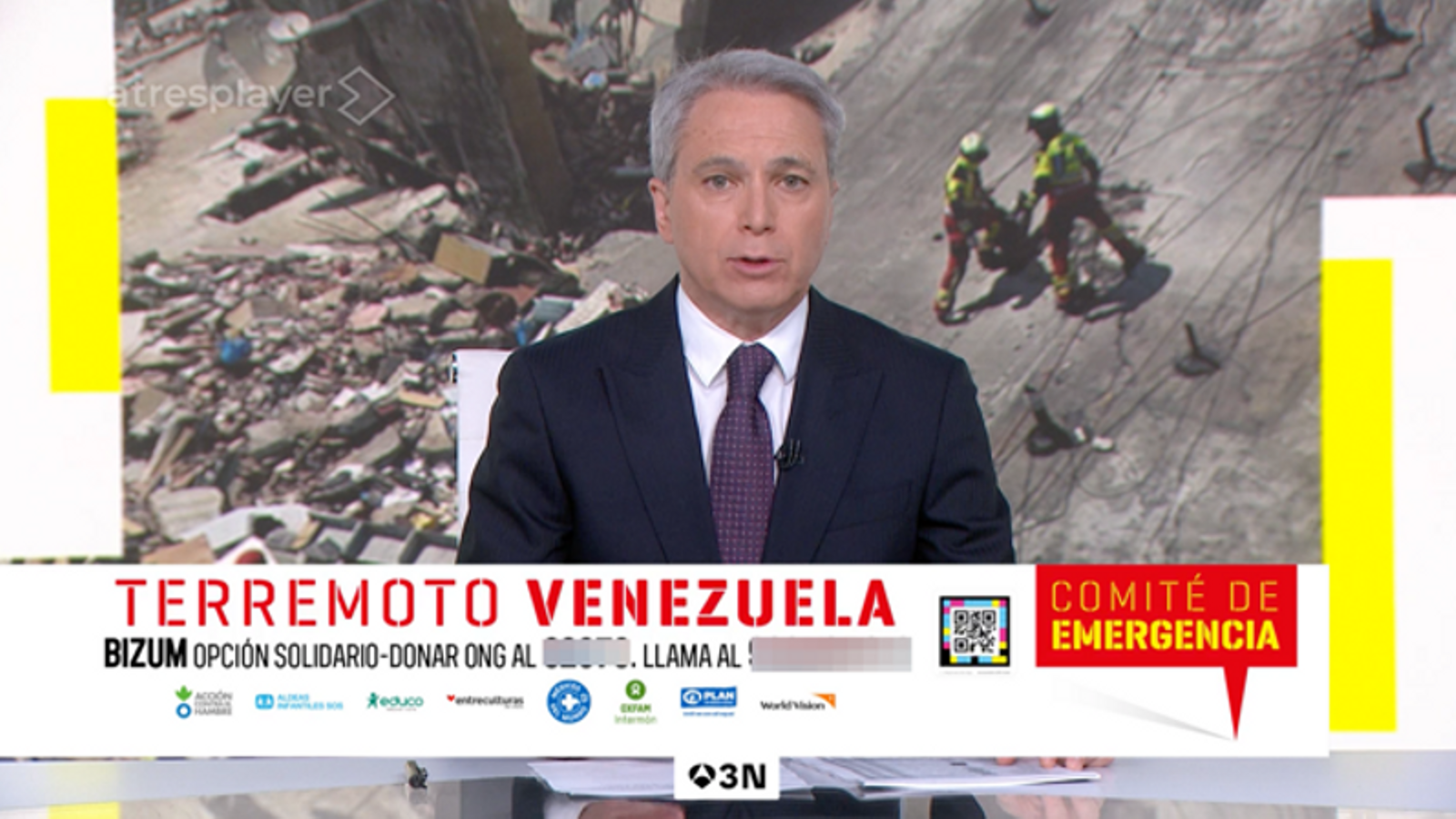
This week, the newscasts of Antena 3 noticias added an element to the narrative. Vicente Vallés said: “From Atresmedia we join the Emergency Committee to help the Venezuelan population. We have already reached 440,000 euros. The goal is to reach one million euros”, and invited viewers to collaborate financially. A banner at the bottom of the screen detailed a Bizum code and a 900 number to make instant monetary donations via mobile.
It is not at all common for news programs, which theoretically should be limited to explaining events, to dedicate themselves to mobilizing economic solidarity. We assume there is good will and that the channel does not obtain economic gains based on participation and the amount collected. In any case, Vicente Vallés did not specify this data. We also imagine that the transaction is absolutely transparent and that voluntary donors will have guarantees regarding the management of their contributions.
The dilemma is obvious. It should be clarified in the face of which humanitarian crises the media will consider it appropriate to launch money collection systems. It would be advisable to specify for which causes news presenters will open support campaigns and according to which criteria: whether they do so based on the number of deaths, the seriousness of the events, whether it will only be in cases of natural disasters, whether it will depend on the devastation of the territory or on some internal business parameter that is not detailed. Getting involved in fundraising requires clarifying protocols that do not later lead to redress in the face of new misfortunes.
