Empty streets and closed businesses: thousands of migrants flee South Africa, frightened by violence
Thousands of people abandon the country or wait to be repatriated after weeks of threats, physical aggressions and an escalation of xenophobic tension
-
CAT -
CAST
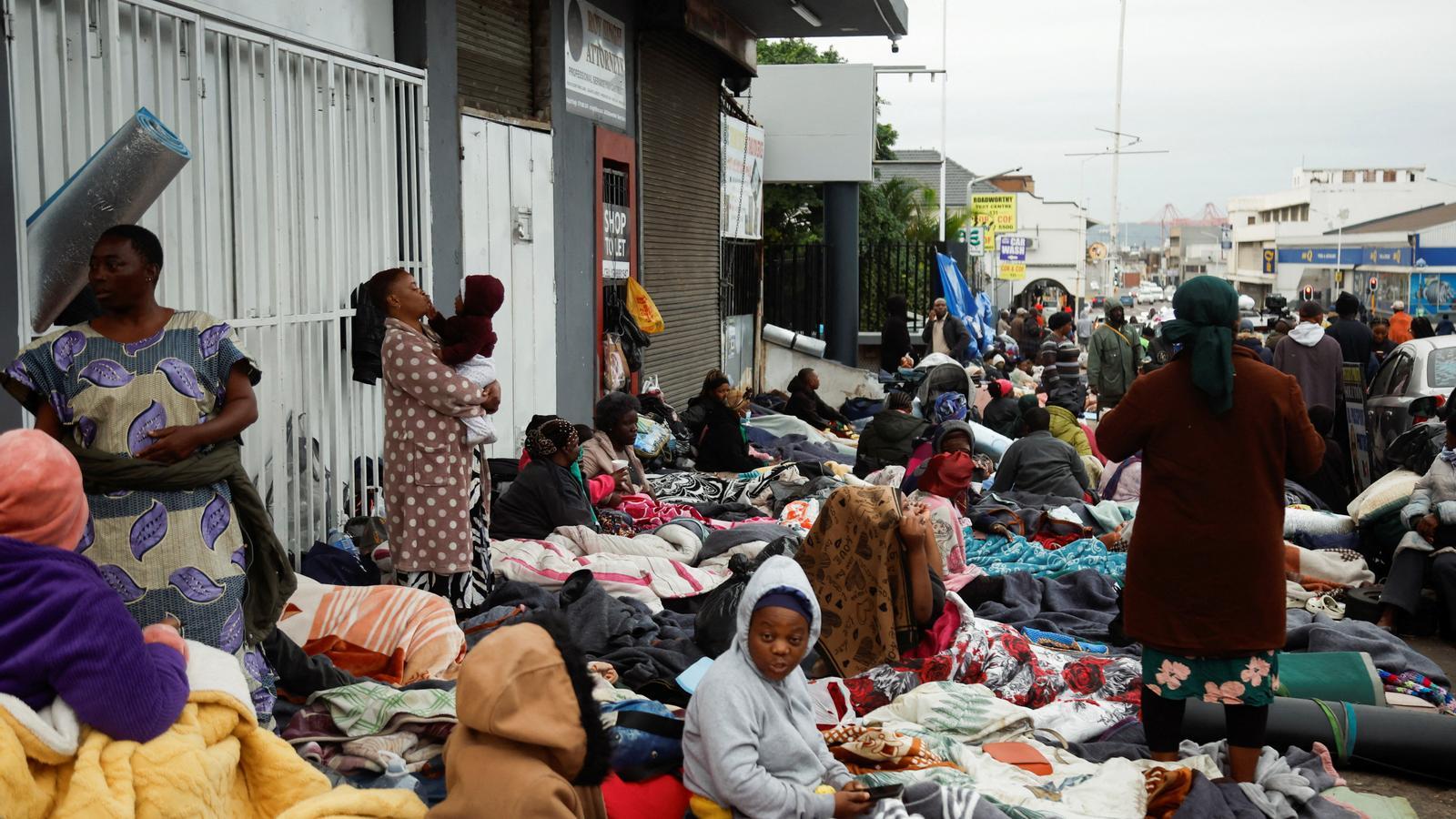
Thousands of migrants crowded around plastic bags, boxes and trash bags with the belongings they managed to salvage, and women hiding babies under blankets. This was the image of recent weeks in a camp in a South African city after anti-immigrant activists asked undocumented foreigners to leave the country before June 30. An image that contrasts with that of this Tuesday: empty streets, businesses with their shutters down, deserted transport stations and a strong police presence. This is how several South African cities woke up on a day marked by demonstrations called by the anti-immigrant group March and March and the opposition party ActionSA, who have set June 30 as the deadline for irregular immigrants to leave the country.

Protests have been called in cities like Durban, Johannesburg or Pretoria, while thousands of immigrants wait to be able to leave the country due to fears of further episodes of violence after the wave of xenophobic attacks. In recent weeks, thousands of citizens, mainly from Malawi, Mozambique, Zimbabwe or Nigeria, have left their homes and gathered in makeshift camps or outside consulates and immigration offices awaiting repatriation. According to various testimonies collected by The New York Times and the BBC, many families have fled after receiving direct threats or suffering physical assaults in their neighborhoods. Mozambique has reported the deaths of at least seven citizens in connection with xenophobic violence, and Uganda, for its part, has also confirmed the death of one of its nationals in an attack.
A 36-year-old Malawian woman residing in Durban told the BBC that a group of men armed with guns and machetes came to her house to demand that they leave the country. During the attack, her husband was injured in the head and neck and had to be hospitalized. "They held his neck as if they wanted to kill him," details Esnat Joseph. Other immigrants report door-to-door intimidation, insults, destruction of businesses, and physical assaults. Even legally recognized refugees claim to have also been persecuted, harassed, or asked to show their papers on the street.

Structural problems, service saturation and insecurity
South Africa is the richest nation on the continent and with the most developed economy. This is precisely the magnet for citizens from poorer countries. The demographic weight of migrants, however, is very low: the latest figures show that South Africa hosts about three million foreigners, approximately 5% of the population.
The organizers of the protests deny that the movement is xenophobic. They assure that their demand focuses exclusively on irregular immigration and accuse the government of not applying current legislation. High irregular immigration exacerbates, according to these groups, structural problems such as unemployment, saturation of public services, or insecurity. According to Statistics South Africa, South Africa has one of the highest unemployment rates in the world, at 32.7%.
The demonstrators insist that Tuesday's mobilization aims to pressure the government to toughen immigration control. "What we are doing today is not only important for us, but also for the future generations of this country," citizen Thabo Mhlongo pointed out to the South African press in Durban. "We are not xenophobic. We do not hate Africans," declared Tumisang Mabula, another demonstrator, in Pretoria, the capital.

"Maximum alert" in the face of anti-immigration protests
Amidst this new wave of protests against immigrants residing in the country without documentation, South African police are on "high alert". The South African government has announced "a strong police presence", especially in areas considered most conflict-ridden, such as the provinces of KwaZulu-Natal, in the east of the country, and Gauteng, in the north. The President of South Africa, Cyril Ramaphosa, has reiterated that irregular immigration is a legitimate concern for many citizens and has admitted the need to reform the migratory system, but has warned that no protest can justify threats, intimidation, or acts of violence.
In a letter addressed to the population, Cyril Ramaphosa admitted that South Africans have expressed their "deep concern" about illegal immigration, border management, pressure on public services, criminal organizations taking advantage of the immigration system, and the impact these challenges have on communities. "These concerns are real and deserve to be heard," Ramaphosa stated, adding that "the right to protest is enshrined in the Constitution." However, he also pointed out that the right to protest and freedom of expression "do not permit threatening or intimidating other people, nor committing acts of vandalism or violence." The South African president also took the opportunity in the statement to remind that many foreign nationals reside legally in the country, work, study, and contribute to the South African economy.

Thousands of people are waiting to leave the country
The fear of possible reprisals has led to an unprecedented mobilization of consulates from various African countries. Countries like Zimbabwe, Ghana, Nigeria, and Malawi have repatriated hundreds of citizens, and others like Kenya and Lesotho have issued security alerts for their citizens residing in South Africa.
In Durban alone, thousands of Malawians have spent days or weeks housed in temporary camps while awaiting processing before boarding buses back to their home country. Some witnesses explain that they are leaving unwillingly, but no longer feel safe in South Africa after the escalation of violence.
The biggest crisis in the country in recent years
The truth is that the current situation, although more serious, is not new. Xenophobic tensions against African migrants are a recurring problem in the country, with several waves of violent protests that particularly affect the most vulnerable neighborhoods. The most serious case occurred in 2008, when a wave of xenophobic attacks caused the death of more than sixty people and forced thousands of foreign residents to leave the country. Subsequently, new episodes were recorded in 2015, 2016, and 2019, the year in which 18 foreigners died, according to data from the NGO Human Rights Watch (HRW).
