The Supreme Court doubts the legality of the regularization of migrants and considers sending the case to Europe
The Spanish government defends the procedure and will speak out to "clarify" the issues raised
-
CAT -
CAST
Barcelona / MadridThe Supreme Court expresses doubts about the legality of the extraordinary regularization of migrants that the Spanish government has promoted and which ends this Tuesday. In two rulings to which ARA has had access, the high court questions the fit of the decree approved by Pedro Sánchez's executive within European law and gives five days to the parties involved against the process – in this case the government of Aragon and that of the Valencian Community, both from the PP – to pronounce on the suitability of raising a preliminary question to the Court of Justice of the European Union (CJEU), based in Luxembourg.
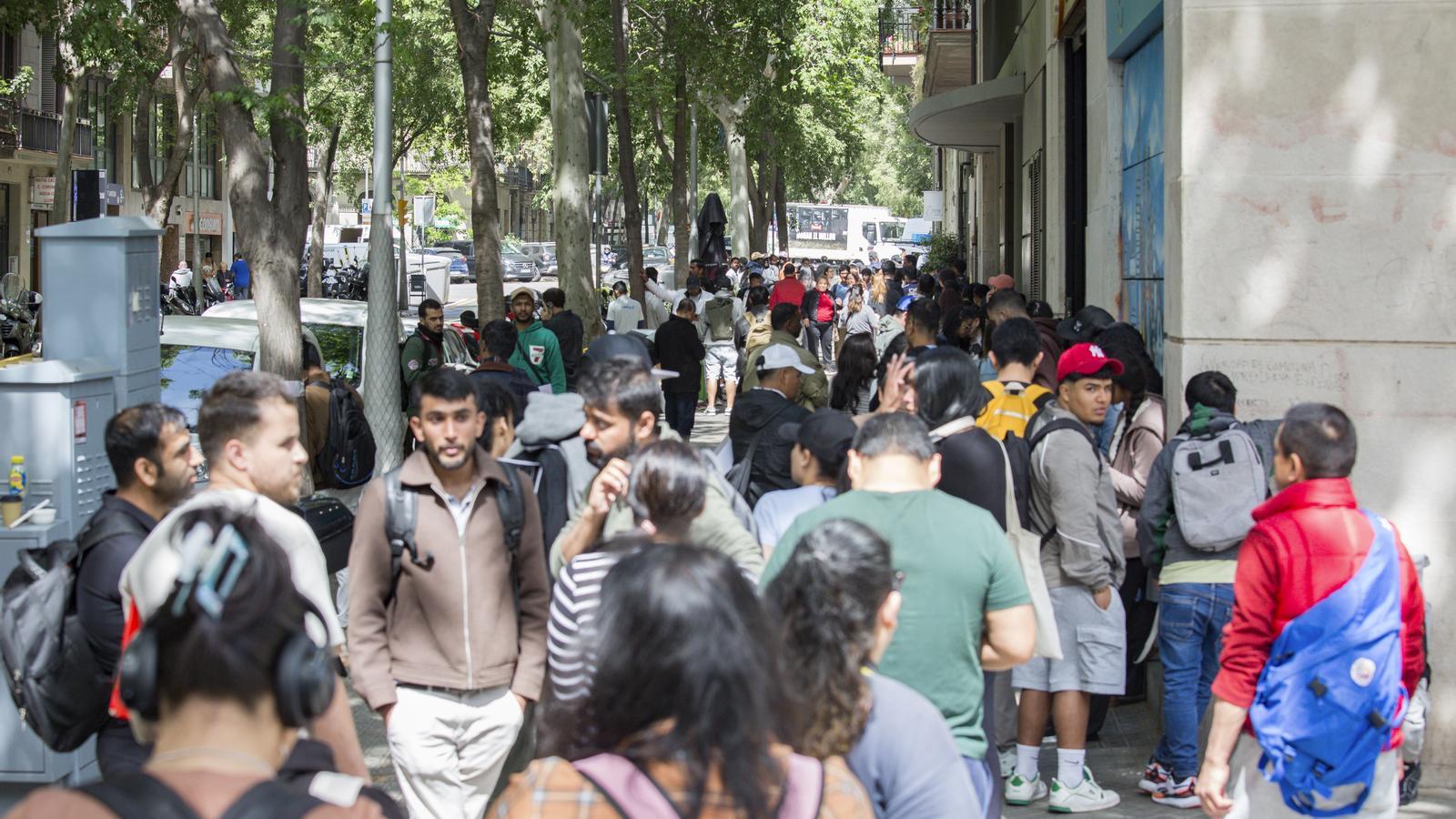
The Supreme Court's writings, dated June 24 and in response to the appeals of these two regional governments, have become known when there are only a few hours left for the regularization process to end: this next midnight the deadline to submit applications expires. The latest official data from a couple of weeks ago indicated that 900,000 applications have been made, although the Spanish Prime Minister himself, Pedro Sánchez, revealed this Tuesday that more than 1.2 million files have been processed, more than double the Spanish government's forecasts (500,000). Sánchez said this during the presentation of a 500 million euro plan to reinforce, precisely, the integration of migrants in the State.
What does the court say?
Specifically, the Supreme Court is focusing on different elements. The first is that "the regularization regime established by the Spanish government [...] raises the doubt of whether it could collide with the norms that implement the EU Migration and Asylum Pact [which came into force on June 12]", states the high court in its rulings, which doubts that states can approve norms that go against this agreement even if they were implemented before the pact came into force.
The magistrates also raise a possible collision with the EU return directive and question whether it is "admissible" for people who are in an irregular situation in Spain not to be subject to a return order with the exceptions that the same community norm authorizes, but rather that "they are recognized a temporary right of residence in general and for the mere fact of irregular stay in Spain".
At the same time, the Supreme Court doubts that the EU regulation allows a state to adopt and apply, through a regulatory norm of "sub-legal" rank, a massive regularization process for people from third countries in an irregular situation.
Finally, it warns of a possible clash with the Schengen Borders Code, according to which "border control is not carried out solely in the interest of the member states where this control is carried out, but in the interest of all states". In this regard, it recalls that a migrant who obtains a one-year temporary residence permit acquires the right to "move freely within the Schengen area" for 90 days in periods of 180. The Supreme Court doubts that this can be done without any prior coordination with the other EU states.
For all these reasons, the high court has informed the parties that they have a period of five days to report on the option of appealing to the CJEU so that it can analyze whether the regularization complies with European regulations.
The government appeals for "calm"
When a preliminary ruling is issued, the judicial proceedings are automatically stayed, although this should not affect the validity of the regularization. It should be recalled, in fact, that the contentious-administrative chamber of the same Supreme Court rejected in May the provisional suspension of the decree by the Spanish government, as requested by Vox and the Community of Madrid, presided over by Isabel Díaz Ayuso.
The Spanish government calls for "calm" from all those who have submitted an application and defends the legality of the entire process, supported by a favorable report from the Council of State – the highest consultative body. Thus, at Moncloa there is confidence that the process will move forward, although they point out that, in any case, if the ECJ were to rule against it, applications that have not been approved run the risk of being left in limbo.
Sources from the Ministry of Migration recall that they can also rule on the "relevance" of the preliminary ruling and that they are already working with the State Attorney's Office to "clarify" the doubts. "If it were to be elevated [to the ECJ], it would serve to resolve specific doubts before resolving the merits of the matter," they point out from the ministry, which argues that the wording of the regulation is "strictly" compatible with EU law. "The regularization grants a residence and work permit valid exclusively in Spanish territory," in the exercise of state powers, the same sources reiterate.
For their part, and although one has nothing to do with the other, the leader of the PP, Alberto Núñez Feijóo, has linked the Supreme Court's doubts about the regularization of migrants with his denunciation of the nationalizations provided for in the democratic memory law. According to Feijóo, the Spanish government is making decisions "of great demographic and electoral impact without sufficient consensus." The regularization that ends this Tuesday grants a work and residence permit for one year and not nationality or the right to vote.
Latest news from entities
From the legal world, Quim Clavaguera, lawyer and deputy responsible for the immigration commission of the Bar Association of Barcelona (ICAB), questions that the ECJ rules in favor of annulling the regularizations and, on the contrary, states that perhaps there is a reproach about how the process has been carried out and it may even end up imposing a fine on the State. However, he indicates that the approved regularizations are "acquired rights" and, moreover, the community court may take years to evaluate the Supreme Court's request, a time during which the beneficiaries of the procedure will have already had to renew their documentation.
Despite this, Clavaguera points out that the entire regularization process has been carried out "chaotically" and "hastily" from the beginning, with various criteria and requirements to apply for the procedures, and that once the windows to collect documentation were opened, there was also confusion, as seen in the fact that five weeks after the start of the process, the Ministry of Social Rights had to step in to resolve doubts and confusions. In this regard, the lawyer indicates that documents were requested that were not necessary and warns that now the "chaos" is in the National Police stations, where no appointments can be found to take fingerprints.
The Supreme Court's move has caught social entities in the final stretch of supporting migrants. Albert Parés, a lawyer specializing in migration from the Noves Vies Association, assures ARA that the Supreme Court's decision "will not affect" the regularization process because it ends precisely this Tuesday. Victoria Columba, spokesperson for Regularización Ya, the entity that promoted the signature collection that allowed the process to open, dedicates the day to going to the queues at Social Security or National Police stations. She dismisses the idea that the judicial route has any traction in the court's action and frames it as an attempt by "the far-right to make political statements" in the face of the success of granting rights to thousands of people. For the activist, it is also one more of "the obstacles, the bureaucratic labyrinth, the institutional racism" that the immigrant population faces, and she recalls that they were already able to stop the precautionary measures presented to the same Supreme Court by Vox, Hazte Oír, and the Community of Madrid to try to prevent the process from starting. Along the same lines, Maria Creixell, from the Obrim Fronteres Coordinator (an entity collaborating in the process), states that the only objective today is to be able to register all applications "until 11:59 PM" and that "from tomorrow" they will see if they have to "battle" for other issues.

