Angel Dust: "I am an 'outsider'"
DJ

-
CAT -
CAST

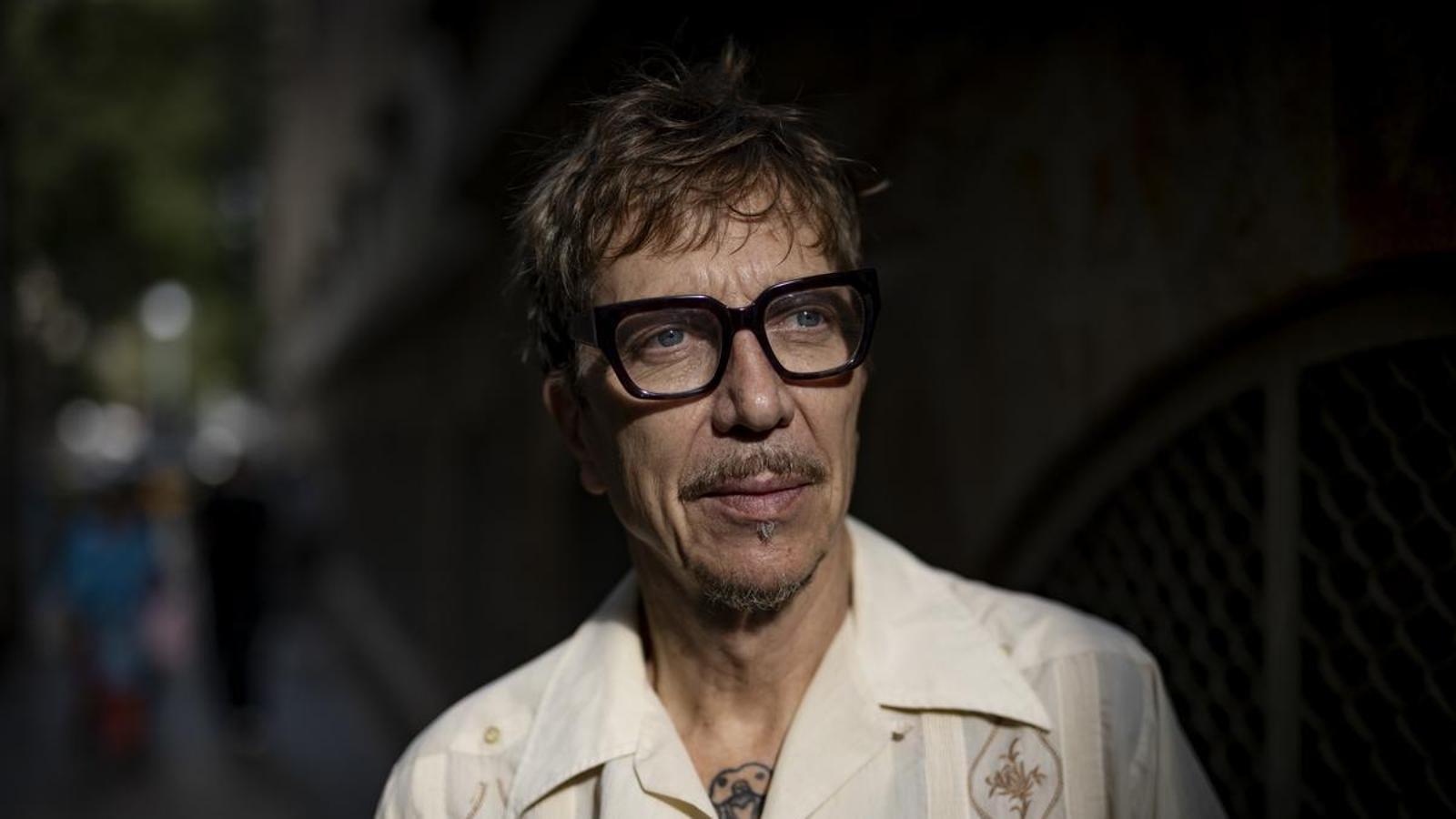
He was born in Mexico as Ángel Francisco López and, in Barcelona, he became Professor Angel Dust. It is the name with which he established himself as a DJ and with which he filled the nights of Bongo Lounge at La Paloma in the 2000s. Until his fall into hell. In 2008, he was admitted to a prison in Panama accused of drug trafficking in a sinister case, although he has always maintained his innocence. He explains this in the book En el estómago de la bestia (Editorial Contra), which has on its cover a photo similar to the one on his WhatsApp, but with a fundamental difference: in the one on his phone, he is smiling. He accompanies the image with a phrase: life is life. Life is life.
And yours, your life, how would you define it?
— Fantastic. It hasn't been typical, it has had many things.
How do you remember the Barcelona you arrived in in 1988?
— I loved the dark and romantic part, with people from different places trying to make a living in creative professions. Nothing to do with the world of expats that we have today.
A person told me recently that they remember it as gray.
— It was grey in the good sense of the word. Not a single posh kid went down to Plaça Reial. There were art students, punks, freaks… Marc Almond, singer of Soft Cell, and Lydia Lunch used to go there quite a lot. I started at San Francisco, playing black and psychedelic music, and the few tourists who were there mixed with the most radical and freakish LGBTI movement of the time.
You established yourself and ended up DJing at the Paloma nights. Was it really that cool or has it been magnified by nostalgia?
— It was that cool. There was a very free atmosphere, people mixed… Now it’s a nightclub, before it was like opening a portal to a parallel reality. Sometimes people would approach us after a night… as if they had been to church.
You performed for illustrious characters. Quite a name...
— I remember being told: look, I have a surprise. I turned around and saw a guy with a cap; I didn't recognize him. And they told me: it's Leonardo Di Caprio. I shook his hand and it was limp. Beside him was the actor Tobey Maguire. When the night ended, the security guards came and told me: look.
What was happening?
— That everyone had left and Di Caprio had stayed there asleep. We woke him up and he left. He was very young.
What did the closure mean?
— Many venues began closing, musicians were removed. Those were the years of Mr. Clos, who destroyed the city. It was all very radical. I believe that the cultural legacy has been neglected here and has not been taken care of as in Berlin, because it was seen as something for crazy people and night owls, and they wanted to give more importance to the Barça Museum and the Forum of Cultures. I think that was when the charm that Barcelona had began to be lost. And then...
What next?
— Afterwards, for me, all the domino pieces fell down at once.
The arrest in Panama. You had gone there to work.
— I was supposed to perform as a DJ at a private party, and they told me they would cover my expenses, as well as those of my wife and my few-month-old daughter. We thought we could take advantage of it to spend a few days on a paid vacation. Now I see that they had studied the profile; it was a specific recruitment. There was no performance. When we arrived, they asked us to stay for a few more days… and we had to go back because we had commitments.
What do you remember about the arrest?
— I go into shock, as if I had been disconnected. I thought: what am I doing here? Where was I going? But then I assumed that I would be able to get out, that the law would work. I could not imagine how these countries worked and how strange the story would be.
Entering prison feels like a movie. The hallway, the cells, the prisoners saying things… Is it true they called you Shakira?
— Someone shouted something like "blondie, you're going to get yours", and things like that. It was a madhouse, labyrinthine place, where you walked in circles.
You were lucky, within the misfortune, to find protection.
— Already in the dungeon I found myself with a group of Mexicans. And when they found out that I was from the same country, they said: take care of this kid. And what saved me was the music.
You knew how to reinvent yourself, in there.
— There was a music studio in the prison that had been closed, and I brought the project back. It was incredible. We managed to write a song, Paz en el ghetto and we were contacted from the outside because they wanted to use it for a peace concert in Panama. Finally, we ended up recording it with the inmates and famous people from the country. Like a kind of We are the world, but for peace.
And you like Michael Jackson.
— Exactly. After all, the pain was like, wow!, what experiences. I didn't think all this could happen to me. And the song reached the buses, the ghettos, and the prisoners were happy. That's why they respected me. Doing the music studio inside the prison saved me.
What were the prisoners like?
— Like in many places, humble people, from the ghetto, gang members. In the prison where I was, El Renacer, furthermore, there were also many minors who arrived when they reached the age of majority. 90% were hitmen. I was surrounded by very messed up people, and I had to try to empathize instead of being afraid.
You describe it as a sad place.
— You might think that prison is a violent place, but I would say that above all there is sadness. And in the end, a certain brotherhood is generated because the people who are there are considered scum by society, and you have to create some system to endure it. It is also true that…
Tell me, tell me.
— Look, I was with people who had dismembered their girlfriend, or who had burned her. I mean, it was the easiest thing in there. Nobody cared much about me.
To make everything even stranger you crossed paths with General Noriega.
— Some prisoners and officials still greeted him saying "my general". He was always accompanied by two or three policemen so he wouldn't be killed; he was already an old man. And he almost took our studio away from us. We ended up building a new one, very cool, and he complained that there were leaks in his cell and they moved him there. And he wouldn't leave. We took action and finally managed to get him out. In other words, we beat Noriega.
You went to prison, and your wife too, with whom you had a daughter a few months old. How can one live through that?
— It was the most painful thing. I had a kind of altar, where I slept, with photos of her that gave me strength not to fall into depression. And it reassured me to know that she was in good hands, with my parents.
After five years, what is it like to go out?
— It is putting an end to the nightmare. The first shock was at the airport, when they let me go alone to the duty free. And then everyone was talking about crises; they were depressed and very much on their mobile phones.
Is that what surprised you the most?
— Yes, because when I entered there was a small Nokia and when I left there was WhatsApp and people were taking selfies. I remember the first restaurant I went to with some friends, and they took out their phones while we were at the table, and I thought: wow, how rude.
Does it take a toll, having been in prison?
— Yes, jobs can fall through. And there is always that point of, what will they think, right? It's a stain.
Does it make you angry?
— Yes.
What is done with anger?
— You swallow it, right? And you hope that someone sees that it is an advantage to have gone through a situation like that. It gives you social tools that you perhaps would not have by going to university or a survival course.
You have your band, Warmgun.
— But we do it a little bit for the love of art, eh? We are no longer looking for many gigs. I do produce a lot of music. It is what makes me feel good and productive, the universe that I am crazy about and makes me disconnect from the noise of the grotesque and ugly world in which we live.
You have a little daughter conceived in prison.
— It was during a face-to-face visit a few months before I got out, and also before my wife could get out. She was using an IUD, and we didn't know it wasn't working. And, just with the fact that she exists, everything else is fine by me. I prefer to have suffered rather than for her not to exist today.
Why so many tattoos?
— I had been getting tattoos for a long time. Most of them are by Doktor Lakra, a friend who, besides being a tattoo artist, is a visual artist. I like them because of the sailors, because a long time ago they were for outsiders. I have always been an outsider.
You have some dice.
— They represent chance. And here is the phrase "Love is the law". Love is the law. It is the law of Thelema, by the philosopher Aleister Crowley. For me there are two forces: fear and love. And love is the only law.
And this other one?
— Life is short, but vast. It is a bit like that… When you stop for a moment you can see that yes, it is short, but the possibilities are infinite.
