10 memorable literary and cinematic eclipses
The astronomical phenomenon is a recurring presence in books and films as notable as 'The Odyssey', 'Ladyhawke', 'Apocalypto' and the 'Diaries' of Virginia Woolf
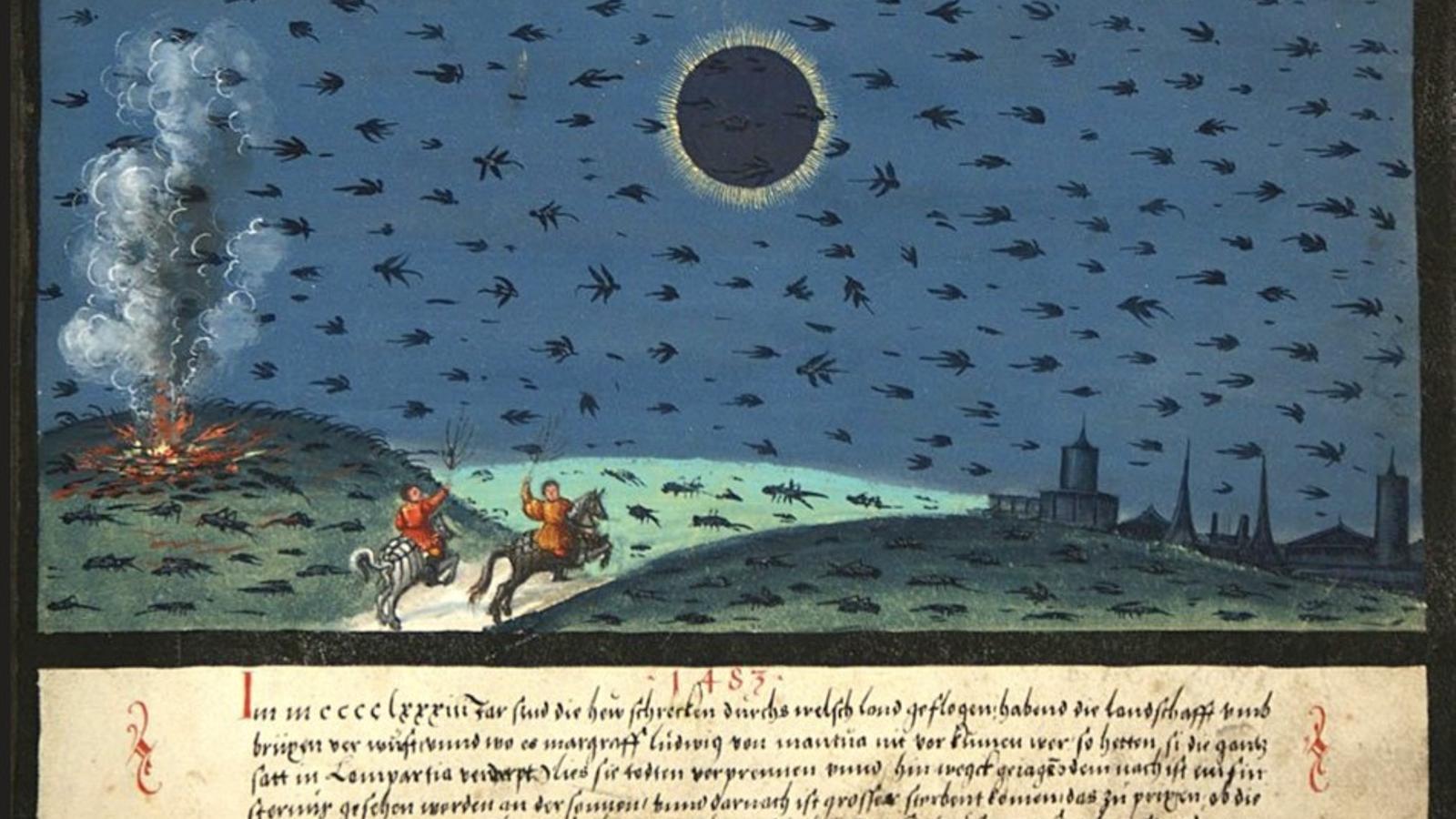
Barcelona"From noon until three in the afternoon a darkness spread over the whole land." With these words theGospel according to Matthew explains the agony of Jesus Christ on the cross. During these hours of darkness, which exaggerate the duration of a solar eclipse, the messiah endures the suffering in silence until, shortly before dying, he lets out a final cry of despair: "My God, my God, why have you forsaken me?"
The relevance of this scene in Western religion and culture demonstrates the power –often associated with bad omens and misfortunes– that eclipses can have. The term, which comes from the Greek ékleipsis, means disappearance or abandonment and describes an astronomical phenomenon that occurs when a celestial object moves through the shadow of another. Coinciding with the proximity of the total solar eclipse on August 12, we choose ten emblematic representations of the phenomenon in the history of literature and cinema.
'The Odyssey'
HomerIn Catalan, it can be found in the Bernat Metge collection, translated by Carles Riba, and in the Bernat Metge Universal, in a version by Pau Sabaté
To the Odyssey of Homer, one of the foundational literary texts, composed and recited orally since the 9th century BC and fixed in writing during the 8th century BC, there is a passage in which the seer Theoclymenus mentions the evils that a solar eclipse can unleash. The character addresses Penelope's suitors in the 20th canto of the poem, shortly before Odysseus, who has already returned to Ithaca incognito, confronts them: "Ah, wretched ones, what evil is this that you suffer?", he begins, and mentions the burning groans, the tears, the blood, the specters, and the mist that accompany the phenomenon. "In the sky the Sun has failed", can be read in the emblematic version by Carles Riba. It is a symbolic way on Homer's part to announce the imminent death of the men who still covet Penelope. Astronomer Constantino Baikouzis and biophysicist Marcelo O. Magnasco assure in a study published in 2008 that the eclipse mentioned in the "Odyssey is inspired by a real one that took place in the Ionian Islands in 1178 BC.
'Barrabas'
Richard Fleischer (1961)
The first eclipse in cinema was a documentary, recorded by John Nevil Maskelyne in 1900 in North Carolina, United States. But one of the most famous was also real: in 1961, producer Dino De Laurentiis and director Richard Fleischer were filming a blockbuster about Barabbas, the thief whom Pontius Pilate released instead of Jesus during Passover. And for the crucifixion scene, Fleischer and De Laurentiis timed the filming with the solar eclipse that was to occur in Italy on February 15, 1961. In Roccastrada, Tuscany, the team deployed over 40 cameras with various exposures to capture the strange luminosity of the eclipse, which lasted two minutes and 45 seconds. There was no room for error, but they succeeded, and the result is a sequence of great beauty, without tricks or shortcuts. That same eclipse was witnessed by filmmaker Michelangelo Antonioni and inspired one of his classics, precisely titled L'eclipsi, in 1962.
'The Song of Roland'
Quaderns CremaCatalan translation by Joan Jubany
The Song of Roland, a medieval epic of the 11th century narrated in verse, reconstructs the battle of Roncesvalles captained by Roland, the best of the knights in the service of Charlemagne. Translated into Catalan by Joan Jubany, who respected the decasyllables of the Anglo-Norman poem, the work delves into the feats of Roland and his army until they are defeated by the Saracens when they are about to reach Gascony. At that moment, the poem describes the sudden darkening of the sky, storms, and an earthquake, signs of a possible end of the world.
The anonymous poem exemplifies one of the most common interpretations of eclipses in medieval literature, which relates them to bad omens or the imminence of political and religious changes. Philosophers and writers like Ramon Llull, on the other hand, set aside the symbolic and apocalyptic charge of eclipses and make them appear from a descriptive point of view in treatises such as the Book of Contemplation in God (1271-1274) and Tree of Science (1295-1296).

'Lady Falcon'
Richard Donner (1985)
About the lovers protagonists of the medieval fantasy Ladyhawke (1985), played by Michelle Pfeiffer and Rutger Hauer, lies a magical curse: during the day, she transforms into an owl, and at night he is the one who transforms into a wolf. Supposedly, the curse can only be broken during "a day without night and a night without day"; that is, during a solar eclipse, which allows Pfeiffer and Hauer to see each other beyond the few seconds of dawn or dusk when they coincided in human form.
'Apocalypto'
Mel Gibson (1985)
The thrilling Apocalypto (2006), by Mel Gibson, is one of the most unusual and fascinating adventure films of this century. Set in the early 16th century in the Yucatan Peninsula, the protagonist is a man from a tribe living in harmony in the jungle until a hostile expedition from a Mayan city razes the village and takes the men prisoner to be sacrificed to the Mayan sun god, Kinich Ahau. About to be sacrificed at the top of a pyramid, a most opportune solar eclipse is interpreted by the terrified Mayan priests as a sign of the sun god's satiety, and thus the protagonist saves his life.
'A Connecticut Yankee in King Arthur's Court'
Mark TwainQuaderns CremaTranslated by Joan Sellent
Mark Twain was one of the masters of satirical narrative in the second half of the 19th century thanks to books like The Million Pound Bank Note –which Cal Carré has just translated into Catalan for the first time– and the novel A Connecticut Yankee in King Arthur's Court. In the latter, published in English in 1889, the protagonist is Hank, a mechanic from Connecticut who, after a nap, travels through space-time and ends up in 6th century England. The work confronts industrial America with medieval England in a comedic vein, and Hank manages to save himself from being burned at the stake thanks to a solar eclipse: if they don't spare his life, he assures them that the Sun's light will no longer illuminate the Earth and chaos will reign. This same strategy was used a little earlier by H. Rider Haggard in the novel King Solomon's Mines (1885), in which an explorer who learns of an imminent eclipse convinces the kukuana tribe that with his magical powers he will be able to hide the Sun, and that it will not reappear until he wishes. In exchange for illuminating the world again, the kukuana must obey the explorer in everything he asks.
'Diaries', by Virginia Woolf
'A Writer's Diary' (Viena, 2022; trans. Dolors Udina) and 'Diaries' (Club Editor, 2022; trans. Carlota Gurt)
The author of Mrs. Dalloway did not want to miss the first total solar eclipse that could be seen in England in almost two hundred years. On June 28, 1927, accompanied by her husband, Leonard, and a good part of her select group of friends – which included Vita Sackville-West and Quentin Bell – Virginia Woolf traveled by train from London to Richmond, in North Yorkshire, to witness the promised 24 seconds of eclipse. She described the experience in a long entry in her Diaries: "It became as dark as at the beginning of a violent storm. The light was disappearing. We told ourselves that it was the moment of shadows, and when we thought that [the eclipse] was about to end, suddenly the light went out completely. It had been extinguished. The colors had faded. The Earth had died. This was the most surprising moment, because immediately, as if a ball had bounced, the clouds regained their colors, although they were a bit ghostly and ethereal, and then the light appeared again".

'Dolores Claiborne'
Stephen KingEdiciones BTranslation by Enrique de Hériz
Stephen King, one of the most prolific, popular, and well-regarded authors in the horror genre for five decades, could not miss the tempting narrative opportunities offered by an eclipse. In the novel Dolores Claiborne (1992) – which was adapted for the cinema in 1995 by Taylor Hackford under the title Total Eclipse–, the protagonist plans the murder of her husband Joe, an alcoholic and aggressive man, during the solar eclipse of 1963. She talks about it many years later, during the police interrogation for the suspicious death of the elderly millionaire whom she has been serving for decades, silently enduring her demands and mistreatment. In the same year he published Dolores Claiborne, King also released Gerald's Game – which also has a film version, directed by Mike Flanagan in 2017 – where the 1963 eclipse also plays a relevant role.
'Darkness'
Jaume Balagueró (2002)
In Jaume Balagueró's second feature film, the thrillerDarkness, an American family moves into a house on the outskirts of Barcelona where 40 years ago six children were sacrificed in a satanic ritual that coincided with a solar eclipse. The celestial phenomenon is a recurring motif in Balagueró's cinema, which he used again in Venus (2022), a coven of blood and black magic where a demonic entity wants to possess Ester Expósito during an eclipse. The friend and colleague of Balagueró in the [REC] saga, Paco Plaza, is also fond of eclipses, who in Verònica (2017) sets the scene of the protagonist's séance with a ouija board during a solar eclipse, and uses this visual motif again in the film's prequel, Sister Death (2023).
'Night Falls'
Isaac AsimovGregal BooksTranslation by Carme Manuel
Science fiction has also turned to the uniqueness of eclipses on numerous occasions. The iconic film 2001: A Space Odyssey (Stanley Kubrick, 1968) opened with an initial shot in which the Moon, the Sun, and the Earth aligned to the rhythm of Also sprach Zarathustra, by Richard Strauss. One of the pioneering writers in the exploration of eclipses in other civilizations was Isaac Asimov, who, in Nightfall, a 1941 story, posits the case of the planet Lagash, which revolves around six suns and only experiences an eclipse every 2,050 years. This absolute and unusual absence of light drives its inhabitants to madness.
