Santana Cajal, the Chinese 4x4 driven by an Argentinian and that wants to be Spanish
Santana presents its new all-terrain vehicle Cajal, named in honor of the scientist Santiago Ramón y Cajal and which will be assembled in Linares (Jaén)
-
CAT -
CAST
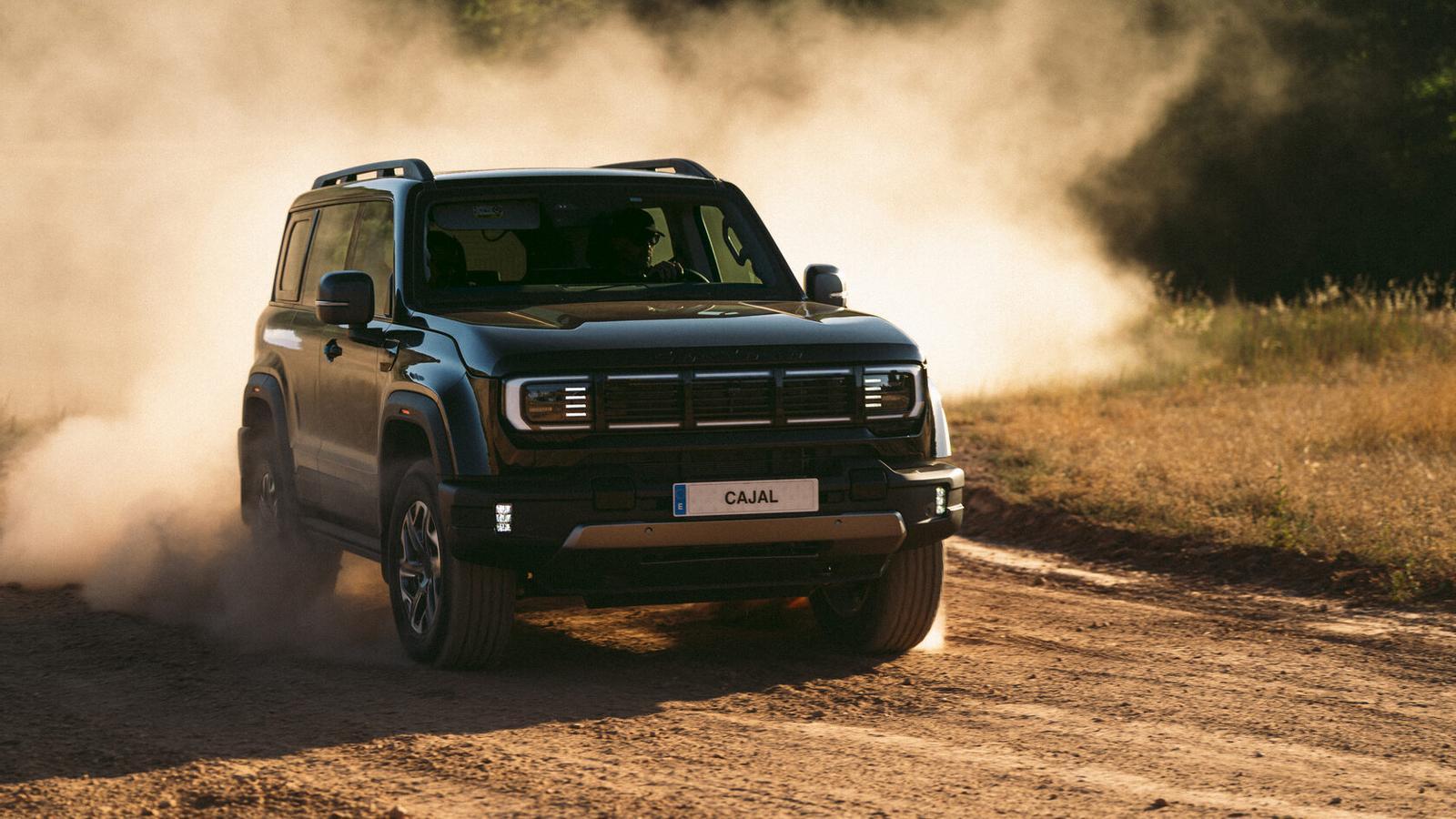
A few months ago, a group of Spanish businessmen led by entrepreneur and adventurer Edu Blanco announced an agreement with Chinese automotive manufacturers to resurrect the legendary Santana all-terrain vehicle brand, headquartered and with a factory in Linares, in the province of Jaén. After announcing a van or pickup called Santana 400 – which also used the base of Chinese models – the Andalusian brand has surprised everyone with the announcement of its second model, an old-school 4x4 called Santana Cajal, in honor of the Spanish Nobel laureate Santiago Ramón y Cajal.

The new Santana Cajal is an all-terrain vehicle with a ladder chassis, triple differential lock, permanent four-wheel drive and a 163 HP diesel engine that aims to become an economical alternative to the current Jeep Wrangler or Toyota Land Cruiser, and aims to respond to a very specific market niche, oriented towards a rural environment and intensive off-road use. Although Santana has not yet confirmed the final price of the Cajal (it has announced that it will cost less than €50,000, making it between €16,000 and €20,000 cheaper than its competitors, this model uses the base, engines and technology of the Chinese all-terrain vehicle BAIC BJ40, which has a price of €39,000. At first glance, we can see that the Santana Cajal is a robust vehicle, with a powerful body in which angular shapes and geometric design predominate, with a somewhat retro luminous signature that contrasts with the LED lights of the headlights. The fact that it does not have frames for the doors and the oversized wheel arches already show from the outset the adventurous vocation of the Cajal. In fact, it's impossible not to see certain reminiscences of the design of the Jeep Wrangler, the Land Rover Defender, the Suzuki Jimny or the Toyota Land Cruiser in its design. And it is that the Chinese know well what the design of 4x4s that works in all markets of the world is and have applied the recipe to the letter, obtaining a quite remarkable final result: this Cajal is a car that looks good.Regarding the interiors, the Andalusian brand has opted for a digital and connected instrument cluster, with a large 12.8-inch central touchscreen that allows access to the vehicle's functionalities. The seat upholstery is made of leather and its cabin is spacious and open, a feeling that is emphasized thanks to the standard panoramic sunroof.An old-school 4x4
The CEO of Santana, the Hispanic-Argentinian Edu Blanco, is a great fan of the Dakar, the toughest automotive event in the world in which he has participated more than 18 times. It is not surprising, therefore, that the second model of his brand is an old-school all-terrain vehicle, with a reduction gear, differential lock, and ladder chassis. In fact, more than one buyer may be surprised to find that the Santana Cajal only has a 163 HP diesel engine with 390 Nm of torque associated with an eight-speed ZF automatic transmission that makes it worthy of the DGT's C label, but it must be remembered that this is a true all-terrain vehicle, designed to offer performance on sand, mud, and stones rather than on asphalt, and that no Cajal should be the indicated vehicle for moving around urban environments.The Cajal has several driving modes (ground, snow, sand, mud, stones, or asphalt) and a traction mode selector that allows choosing between 2H (two-wheel drive), 4A (four-wheel drive), 4H (four-wheel drive with differential lock), and 4L (permanent reduction gear drive) modes.

The off-road capabilities of the new Cajal are confirmed by an approach, breakover, and departure angle of 37°, 23°, and 32° respectively, and notably improve upon the capabilities of the Wrangler or Land Cruiser. It can also overcome a river crossing ford up to 80 centimeters deep, has a standard tow ball, and is capable of towing trailers weighing up to 2,500 kilograms.This second Santana model will also be assembled at the Linares plant, in the province of Jaén, which expands the factory's production capacity while awaiting the third model, which could be an urban electric car based on some models from Chinese manufacturers. The Andalusian factory will only assemble the car parts coming from China, and will not have a stamping, painting, and welding line, which limits the impact in terms of jobs and the generation of a supplier ecosystem around the plant.
