Aleix Prat: “The research career, pure and hard, is very tough”
The doctor and researcher explains his relationship with money and work
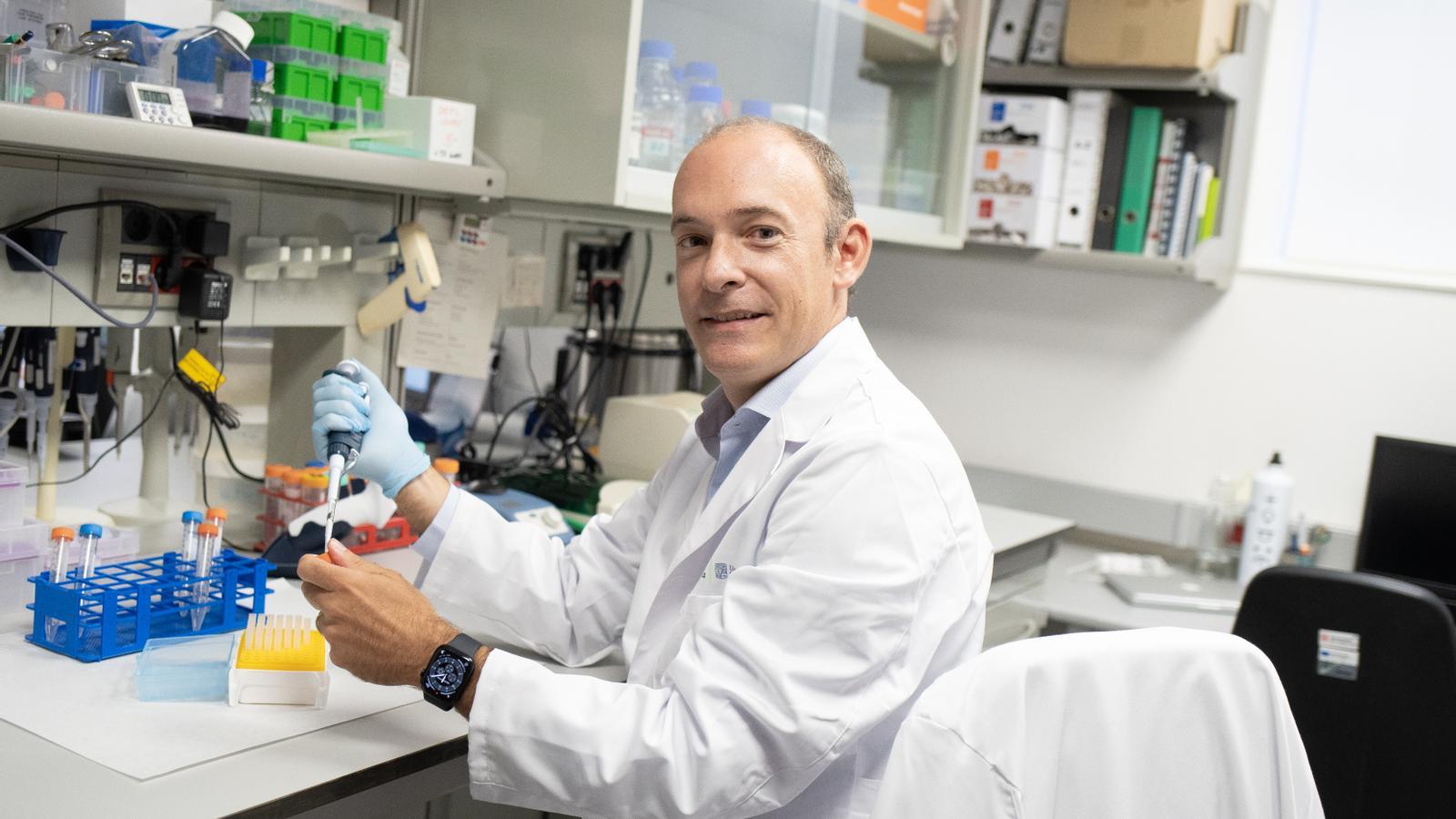
-
CAT -
CAST
Aleix Prat (Barcelona, 1979) began to discover his vocation for combining medicine and research at the age of seventeen, when he went to the United States. After studying medicine at the University of Barcelona, a stay at the Mayo Clinic in Rochester convinced him to follow this path: "I saw a doctor who visited patients, interpreted the biological data of the tumor and, at the same time, had a laboratory. I thought that was what I wanted to do." His first mentor, the oncologist Josep Baselga, guided him towards the medical oncology residency at Vall d'Hebron.
Subsequently, he spent four years researching breast cancer in North Carolina. When he returned, he resumed clinical activity and, after two years, the Hospital Clínic proposed that he direct the medical oncology service. He was 35 years old. "The hospital had the vision that oncology had to grow and made a bet on a young doctor who also did research," he recalls.
Combining both vocations has been the main challenge of his career: "You have to be a good doctor and a good scientist, and combining both things is not easy." There are few opportunities and it is a position that falls outside the usual scheme. Prat defends the role of the physician-researcher, capable of translating the needs of patients to the laboratory and turning scientific advances into better treatments. Despite being a key figure in bringing innovation closer to clinical practice, he considers that it is still poorly recognized: "The career of a researcher, pure and simple, is very tough. The salary ceiling is low and there is a lot of uncertainty." Furthermore, he laments that the health system prioritizes assistance activity over research.
In his case, however, he assures that he has felt well valued economically. "I have looked for a way to be well compensated and I have understood that the public system only goes so far." Beyond hospital work, he has given talks and training activities: "In Catalonia we are not competitive with respect to Europe, and if we had to live with three children only on a hospital salary it would not be easy." He defines himself as a thrifty person, but argues that vocation must be accompanied by adequate remuneration. In fact, his passion often makes it difficult for him to disconnect. To achieve this, he likes to dedicate time and part of his money to his hobbies: "I really like traveling with my family and it is very good for me to disconnect."
After years of developing research projects, he realized that a part of the knowledge generated did not quite transcend: "The circle did not close. We were producing science, but it did not always return to the patient." From this reflection, Reveal Genomics was born six years ago, a company of which he is a co-founder, with the goal of converting scientific advances into oncological diagnostic tools.
To dedicate himself to it, he requested a leave of absence from the hospital. "It was a brave and also risky decision, because we were entering an unknown world." He delved into areas that until then were foreign to him, from financing to legal and regulatory aspects. The reward is seeing the impact of the research on patients: "Seeing that a science that has come out of my laboratory helps patients around the world to be treated in a more precise way is an enormous satisfaction." Despite the difficulties, he assures that he would repeat the experience.
When he returned to the Hospital Clínic, three years ago, he initiated the Cancer Center, a project that integrates the hospital, research, and the university to generate synergies: "Before, we had a puzzle with the pieces disassembled." And he highlights the importance of strategy and teamwork: "If I have achieved things, it is because I have surrounded myself with extraordinary people."
His main concern is that the healthcare system does not sufficiently recognize the value of research: "Perhaps seeing patients for two days and dedicating the rest of the time to research provides more value than just providing assistance." He acknowledges that Catalonia has a powerful biomedical ecosystem, with talent and scientific capacity, but warns that funding continues to be limited and that there is a lack of culture of transfer and innovation. "It is a pity that, having the talent and the conditions, we end up incorporating innovation from China or the United States. The health system is very good. Let's not let it fall. It can be an engine of growth for the country," concludes the doctor.
