The birth of Miami-Platja

-
CAT -
CAST
In 1952, the Barcelona businessman Marcel·lí Esquius i Garcia (1896-1969) set his sights on an extensive territory on the coast of Mont-roig del Camp, a practically uninhabited area. Those lands, popularly known as the Vedat, had been the property of the Marquis of Marianao and were used as a hunting reserve. Esquius saw a business opportunity there and, at the same time, the possibility of materializing an ambitious project: creating a new population center on the seafront, with a residential and tourist vocation. Thus, the initiative that would lead to Miami-Platja was born. The chosen name evoked a model of an international coastal destination, with a name that was easy to remember and a sonority that allowed for the projection of a modern and attractive image.
The land had a previous history. At the end of the 19th century, Salvador Samà i Torrents (1861-1933), second Marquis of Marianao, had acquired several estates in the area, with a joint extension of approximately 700 hectares, which he converted into a large hunting reserve. The estate occupied an important part of the southern coast of the municipality of Mont-roig. For decades, that space maintained a rural character, with fields and unproductive land. The Samà family, Marquises of Marianao, was part of the Catalan high bourgeoisie, with a fortune made in Cuba. It was also linked to the well-known Parc Samà, located between Cambrils and Montbrió del Camp.
Marcel·lí Esquius was not a businessman unfamiliar with the real estate world. Coming from Barcelona, he had previously developed urban planning initiatives in l'Hospitalet de Llobregat, where he had participated in the transformation of several spaces and in the construction of facilities. When he discovered the coast of Mont-roig, he found a landscape that reminded him of some places on the Costa Brava and conditions that he considered favorable to promote a newly planted urbanization. The first step was to acquire all the land from the company Villamar del Infante, which at that time was the owner of the approximately 700 hectares.
The project began to take shape between 1954 and 1955, when urbanization work started. To give coherence to the whole, Esquius commissioned the urban design to the Tarragona architect Juan Zaragoza Albi (1913-2006), who worked on the layout of the streets and plots. The intervention was intended to allow for the organization of land sales and to facilitate the arrival of new owners. The national road 340, which crossed that area, became a fundamental element of the layout and future commercial activity, as it ensured communication with Tarragona, Reus, and Barcelona. The construction of the urbanization attracted families looking for work, most of them coming from Andalusia and Aragon. Among the developers and contractors who worked there were Jesús Anguiano, from Ejea de los Caballeros, and Salvador Alceda, from Zuera (Zaragoza).
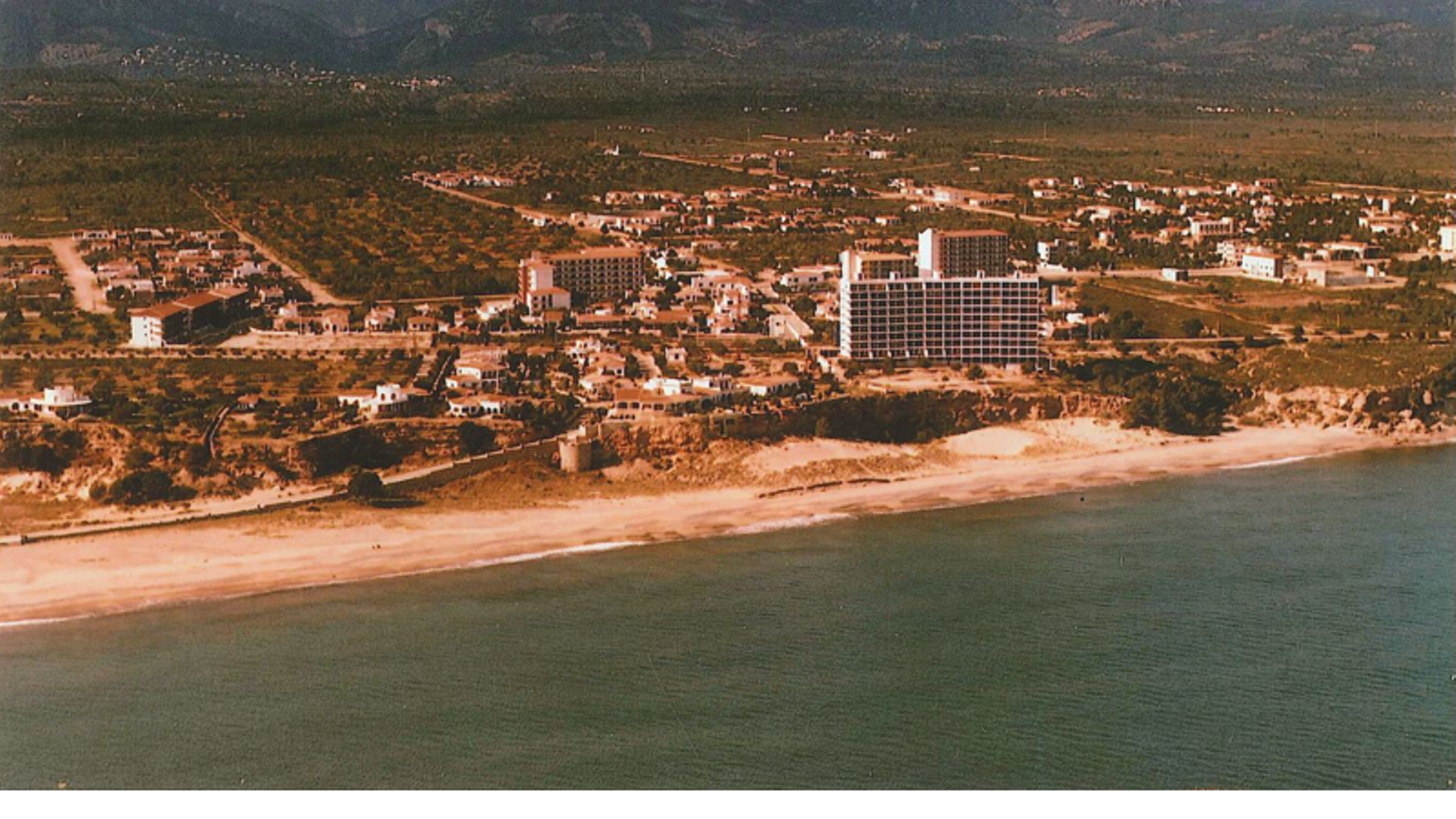
The commercialization of the plots was an essential part of the operation. Esquius did not limit himself to selling land, but intended to build a new town, with the services and facilities necessary to attract residents and vacationers. The first buildings were concentrated around the current Plaça de Tarragona. In 1956, the urbanization began to receive its first inhabitants. That year, well water was already available. The following year, the first major festivals were held, a sign of the desire to create a stable community. In 1957, the first stone of the Hotel Miami was laid, which opened its doors in 1958. Located next to the national 340 road, the establishment became a point of reference for travelers and the first visitors to the area. In 1958, the first Germans also settled there as permanent residents, creating their own neighborhood. Two years later, in 1960, electricity would arrive via generators installed on Avinguda de Saragossa.
Esquius' initiative coincided with a moment of economic and social transformation in the Spanish state. In the late fifties and during the following decade, the growth of tourism, the increase in mobility, and the progressive expansion of the middle classes favored the emergence of numerous real estate projects on the Mediterranean coast. The demand for second homes and holiday accommodation turned many coastal areas that had hitherto remained outside the major tourist circuits into economic opportunities. Miami-Platja participated in this process and attracted buyers and investors from diverse backgrounds, including French, German, and other European citizens.
Esquius wanted to provide the new center with its own facilities and services. One of the most significant actions was the construction of the church of Santa Maria Magdalena. The building, inaugurated in 1964, was donated by the businessman to the Archbishopric of Tarragona. Squares, streets, and other public spaces were also gradually configured, which contributed to consolidating the identity of the new settlement. As an anecdote, in 1960, Fleming Square was inaugurated with a bust dedicated to the discoverer of penicillin, in an event attended by Amalia Fleming, his widow. That same year, the promenade tower was built, which recreated an old watchtower.
During the first years, Miami-Platja was still a center under construction, with scattered buildings and a small population. The most intense growth would arrive during the sixties and seventies, driven by tourism development and, subsequently, by industrial and labor activity linked to the Vandellòs I nuclear power plant, inaugurated in 1972.
Marcel·lí Esquius could not see the full dimension that the project would eventually reach. He died in 1969, when Miami-Platja still had a long way to go. His initiative, however, had laid the foundations for a new coastal center that, over time, would become one of the main residential and tourist centers of the Baix Camp.
