Eleven years as a librarian of Mas d’Enric
Anabel Lambea highlights that this Catalan exception is the great difference compared to the centers in the rest of the State
-
CAT -
CAST
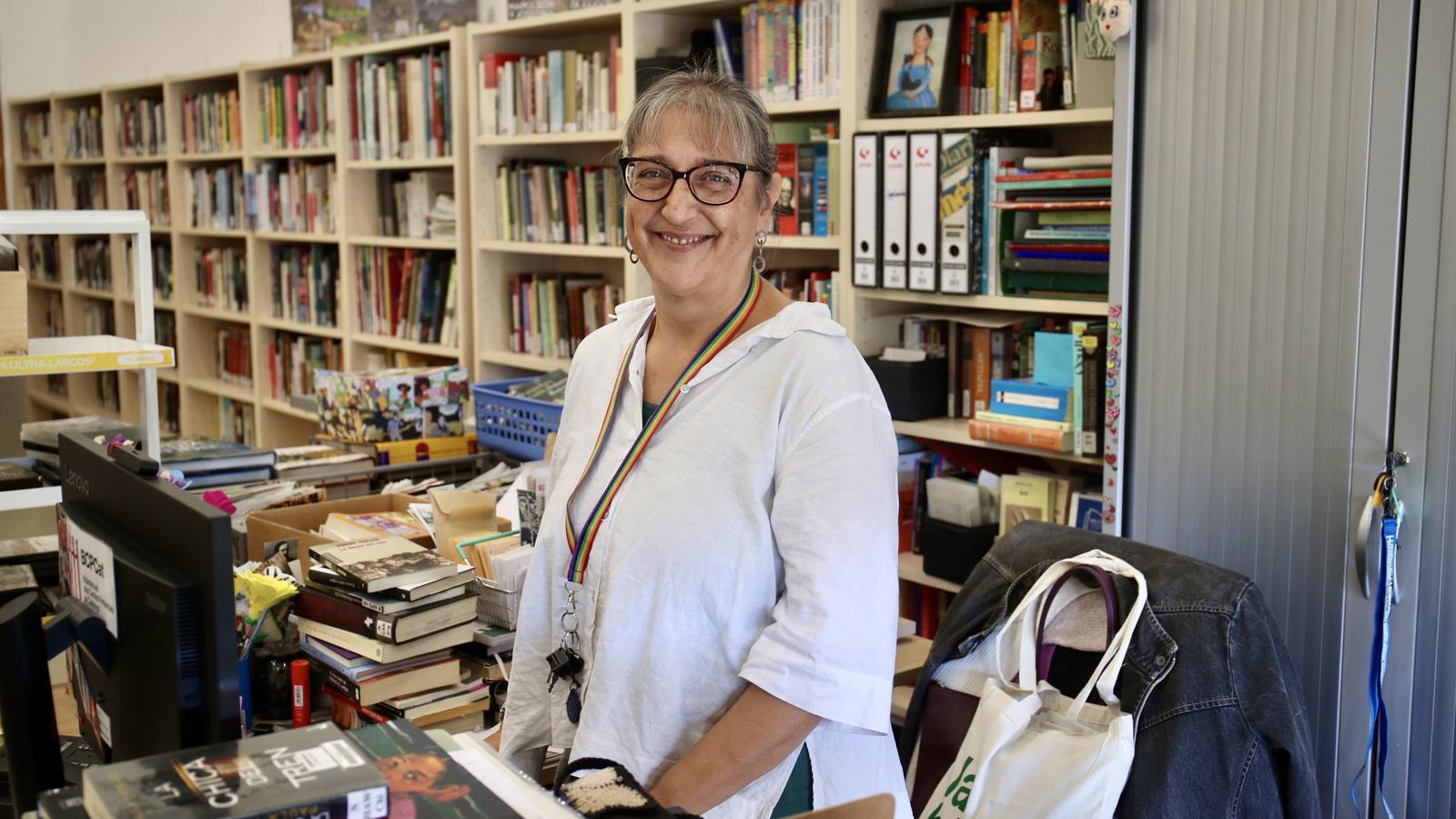
Catalonia is the only autonomous community in the State that has librarians at the head of prison libraries. It is a commitment that the Department of Justice made when the Generalitat assumed the powers over the penitentiary centers. “Putting librarians in prisons is a big difference with respect to prisons in the rest of Spain and super important, because it allows having libraries with librarian criteria. That is to say, to provide quality in the selection of materials, and not to have a warehouse of books that are the result of donations, and also quality in the services offered, and here is where the offer of activities and the book club proposal come in,” explains Anabel Lambea, librarian of Mas d’Enric.
Lambea comes from the Tarragona Public Library and won the librarian position at the old Tarragona prison in 2014, where she practically only dedicated herself to dismantling it, since the following year Mas d’Enric opened its doors, in El Catllar, and she began her work there. “At the prison in the center of Tarragona the library was very small and old and, on the other hand, at Mas d’Enric we have a large library, which already has about 20,000 volumes and smaller reading rooms in each module. There are a total of ten: seven ordinary modules, the women’s, the youth, and the infirmary,” explains the librarian.
She is proud to have a profession that only ten people practice in the State, and all of them in Catalonia. In the rest of the State, prison libraries are managed by civil servants without any specialization and who also perform other tasks. Four years ago, the libraries of the penitentiary centers were incorporated into the Public Reading System of Catalonia, dependent on the Department of Culture of the Generalitat, just as hospital or libraries for the blind are also integrated into it. Since then, the contact between prison librarians, who share experiences and problems they encounter on a day-to-day basis, has increased.
Books in very diverse languages
With their incorporation into the Public Reading System of Catalonia, penitentiary center libraries now have their own annual budget and no longer depend solely on donations from entities and individuals. “Now we no longer have to beg and can access distributors to obtain the books we believe are most appropriate,” points out Lambea. They also receive many magazines, such as Sàpiens, Descobrir or, even, Panenka.
A prison library is similar to a public one, but it has some differences, such as the presence of encyclopedias, since inmates do not have access to the internet and use them for many inquiries, or volumes in many languages, because the prisoners speak very different languages. Lambea acknowledges that she makes great efforts to acquire books in very different languages and classifies them with flags on the shelves. Catalan and Spanish are the majority, followed by English and French, but at the Mas d’Enric library, we can find books in languages as different as Albanian, Bulgarian, Georgian, Arabic, Wolof, or Urdu. “If there is one thing in prison, it is time, and there are inmates who read a lot. There are some who do not have the habit, but here they acquire it. Those who read the most are those who come from Eastern Europe,” explains Lambea.
The book loan system is similar to that of a public library, and they do it using the identification number that each prisoner has. They can take the book for twenty days, which can be extended.
