Reading, the best antidote against routine in prison
The reading club of the Mas d’Enric Penitentiary Center has allowed inmates to analyze and debate books of different genres for three years

-
CAT -
CAST
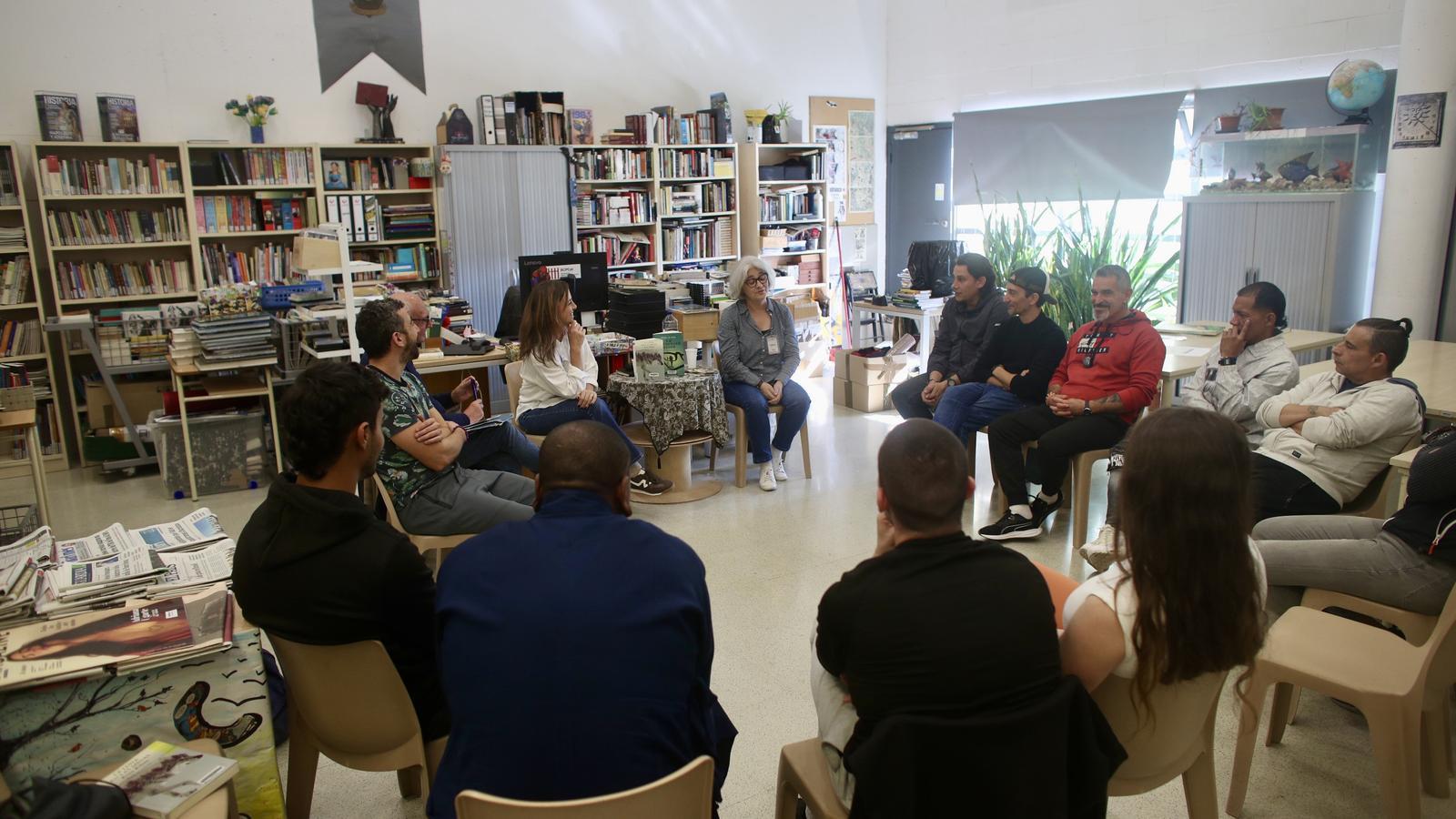
El CatllarWhile the coordinator of the reading club at the Mas d’Enric Penitentiary Center, Raquel Gámez-Serrano, finishes preparing the session with writer Rosa Ribas, the inmates enter the prison library and take a seat in one of the chairs arranged in a circle. They are of different ages and races. There is only one young woman, who comes from the women's module and is the partner of one of the other participants. A couple of them arrive very well prepared for the session, with papers under their arms. They are Pepe and Carlos.
When everyone is seated, the session begins with a brief presentation of the activity by the librarian of Mas d’Enric, Anabel Lambea, who gives way to the reading club coordinator, the Creixell writer Raquel Gámez-Serrano. She recalls that in recent weeks the participants have been able to read two books by the guest writer, Rosa Ribas: La detective miope and La luna en las minas.
The first question from one of the inmates to Ribas is whether she had been to a prison before. The affirmative answer surprises some of those present. The writer explains that she lived in Germany for thirty years and that she visited the Frankfurt women's prison to participate in an activity where the inmates met other women who worked in very different professions to learn about life models and what routines they had, since most of the prisoners came from very dysfunctional families and had not acquired any. “It was a very intense experience,” Ribas acknowledges, and Lambea confesses out loud that she really likes the idea. Perhaps it will soon be a new activity at Mas d’Enric.
The conversation continues with questions from the inmates to the writer. They ask her if the crime novel better explains the problems of society, or which character she feels most comfortable with as a narrator: a policewoman, a journalist, or a detective.
“Taking them out of their comfort zone”
The Mas d'Enric prison reading club began three years ago, as a second step beyond the reading and lending service of the penitentiary center's library, when the librarian, Anabel Lambea, detected that there were inmates who were avid readers. “It was also a way to take them out of their comfort zone, to make them discover new genres, do more activities, complement it with movies, documentaries, meetings with authors...”, recalls the librarian.
At first, it was a reading club in which each inmate connected from a computer with the activity coordinator, then Òscar Carreño, and there was an in-person session. In 2025, Carreño moved on to coordinate the reading club at Can Brians and was replaced by Raquel Gámez-Serrano, who was already in charge of the activity in the youth module at Quatre Camins. They changed the method and started doing two in-person sessions, one at the beginning and one at the end, and in between a video call all together with a single screen and some exercises related to the work. When possible, the author of the book participates in the last in-person session, as was the case with Rosa Ribas this October. Previously, Anna Maria Villalonga, who also coordinates the reading club at Lledoners prison, had come. “They love it when people from the outside come. It breaks their routine and they appreciate it a lot”, explains Lambea.
Currently at Mas d'Enric, two reading clubs are held, one for novels and one for graphic novels, with an average of between twelve and fifteen participants in each session. Some repeat. And every month a book is worked on, with very varied themes. The last graphic novel they have worked on has been Chess Story, by Stefan Zweig, and this November they will finish the novels with the Mexican writer Juan Rulfo.
“I read seven books a month”
One of the most active participants in the Mas d’Enric prison reading club is Carlos. He not only arrived loaded with papers containing conclusions from the reading of both books and questions for the author, but he also gives his fellow inmates a bookmark he prepares in the workshop for each book, and asks Ribas to sign them. “In prison, we have a lot of time and I like to read. That’s why I signed up for the reading club, and I’ve also looked for more people who want to participate,” he explains, admitting that he reads an average of seven books a month. He likes long books and cites authors such as Dolores Redondo, Carmen Mola, and Santiago Posteguillo. He explains that the latter is very popular among the inmates at Mas d’Enric, and he acknowledges that he is very attracted to Roman culture. In the women’s unit, Nordic crime fiction authors are the most successful.
Carlos comments that Anabel motivates them to read other genres that go beyond crime fiction, and he recalls that one of the books that has impacted him the most is Seda, by Alessandro Baricco. On the library wall, we find a corkboard with illustrations prepared by the reading club participants, inspired by this work. He believes that the management should promote activities like the reading club because it motivates the inmates in a daily life marked by routine and allows them to find people to talk to about what they are reading.
Pepe is the oldest member of the reading club and one of the most participatory. He talks periodically about the activity on the prison podcast, Ràdio-escena, and also writes book reviews for the magazine Resiliencia, in which prisoners from all over the country participate. “Reading and writing is a way to be free in prison,” he reflects. A pharmacist by profession, he is now studying for a communications degree at the Open University of Catalonia. He agrees with Carlos that the reading club helps him combat the routine to which prison subjects them. He comments that the Mas d’Enric prison reading club group is very diverse in terms of race, age, religion, and culture, and therefore, Spanish ends up being the vehicular language. “Little Catalan is spoken,” acknowledges Pepe.
