Elena Moya: "The world still has to see what it would be like if women were in power"
Journalist and author of 'Girls, let's talk about money'
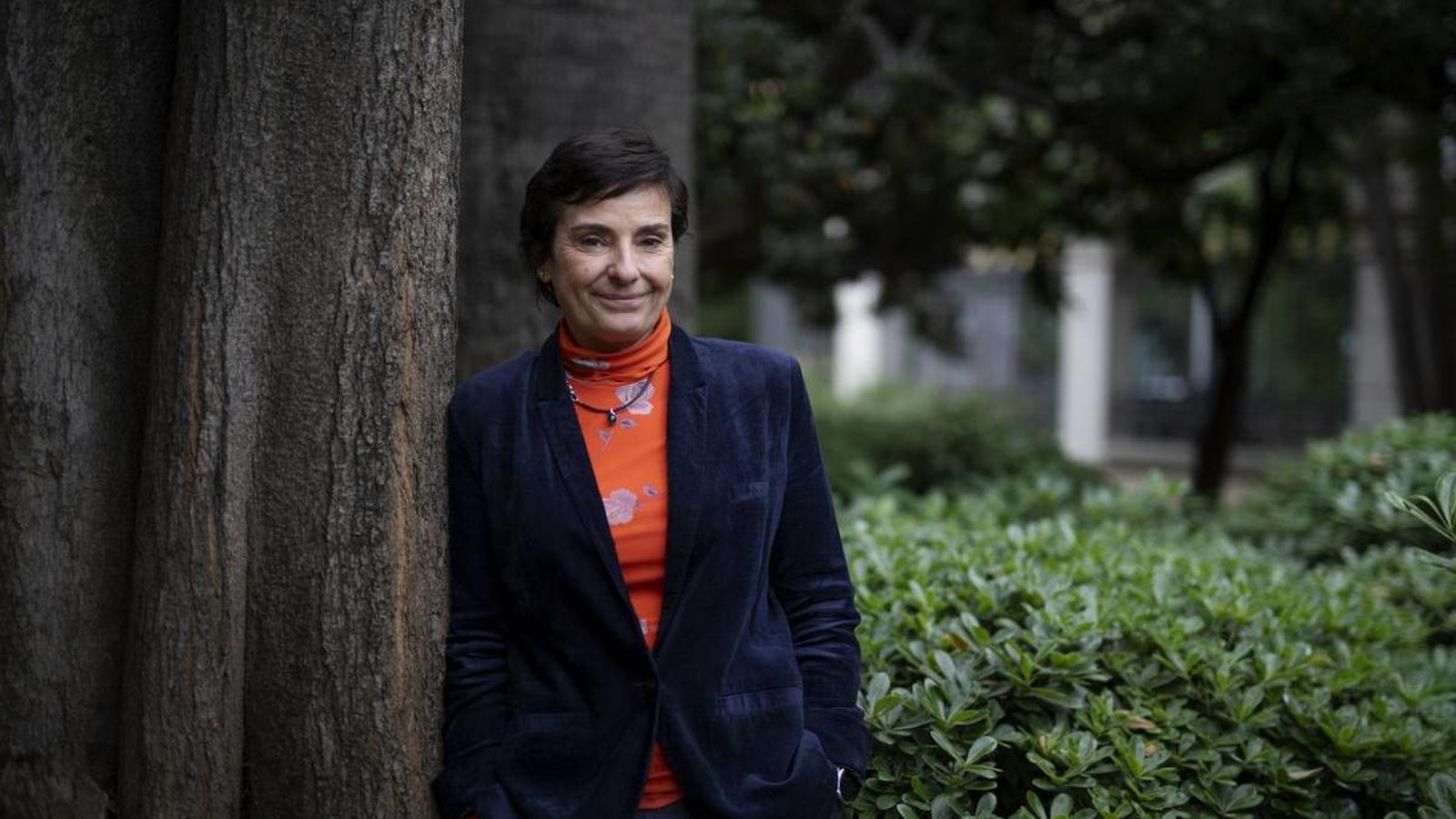
BarcelonaElena Moya (Tarragona, 1970) is a journalist and for more than thirty years she has followed the financial markets, first as an information professional in Spain, the United States, and England, and then as an investment professional in fund managers. She has just published Chicas, hablemos de dinero (Larousse), a book in which she considers why many women save but do not invest and how this impacts their personal freedom. The journalist, who currently resides in Ireland, is passionate about football, has written four novels, and is the driving force behind the Morella International Literary Festival.
Your book is specifically aimed at women. How do women relate to money?
— I think we relate to it wonderfully. Women have their accounts crystal clear, I don't know if due to a tradition of domestic economy. They have a great capacity to stretch money: they can live on a budget of 1,000 and 10,000. They have a great capacity for calculation, but what happens is that it's on a micro level. We think small, in domestic economy. We are very good in the domestic sphere, but we lack the step of investment, of acquiring more money and capital. And I don't say this to get rich, I say it to have personal independence. For example, to get divorced, if you want. There are people who don't move out of the house simply because they can't. In other words, if you want, you take the children, you leave, and you buy an apartment. Or leave a job you don't like. Or reinvent yourself. For all of this, you will need capital. No one wants to be the richest person in the cemetery, I'm talking about a capitalist mentality with a goal of personal fulfillment and growth. There are many people who are enslaved by a job until they retire. That is not living. For example, I dream of stopping working and dedicating myself to writing books, but for that I will need capital.
Does the relationship of women with money change depending on the countries?
— In the United Kingdom they have a much more capitalist mentality than ours. But here comes the role of religion, of the Catholic mentality that tells us that "it is easier for a camel to go through the eye of a needle than for a rich man to enter the Kingdom of God". It is a way of controlling people. That is to say, the Catholic Church can accumulate all the capital it wants, but the faithful cannot. Of course, if you want to control women, don't educate them and make them poor. There is nothing like an uneducated and poor person to keep them under control. There is nothing wrong with having money: people with money are fantastic, they pay taxes. With a country of low-wage earners, the country does not move forward. Schools must be built, people who cannot help themselves must be protected, social projects must be undertaken. We need people with high salaries who pay these taxes in order to have services.
In the end, there is a problem of sexism when we talk about women and money.
— Exactly. There are many Harvard studies that have the same case study that changes opinion depending on whether the subject is a man or a woman. If it's a man, the group that followed that case study said things like "entrepreneurial, brave, thinks independently, leader". If it's a woman, it's "selfish, thinks she's the center of the world". This has been studied extensively. Now Barça and women's football have taught us that it's great to be a woman, score a goal, and raise your fist. Before, if a woman did that, they called her a tomboy. Mary Beard, the classicist from Cambridge, has a book that explains that men have an intrinsic view of power, they believe it belongs to them, while women have a more instrumentalized power, they use the power they have to do something specific. Regarding finances, I have a similar view: we work towards goals. That is, I want to achieve something specific, and I have to accumulate money to achieve it.
You have followed financial information for thirty years and worked in investment. Have you encountered a gender bias?
— Absolutely, I work in a sexist and classist world. It's tough. What happens to many women happens to me, you talk and it seems like you're talking to a wall. In the financial world, the way investment is made is absolutely masculine.
Do women have a different way of investing?
— We are making a generalization, but yes. Christine Lagarde, the president of the European Central Bank, said that if Lehman Brothers had been Lehman Sisters, perhaps we would not have had a crisis. Also, sometimes, women could take more risks, which would do us good, and we should learn it from men.
Do women have more fear when investing?
— What we lack is the ability to say "you can". As Gandhi said, "we live within circles and we draw the limits ourselves". Investing is not complicated, it is not difficult. Financial markets are reflections of the economy. There are many men who have made them very complicated with the goal of earning more commissions.
Are we still afraid to go to the bank and be deceived?
— Yes, because we have had cases like those of the preferred shares. But everything is simpler. As I said, financial markets are a reflection of the economy, and the economy is a reflection of people's lives. We sleep eight hours out of twenty-four, that is, a third. Financial markets are in recession a third of the time. Markets are much more human than we think, and stock market reactions are as overreacted as ours. In Catalonia, we have a lot of this "seny" (common sense) and "rauxa" (passion/impulse) and, sometimes, we go too far with common sense and, sometimes, with passion. Well, financial markets operate by common sense and by passion. The Strait of Hormuz is closed and the stock market plunges five percent in March. There is a peace agreement in April and it rises. Neither in March was it so bad nor in April was it so good. This happens to all of us: there are days when you go out feeling like you can conquer the world and there are days when you go out and think you'd have been better off staying home.
After so many years in the industry, do you see a change in the new generations of women?
— I see them more open, more with the idea of "I deserve it all". My mother, for example, says: "But if you already have a job and you already have a house, why do you want more?". That, for me, is ignorance. This generation doesn't know that at my age, I'm 55 years old, the pension doesn't reach us. Pensions in Spain receive an average of 80% of the salary, which is double what is paid in Europe. The pension model in Spain is an unsustainable model. It's not enough to have a job and a house. People who have pensions that we have to collect in five or ten years and want to enjoy our last years have to start getting our act together, because if not, we'll have it tough. I see young people much more open-minded. I am a lesbian and when I was young you had to go around Barcelona knocking on a door and have someone behind the peephole let you in. Now a niece of mine who goes to a convent school told me that half of the girls had already tried it with men and women. They have no borders: neither in relationships nor playing football, nor investing.
You compare finances a lot with football.
— I am an active footballer, I haven't hung up my boots yet, I won't do it until my legs fall off. I believe that sport is a great life lesson. For me it has taught me not to lose: out of morality and principles, don't give up (you don't give up). You have to play with everything you have until the last minute for personal dignity. It is the same principle that you follow when you do your job to earn money but also for professional dignity. Journalists do not tell lies, they have professional ethics and sport is the same.
In women's football it is common for female players to come out of the closet, but this does not happen in men's.
— And more things! And some female footballers have said "I'm not going to the World Cup in Qatar because I'm against it". I'd love to see that in men's football. There are people who say they don't have as much to lose because they earn less. The world still has to see what the world would be like if women were in power. The world is controlled by technology, by energy, by banking, by central banks and by some governments. You put the photo of Apple, Google, Amazon, Tesla, the central banks of Japan, the United States, and it will be a visibly male photo. I celebrate that there are women in Pimec and the Generalitat, and at the head of newspapers too, even though newspapers have less power now. I once read a book and it said that many times, in certain countries, you look where the women are and you know where the power is. They mentioned a developing country whose parliament was predominantly female. That already tells you where the power isn't.
