The utopian city of India that lives a profound crisis
For almost sixty years, the international community of Auroville has tried to demonstrate that another way of living is possible. Now, its inhabitants fear for the survival of the dream
-
CAT -
CAST
1958, Genoa. A young German, Frederick Schultze Bookslow, is at the port waiting for a cargo ship to go far away, to India. He is twenty years old, has read Herman Hesse, and is eager to live and discover a different world. His partner doesn't want him to go, says she loves him, but then the ship takes a long time to arrive, she gets tired and returns to Germany. Frederick, on the other hand, waits and leaves, determined, on a long journey to Bombay.
He explores southern India and later arrives in Pondicherry. There he hears about the mystic philosopher Sri Aurobindo, famous for his concept of "integral yoga," an idea of yoga that encompasses every moment of life, lived as a state of higher consciousness that unites spirit and matter. While visiting the sage's ashram, one day, under the famous balcony of the spiritual community, he meets for the first time "the Mother," Mirra Alfassa, Aurobindo's spiritual companion.
“From the first moment I felt that his words penetrated within me,” Frederick will explain. “He was a strong man, a playboy, convinced he feared nothing. When he looked into my eyes, however, I melted. My knees began to buckle. Suddenly my masks, my fears, and my illusions fell away. I knelt. I put my head on the ground. I had perceived his power, his energy,” he still recalls emotionally, “and I had understood that I wanted to serve her”.

Ten years later, on February 28, 1968, in front of five thousand people from 124 countries and all the states of India, Frederick will witness the birth of Mother's most ambitious project: Auroville. In a symbolic urn, all those present pour soil from their respective countries of origin. According to Mother: “Auroville belongs to no one in particular. It belongs to all humanity. It will be the place of endless education, of constant progress. It will be a bridge between the past and the future, a place for material and spiritual research for the living embodiment of a true human unity”.
Building a dream
“The early days were very hard,” recalls Frederick, now eighty-six years old. “We settled in the middle of nowhere, in the area now called Revelation. Caravans of hippies and idealistic young Europeans arrived, often, unfortunately, without real professional skills. We were aware of working on something unique and we had fire inside us, a fire I don't see in young people today. Back then we knew who the enemy was. Today young people carry it inside.”
A utopia without political borders, creeds or ideologies, beyond religions, races and hierarchies: a place to realize many of the dreams that circulated among the youth of '68. The first house in Auroville was precisely built by Frederick. Today his son lives there with his partner. It is a beautiful building, surrounded by trees and flowers. This is how Auroville developed: with the resources of its residents and thanks to private donations from those who sympathized with it. No aurovilian owns the properties, not even when they have built them personally: each person performs a function within the community and receives in return an essential contribution, enough to sustain a simple lifestyle.
“Here the house is yours, but at the same time it is not yours. It’s a bit like in a relationship,” smiles Frederick. “You are with someone you feel is yours and, nevertheless, they are not. Here too, nothing belongs to you, because everything is impermanent”.

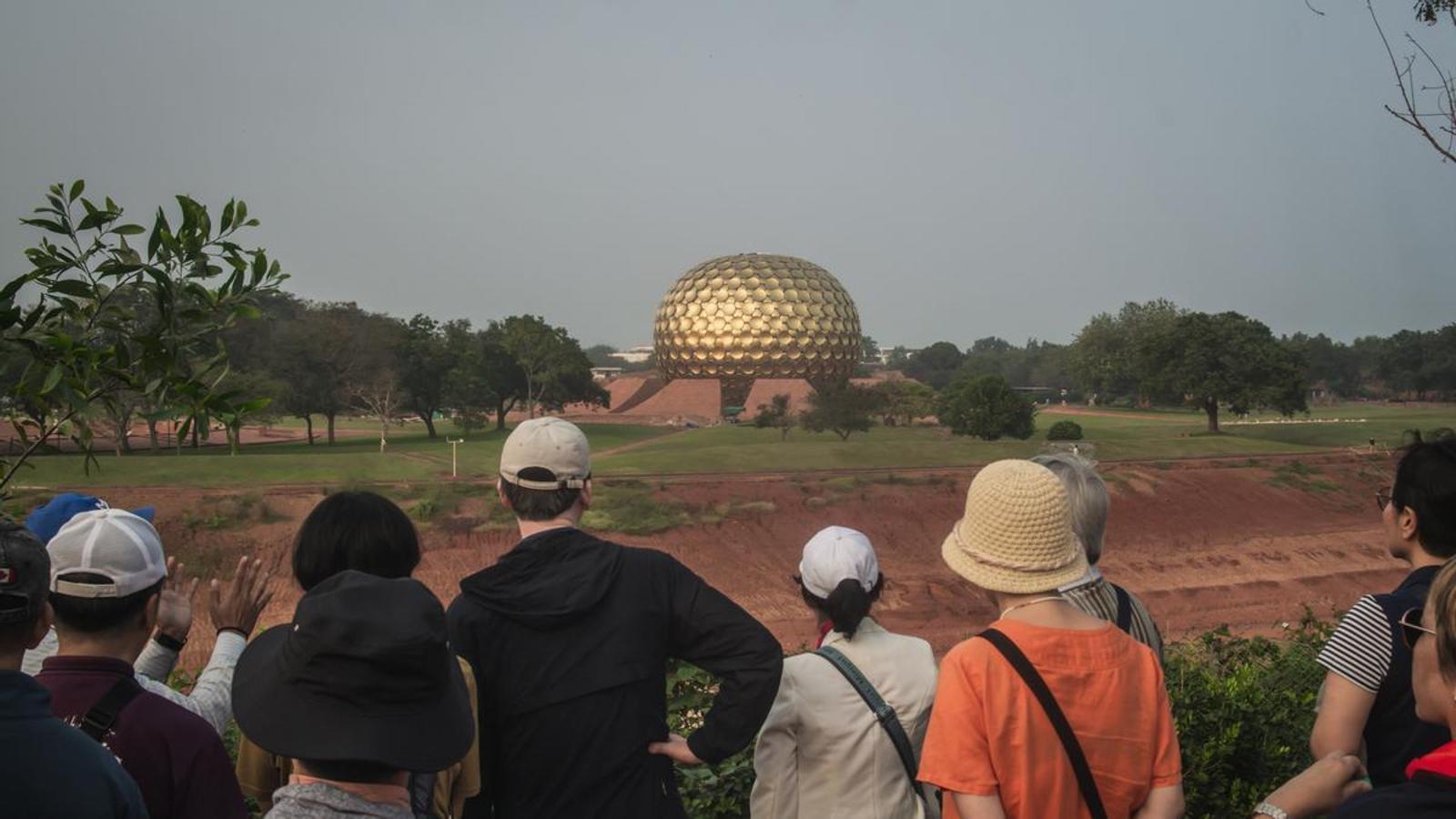
Thanks to donations, the Matrimandir was also built, a kind of central temple of Auroville: a large golden sphere about 36 meters in diameter, covered with more than 1,400 discs that reflect sunlight. Built in several phases starting in 1971, it is surrounded by twelve symbolic gardens dedicated to values such as peace, harmony, and light. Every day groups of visitors sign up for guided tours that lead to the inner chamber, a bare meditation room, with marble walls and a large optical crystal sphere crossed by a ray of light that enters from above through a system of mirrors. A silent meditation of about twenty minutes is proposed there. These visits are the only way to access the interior of the Matrimandir.
A paradise made of forest
The choice of the site for this “golden sun” came in a dream to the Mère, who had seen that it was to arise under a banyan tree, a large sacred ficus. For a time, explorations and photographs of the trees in this area were carried out, until one of them coincided with the Mother's dream. Around this tree, the French architect Roger Anger drew up the urban plan of Auroville, which follows a galaxy shape with concentric circles: in the center the Matrimandir; around it, the residential, cultural, industrial, and international zones. Further out extends the green belt, a large forest planted by the inhabitants in the early seventies, which has transformed an arid territory into a lush ecosystem.
“This is truly our story,” explains Natasha, founder of the Evergreen forest. “To transform a sterile land into a living forest. In the beginning, we planted a thousand trees a day. Water was scarce; we built rainwater collection tanks, earth dams, and aquifer recharge systems. Seeing the water return to the wells was like witnessing a healing process. We live with the forest, not separate from it. We have grown alongside these trees for decades. The forest teaches us cooperation, something that is often lacking in human society.”
According to the first masterplan (1968), Auroville was to achieve “a maximum population of 50,000 citizens”, a number directly set by the founder Mirra Alfassa as the optimal size for a “human” and not megalopolitan urban community. Over time, however, it has developed mainly as a large inhabited forest that today has about 3,500 residents. “This vegetation has become our great school and part of our spiritual journey,” comments Natasha.
The end of the utopia
The spiritual peace of the community was interrupted, however, one morning in December 2021, when, without prior notice, bulldozers tore down protected forest areas to begin the construction of the new radial road that would have allowed the city to expand. “I stood in front of the bulldozers asking that the assembly’s decision-making process be respected,” relates Natasha, “which had clearly been circumvented.” The demolitions continued in the following days, sparking protests from the local community. For the first time in more than fifty years, a decision of vital importance had been imposed from above. Some months earlier, public official Jayanti Ravi had been appointed secretary of the Governing Board of the Auroville Foundation and everything was about to change.
“They are destroying everything without respect for the territory or the commitments made,” states Arun, a veteran ex-serviceman from Kashmir, on the front line of the complaints. “The machines are becoming instruments to silence a collective voice.”
In the offices of the Auroville Foundation, no one dares to say anything. "We don't have the right to talk about these issues," a European official whispers to me, frightened by my questions.
"There is a fascist state here," he continues, accompanying me to the door. "It's like Mussolini's Italy. If we dare to say anything against the foundation, we'll disappear in less than two weeks." A few dozen meters away, a woman from the residence service pretends not to feel uncomfortable with my questions. "We don't know what to say. We are not the right people," she dismisses me with a strained smile. Leafing through the community's monthly newspaper, some members of Auroville call for the pacification of disputes, an end to polarization, and acceptance of these urban expansion projects that would respond to the will of the Mère.
"Part of the community has aligned itself with the new secretary to gain advantages," explain the members of the working committee, the decision-making body representing the residents, which is increasingly marginalized today. They denounce controls and surveillance over internal communications and a progressive centralization of power. "They want to place their people to control everything," they say. "According to the Auroville Foundation Act, the members of the governing board should meet certain criteria – such as having rendered significant service to Auroville – criteria that most of the current members do not meet".
An uncertain future
According to the committee, there would also be a strong political dimension behind the transformations: Narendra Modi often cites Sri Aurobindo for his role in the Indian independence movement, but ignoring his subsequent spiritual evolution and reinterpreting his teachings in a nationalist key adaptable to the hindutva ideology. "Auroville will not be an ashram," the Mother had clearly said at the time of its foundation. And yet, the current changes evoke practices of commodification of spirituality underway in some of the main Hindu sacred cities.
International residents who have raised critical voices run the risk of not having their visa renewed. Normally, Aurovilians need a letter of recommendation from the foundation's secretariat to obtain it. The secretariat can use this power as an instrument of pressure, delaying or blocking procedures until the residence permits expire. Some foreign residents, once they have left India, have not been admitted again precisely because of this visa issue.
Frederick himself remained in uncertainty for a long time. For months he was without a visa and only recently managed to obtain a renewal. Despite everything, he still seems surprisingly serene. “Some bad things have happened here, really. And in the end, it is precisely these that amplify evolution,” he explains. “Every crisis can be useful. We have learned not to own anything. To know the highest form of love, which is not possession but unity. Here I have learned to let go of everything.” With great calm, a slight irony and a certain distance, he continues: “Today I see Auroville differently. Just like the greatest and most evolved ancient societies, like the Tibetan ones, perhaps we too are destined for diaspora, to carry the wisdom accumulated in these fifty-eight years around the world. Young people are already doing it: they are bringing this spirit to other places”.

