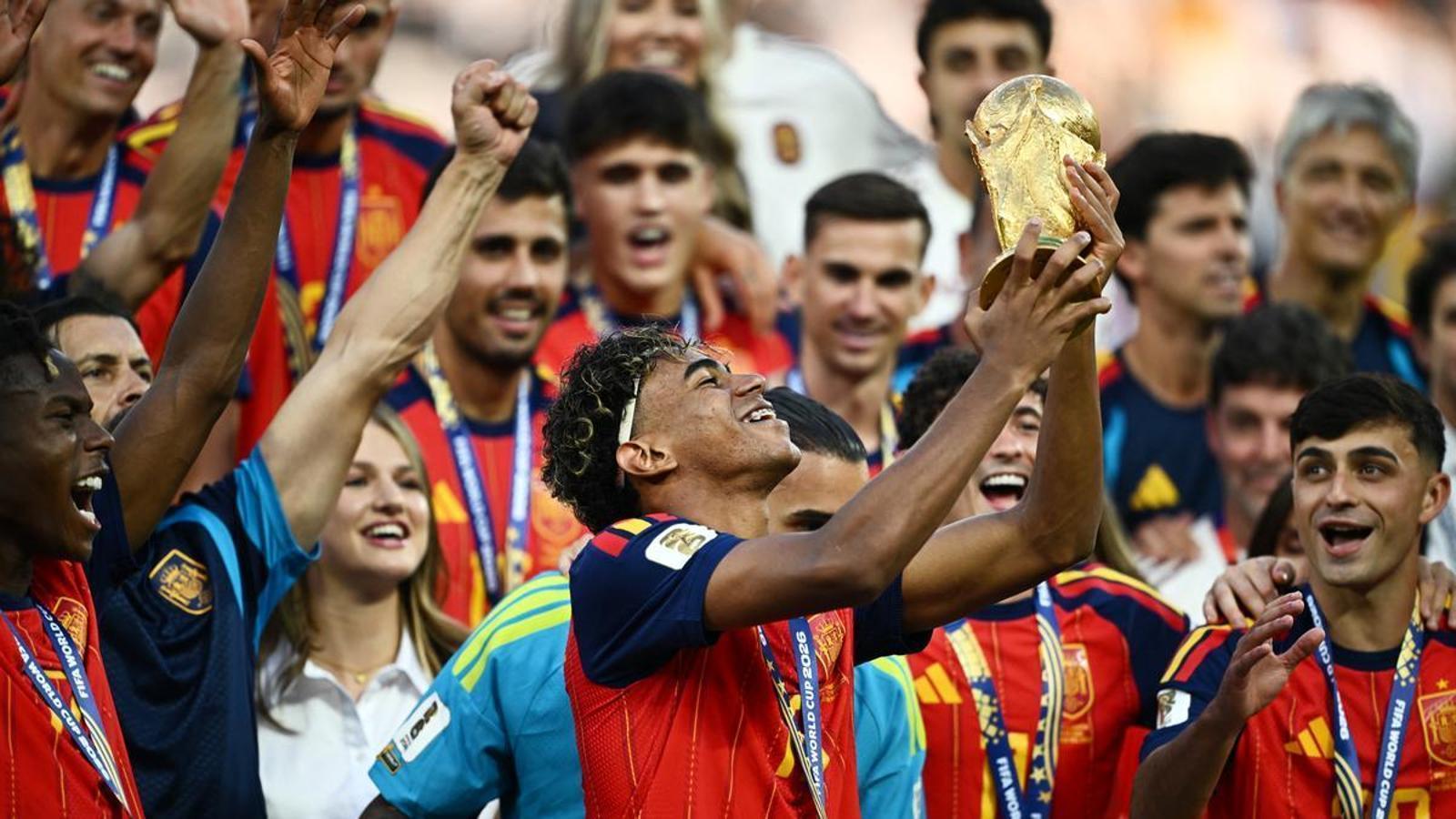
Spain wins the World Cup and begins the Lamine Yamal era
A goal by Ferran Torres in the second half of extra time ends the resistance of a very defensive Argentina (1-0)

-
CAT -
CAST
BarcelonaA new era has begun in world football. Spain sewed the second star as world champion onto their jersey after defeating an Argentina in extra time, who had run out of miracles in the semifinals. The final of a strange and exciting World Cup was always played according to what Spain wanted, turning everything around the ball, attacking with ambition. Glory is theirs after a final in which Messi, very disconnected from the game, ceded the crown to Lamine Yamal. An era ends and a new one begins, personified in the young man from Rocafonda. One man alone cannot win World Cups, but a team can. And Luis de la Fuente's team, a coach until recently unknown, is a block that defends a style. An idea in which the collective rules, even though a lack of accuracy prolonged the agony until extra time. A final decided thanks to an unexpected hero, the Valencian Ferran Torres, who caught a ball inside the area. If in 2010 Spain won their first World Cup with a goal from Iniesta in the 116th minute, on this occasion the goal arrived in the 106th thanks, once again, to a Barça player.
It was a match with the same rules, field dimensions, and duration as others, but at the same time, everything was different. It was a date with immortality. World Cup finals are etched into the memories of millions, both those who watch them from pitchside seats for which they paid a million dollars and those who watch them with a poor signal that cuts out in a hut in the middle of a desert. Few events unite so many people and generate so much interest. The poor and the rich alike, like a Donald Trump who, hidden in a private box, played with the trophy as if it were a toy, under the watchful eye of his friend Gianni Infantino, who had a stadium full of Hollywood stars at his feet, influencers and fans who can afford millions.
The business belongs to them, but the ball is in Spain. No surprise in the staging. Years ago, state football began to sideline warlike rhetoric and individualistic players, and it built a personality following the tenets taught at La Masia: the ball always at their feet, passing it a lot, and attacking. Argentina knew this, so Lionel Scaloni slightly adjusted his initial lineup to be able to entrench themselves well, with players capable of cutting passing lines and hindering the Spanish game. A clearly defined clash of styles: Spain more choral and offensive. And the Argentinians with a more epic and physical narrative. Two states where football is more than a sport. It is part of their identity, their way of being. Not like in the United States, which is why the hosts' contribution was a weak prelude, concerts that didn't add much, and a halftime show to imitate a Super Bowl where Madonna appeared with Ronaldinho and Ronaldo. A show ideal for those who don't like football that extended the halftime more than it should have.
More Lamine than Messi
Top-level football, fortunately, is not yet played as businessmen locked in a New York office would like. A final played in one direction, as expected. The direction in which Lamine Yamal ran towards glory, who, having just turned 19, would have the first clear chance of the match, with a shot that Dibu Martínez struggled to save three minutes into the game. Eyes followed this boy from Rocafonda, and also Lionel Messi. A young man and a veteran, two geniuses with humble roots, capable of deciding matches. The man who has won it all and who wants to follow in his footsteps to reign in world football. The past against the future, facing each other in a present with a Blaugrana touch. The final was the perfect staging of the changing of the guard.
Messi, the first player to be a starter in three World Cup finals, appeared sporadically. Always watched by red shirts. The genius from Rosario guided a group of lively, sharp players, capable of bothering anyone. Spain started plugged in, but little by little it began to fade, despite the grit of Dani Olmo and the leadership of Rodri, rightly chosen as the best player of the World Cup, who sought to link up with a brave Lamine Yamal. The man from Mataró is not one to hide on the day they play the most important match, the one that so many famous footballers have never reached. Spain managed to close down Argentina, but was repelled time and time again. Scaloni's team received them in a well-ordered manner. But if they recovered the ball, they didn't find Messi, who was too far away, on a pitch that was too dry, which also didn't help to move the ball as Spain likes. At halftime, Spain had scraped together some chances. Argentina, which had lost Lisandro Martínez through injury, hadn't even that.
Scaloni seemed to take a step forward at halftime by bringing on Paredes, but the Boca Juniors player was quickly shown a yellow card. For a few minutes it seemed that Argentina would try to keep possession more, but after the strange halftime show, the game returned to its natural state: the ball at the feet of the Spanish, with flashes from Lamine Yamal. But as it continued to be a frustrating dominance, De la Fuente was brave and brought Pedri and Ferran onto the field. He wanted more possession, more circulation speed. He wanted the first goal against an Argentina that was losing its second center-back, Romero, also due to discomfort. But the albiceleste kept resisting, enduring the blows. Looking for a way to break down their wall, De la Fuente would recover the formula that worked for him at the Euros two years ago, and brought on Nico Williams and Merino, to have two pure wingers.
The final was turning into a siege on the goal of a Dibu Martínez who was being kept busy. Even Cubarsí would try with a long shot, in the hope of being the hero and avoiding extra time, which the Argentinians wanted to reach at all costs. And they would reach it, but very shaken by the red card for an Enzo Fernández who was very agitated in the last minute of the match. The wind was blowing in favor of the Spanish, who kept shooting again and again, without luck. Dibu was saving them all. And when one escaped him that Nico Williams turned into a goal, there had been a very questionable foul by Merino beforehand.
But Argentina could not escape its destiny. It was only a matter of time before the goal arrived, and it would be scored by Ferran, a cursed striker, who seemed to have no aim, by heading home a ball recovered by Nico Williams. The glorious era of Lionel Messi was ending as Argentina, wounded, would try to equalize without luck in the only moments it seemed dangerous. And a new era begins, that of a football cooked in Barcelona. The one represented by youngsters like Lamine or Pau Cubarsí, who has played an incredible World Cup. A boy from Estanyol, calm, without fuss, has been the best young player of the tournament. Players who will always remember that day in New York when Ferran Torres scored a goal that opens the doors to eternity.
- Spain: Unai Simón; Porro, Cubarsí, Laporte (Zubimendi, 98'), Cucurella; Fabián (Pedri, 61'), Rodri (Eric Garcia, 98'); Lamine Yamal, Dani Olmo (Mikel Merino, 74'), Baena (Nico Williams, 74'); and Oyarzabal (Ferran Torres, 61'). Coach: Luis De La Fuente.Argentina: Dibu, Gonzalo Montiel (Nahuel Molina, 57'); Cuti Romero (Medina, 69'), Lisandro Martínez (Otamendi, 43'), Tagliafico; De Paul (Giuliano Simeone, 69'), Mac Allister, Enzo Fernández, Nico González (Paredes, 46'); Messi and Julián Álvarez (Senesi, 102'). Coach: Lionel Scaloni.Goals: 1-0 Ferran Torres (106').Referee: Slavko Vincic (Slovenia) and Bastian Dankert (Germany) at VAR.Yellow cards: Lisandro Martínez (40'), Paredes (51'), Enzo Fernández (82' and 94'), Scaloni (1024) and MacAllister (111').Red cards: Enzo Fernández (94')Stadium: MetLife Stadium in New York, 82,500 spectators.
