Why did the ambulance not enter the Tenerife field?
The operation and design of a football pitch can save lives
-
CAT -
CAST
Doha"A 30-year-old boy cannot die playing football". This was stated by Faustino Afonso, one of the CD Tenerife doctors, after the death of Jesús de Miguel. The striker collided with the Andorra goalkeeper in a dispute for the ball during the final minutes of the match at the Heliodoro, suffered a cardiorespiratory arrest and died the following day at the hospital.
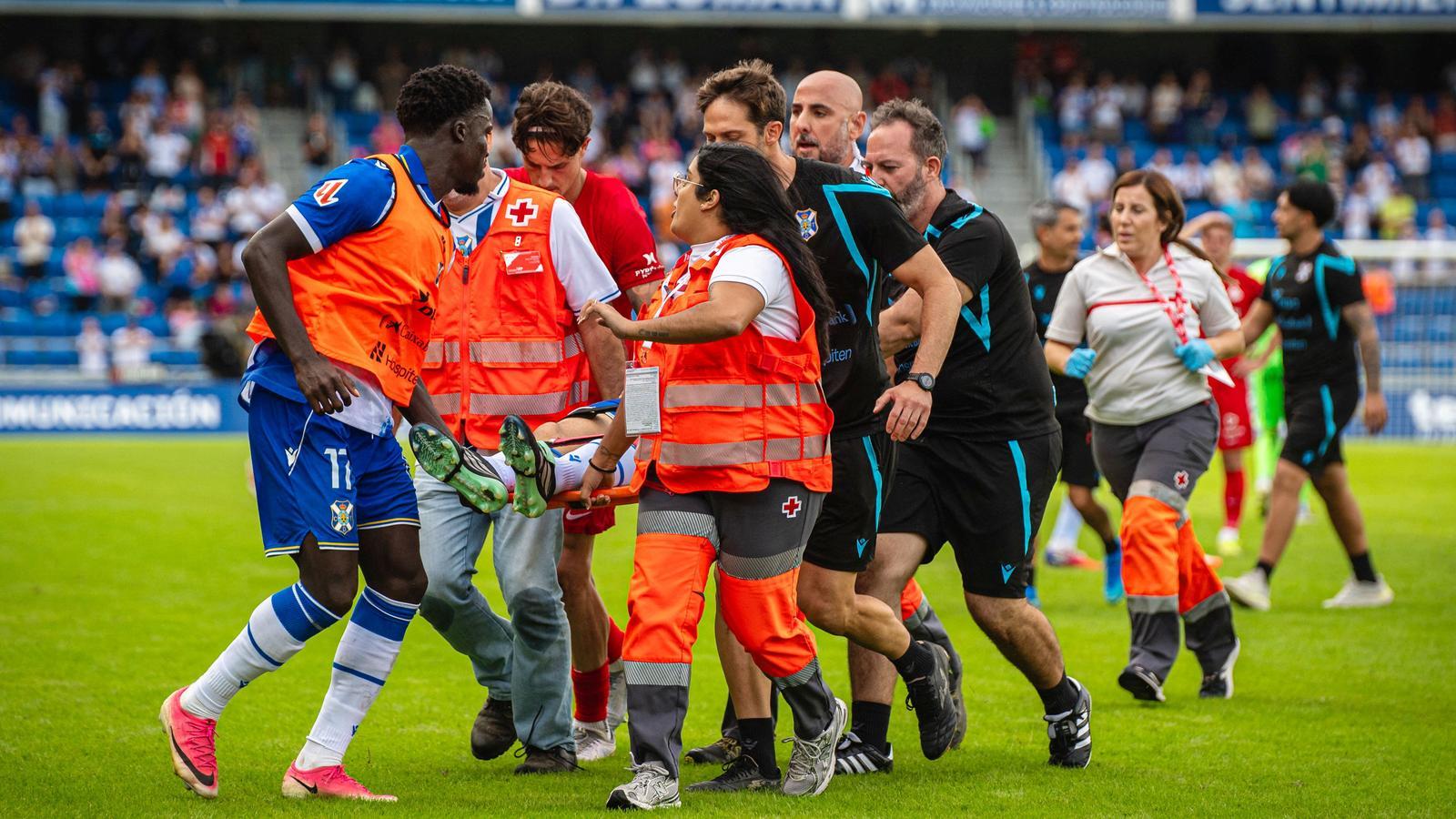
I will not judge the play. That is up to the referee, the disciplinary committee and justice. My sphere is what happens after the final whistle. And in the images, a question was repeated: why didn't the ambulance enter the pitch?
According to the press, the stadium protocol establishes that the player be transported by stretcher to an ambulance parked outside, next to the changing rooms. The ambulance only enters the pitch if the doctors activate the absolute immobilization protocol, and that night it was not activated.
The FIFA Emergency Medical Manual is very clear on both points. In the event of a heavy collision with the footballer lying on the ground, it asks to immediately protect his cervical spine. If there is a cardiac arrest, the player must be moved immobilized on a spinal board, together with the defibrillator, as a single unit, without interrupting the resuscitation for more than ten seconds. And it adds: "Whenever possible, it is preferable for the ambulance to enter the playing field". According to FIFA, this was precisely the case in which the stadium's own protocol provides for the ambulance to enter.
I am not looking for culprits. Dr. Afonso himself was grateful that the medical services gave their all until the end. But the answer to that question was decided long before Monday, in two areas.
The first is operational. In an emergency, there is no time to think, only to act. That is why FIFA insists on planning everything "long before the situation occurs," and describes it as the medical version of a set-piece strategy: everyone knows their role and their position before anything happens. With the pressure and emotion of the moment, anyone can make a bad decision. A clear and rehearsed protocol decides for us in advance. For me, this is the key to what we saw. And such a protocol must be trained until it becomes muscle memory: reviewing it before each match and putting it to the test in drills with the club, the stadium, and the medical services. In a hospital, these situations are daily occurrences. In a stadium, years can go by without one happening. That is why training cannot be optional.
The 2030 World Cup, on the horizon
The second one is the design. I have been dedicated to design and participating in the management of sports facilities for more than 20 years, and anyone who has worked with me knows that I am insistent—some would say annoying—about one issue: an ambulance must be able to reach the pitch, both in stadiums and in training facilities. No regulation requires it, so it is the operator who resolves it once the facility is delivered, adapting the protocol to the possibilities offered by the building. This should be resolved at the project stage: vehicle access to the field and a space in the tunnel where the ambulance can wait during the match, facing the pitch. In the design phase, it costs little. With the facility already built, it costs much more.
It is not theory. In January 2023, Damar Hamlin, a Buffalo Bills American football player, suffered cardiac arrest on the field. They resuscitated him on the pitch, with the ambulance by his side, and he survived. Six days later, in the next home game, an ambulance was waiting in the tunnel, facing the field and ready to enter. And this was a stadium from 1973. An old stadium makes it more difficult, but not impossible.
Spain will co-host the 2030 World Cup and many stadiums are being renovated. Now these decisions are cheap. Owners and federations should ask themselves: can an ambulance reach our pitch? And do we constantly train the protocols that protect players and spectators? Could Jesús have been saved? We will never know. Can we do better, both in terms of design and operations? Of that, I am sure.
Ramón Jesús González Márquez is a sports consultant. He worked at Barça from 2016 to 2019