UE Cornellà: the curiosities of the football club that Leo Messi has bought
The Baix Llobregat institution is a benchmark in youth football treatment
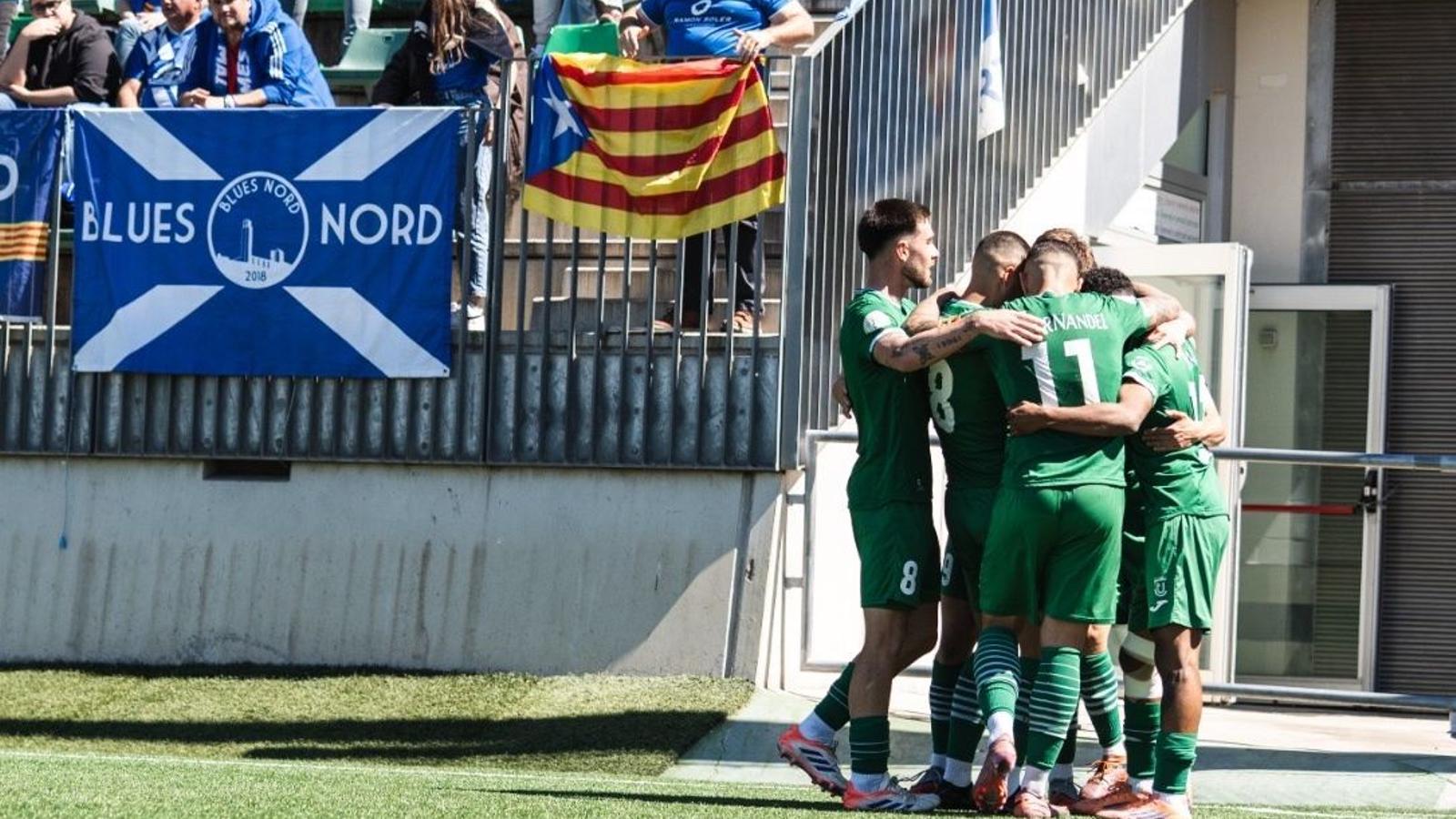

Cornellá de Llobregat“The news of the century! Leo Messi, new owner of UE Cornellà”. In this way, the club from Baix Llobregat announced this Thursday that the Argentine star was becoming the new owner of the entity. The information, published this Thursday, spread like wildfire through its stadium, next to Espanyol's field. At that time, dozens of boys and girls from grassroots football began to arrive at the club's facilities to train; in the changing rooms and on the pitch, nothing else was being talked about.
Nor was it in the stadium's single stand among the children's parents, who received questions from various journalists who had traveled to the ground to hunt for reactions to the news, “of great relevance for both the entity and the city”, as stated in a statement by the municipality's town hall, a working-class town famous for Estopa's rumba and the punk precursor of La Banda Trapera del Río, who sang about the humblest neighborhoods of Cornellà: “Ciudad podrida”.
Catalonia's third nursery
The first thing that catches the eye at Cornellà's ground is the bar, very spacious and bright, and with a large assortment of hot sandwiches and tapas –tripe, meat in sauce and fried eggs, among others–. Very close by, on the way to the offices and changing rooms, there are a lot of t-shirts from different teams, with names and numbers, hanging on the wall. They belong to former club players who have reached the elite: Cornellà is a professional footballer factory.
Historically, it has been considered the third youth academy in Catalonia, behind FC Barcelona and Espanyol. Jordi Alba, Aitor Rubial, David Raya, Keita Balde, Víctor Ruiz, and Javi Puado have trained at the Baix Llobregat club. Also Gerard Martín, who in the space of two years went from playing on the green Calahorra field, the color that has identified Cornellà since its founding, to competing in a Champions League semi-final with Barça at San Siro.
From boosting Cornellà to Barça
Founded in 1951, the key man in consolidating Cornellà as a benchmark for youth football in Catalonia was Andrés Manzano. At the club since 1993, and after more than 700 matches as a player, he swapped the pitch for the offices. As sporting director and general director of the club, as well as majority shareholder –it is a public limited sports company (SAD)–, he drove the growth of youth football and the first team, which in the nineties competed in regional leagues.
His dream was to take Cornellà to professional football and he almost achieved it: between 2018 and 2020, they played three consecutive promotion play-offs to the Second Division without success. They are coming off two consecutive relegations, and currently the first team is fighting to get promoted to Segunda RFEF. They are third in Tercera RFEF –only the first team is directly promoted–, just above L'Hospitalet of Jordi Alba and Thiago Alcántara. They will face each other on May 10th on the last day of the regular league.
Andrés Manzano is also considered the discoverer of Jude Bellingham, who at 15 years old even wore the Cornellà jersey in some friendlies. At that time, the club had a collaboration agreement with Birmingham and the two teams would exchange their best youth players for a few weeks. Manzano, who recommended to the English club that they secure Bellingham, last summer joined FC Barcelona as coordinator of formative football and became the right-hand man of Ramón Alexanco.
The link with Espanyol
The relationship between Cornellà and Espanyol goes beyond the training of its captain, Javi Puado, and geographical proximity. As Fran Garagarza explained at the time, the white and blue club has a collaboration agreement with the Baix Llobregat entity regarding grassroots football. They also share employees: Alberto Casado, the head of communication for Cornellà, is the speaker for Espanyol's first team in Cornellà-El Prat. Furthermore, not long ago, the parrot club used to rent its ground, the RCDE Stadium, and the sports city stadium.

In the current Nou Municipal there are photographs that recall the extinct Vía Férrea, one of the most iconic stadiums in Catalan football. Until 2012 it was the home of a Cornellà that for two years played away from home. Much earlier than Europa exiled itself to Can Dragó, the club from Baix Llobregat had already suffered the consequences of competing in Primera RFEF, a category that requires natural grass and a stadium with 3,000 spectators.
As the Nou Municipal –with a capacity of 1,500 spectators– does not meet either of the two conditions, it jumped from field to field and became a nomadic team between 2022 and 2024, playing home games at Cornellà-El Prat and the Dani Jarque; also in Gavà and Palamós. With the relegation to Segunda RFEF, it returned home. If it approaches professional football, the facilities, which are municipal, will be the main handicap that Leo Messi, who has bought one of the clubs with the most history in Catalan football, will encounter.
