The "Chess Cathedral" is in the Sants neighborhood
In Sants for years they organize a chess tournament that is already the second with the most participants in all of Europe

-
CAT -
CAST
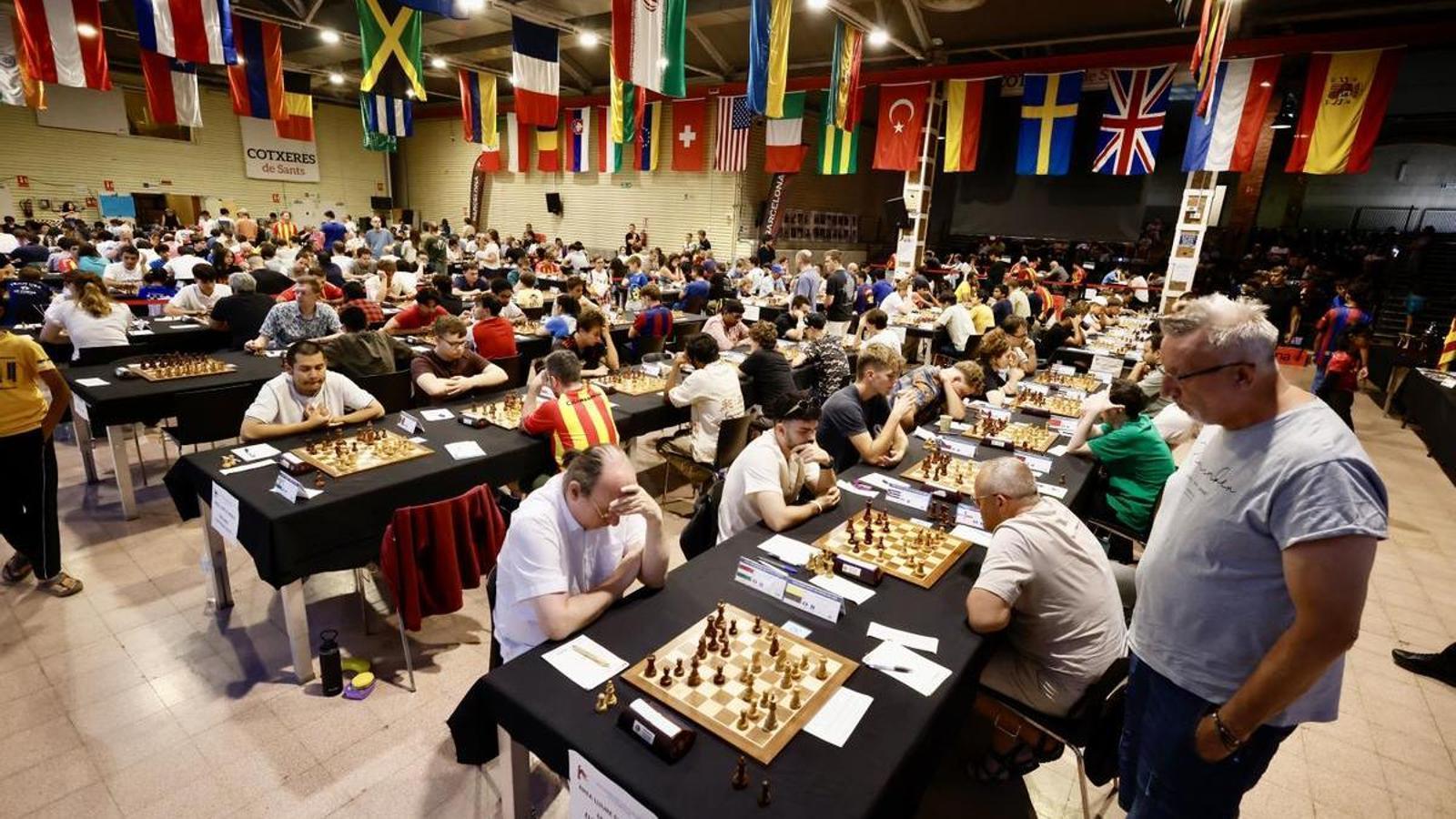
BarcelonaIn 1999, a group of chess enthusiasts managed to get a space at Cotxeres de Sants to organize a tournament. Another event within the packed calendar of a neighborhood's festivities where things always happen. 27 years later, the Sants – Barcelona City International Open occupies more boards than ever at the Cotxeres Civic Center, having achieved a record number of 774 athletes from 54 different countries, consolidating itself as the chess tournament with the most participation in all of Spain and the second largest in all of Europe.
It was the summer of 1998 when the neighborhood's Catalunya Escacs Club decided to organize a tournament. Álex Sulleva, one of the members, requested a room at the Cotxeres de Sants Civic Center, a space much loved by all the neighborhood's residents. And it turned out that its director, Toni Ayza, was a great chess fan, so he joined the cause. Almost three decades later, Toni's son, David, directs the tournament.
"We are happy because we are not losing the spirit with which the Sants Open was born. An event rooted in the neighborhood and in the Sants festivities," explains Ayza, who is also secretary of the Catalan Chess Federation and one of the souls of the tournament. "Without losing this popularity, we have managed to combine it with internationality and the presence of grandmasters and top-level players. We are very happy to have broken the record again and that people continue to trust us after 27 editions," he adds.

At half past four, almost all the tables have already been filled with the agenda. As always, some players arrive late and with their heads down, greeting the opponent who has been waiting for minutes. Distracted geniuses, sometimes. Or champions with high morale. The main carriage house, where events often cause a great commotion, falls silent. Only the sound of chairs as players get up for a walk, contemplating their moves. Young children face adults, men with women, novices with veterans. In the auditorium, a section is reserved for grandmasters, with live broadcast games and security measures: players are passed through a metal detector, like at airports, and cannot carry phones to prevent cheating.
The championship, organized by the Catalan Chess Federation in collaboration with the Secretariat of Entities of Sants, Hostafrancs and La Bordeta, is also part of the VII Catalan Week of Sport, an initiative promoted by the Union of Sports Federations of Catalonia. "The Sants Open has been participating in the Catalan Week for many years. We have seen it grow with us and today it is an international benchmark. It competes in the calendar with high-level world chess competitions. The success that the Catalan Chess Federation demonstrates today is a source of pride for both the Union of Federations and for Catalan sport as a whole," celebrates Isabel Pérez, general secretary of the UFEC.
The tournament is organized into three groups and a classic playing system that brings together both grandmasters and amateur athletes. The first year, the Russian Oleg Korneiev won. Last year, the Lithuanian Valeri Kazakouski. Only one year, in 2006, has a Catalan grandmaster won, Marc Narciso. The organizers celebrate the success of a tournament where players always want to return. Many come to play in the official tournament shirt. Others, quite elegant. You see a Cuban in a blazer and a Georgian woman well-made-up in heels. Others play as if it were their own dining room. Many wear football shirts from Roma, Slavia Prague or Barça, of course.
The tournament has grown so much that if it wants to continue in Sants, it will hardly be able to grow, as there is no more space. It now occupies the garage auditorium and four more rooms, one of them prepared for blind players to play, with special boards and pieces to be recognized by touch. Plácido Pérez Ramírez also participates in the tournament, in his case, despite suffering from cerebral palsy. He cannot move the pieces, so an assistant does it for him.
"It is a pride to return to Sants and see the dimension that this international tournament has reached. We are fascinated to see athletes of all ages competing together; it is one of the sports that best exemplifies integration and equality. In front of the board, neither gender nor age count, but rather the sports overcoming capacity of each athlete," explains César Tovar, territorial representative for Sports of the Generalitat de Catalunya.

According to Ayza, "many young people mainly come here to seek their international chess norms, a title that gives them more projection within the world of chess". Many of these young people are from India, one of the world powers. Families organize their holidays so that they can play tournaments in Europe like this one. One of the young people who has generated the most expectation this year, however, is Marc Barceló, double world champion in the under-10 category. The athlete from the Tarragona Chess Club continues to surprise with successes like when he was proclaimed runner-up in the world in the under-9 category at the World Rapid Championship held in Antalya, Turkey. Rising four spans off the ground, youngsters like Marc play against veterans with long white beards. It is the magic of chess. A world where a tournament is played every day in Catalonia. In the era of screens, chess is not going out of fashion. In fact, screens help it to grow by playing online or allowing people on distant continents to follow live everything that happens in the Sants garages, the "cathedral of chess", according to Ayza.
