The Barça basketball team: 100 years and a historic opportunity
Three seasons without titles and a decade accumulating losses open several debates around the section
-
CAT -
CAST
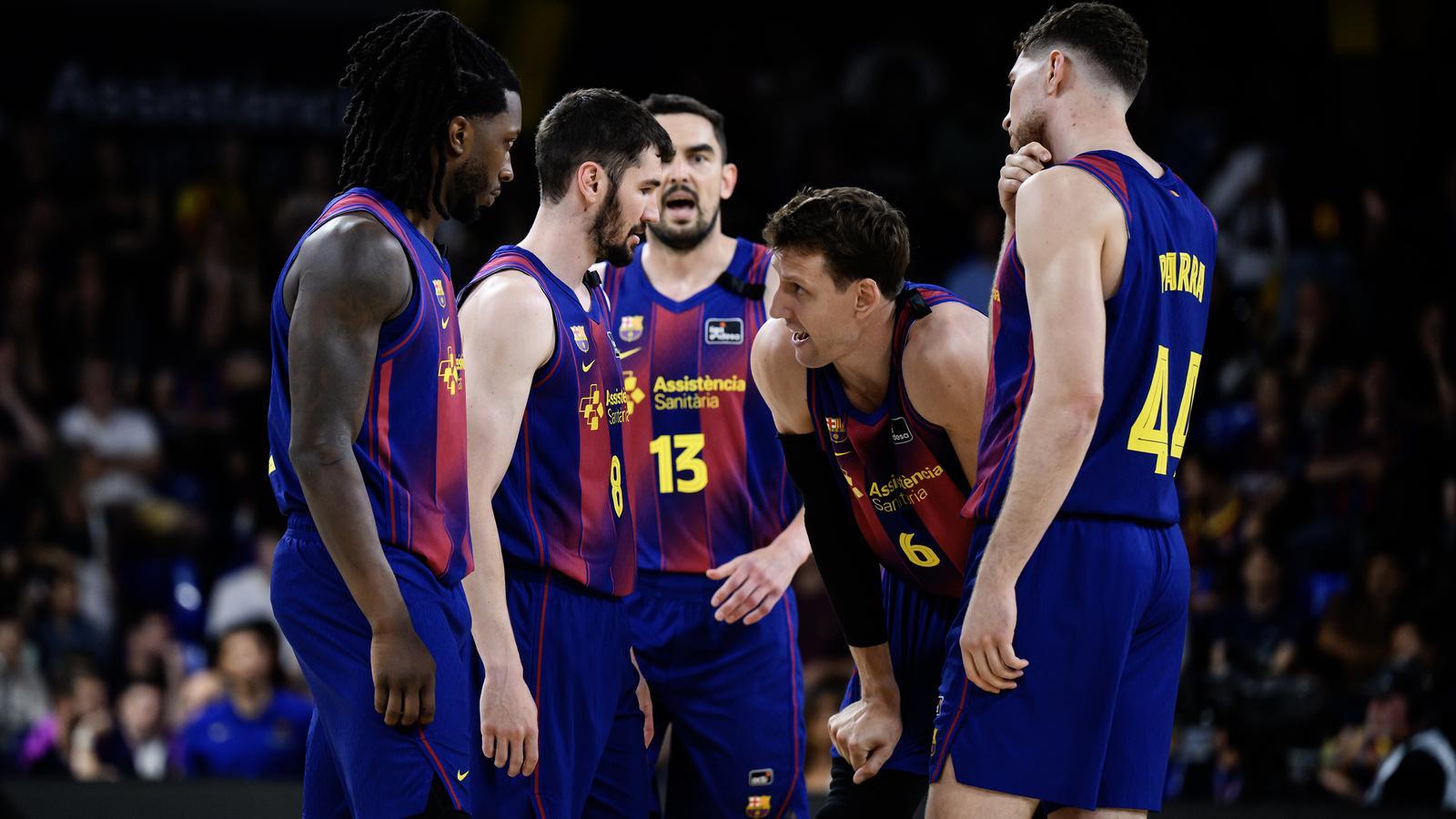
BarcelonaFC Barcelona basketball celebrated its centenary this August 24. The last season has left more doubts than joys. That is why a deep remodeling of the squad and the project has been launched in the offices. This summer, a dozen players have finished their contracts or have put an end to their time at the club. Nico Laprovittola, Tomás Satoransky, and Willy Hernangómez head a list of departures that symbolizes the end of a cycle. They are joined by promising youngsters like Dani González or Nikola Kusturica, who could also continue their careers in the United States. The revolution, however, is not limited to the squad, which will be practically new: only Joel Parra, Juan Núñez, Kevin Punter, and Darío Brizuela survive. It has also affected the sports management and the bench, with Xevi Pujol and Aleksander Sekulic as new faces. The changes stem from one evident fact: the current model has not kept Barça among the great dominators of European basketball.
However, the problem goes far beyond proper names. What does Barça really need to compete for the EuroLeague again? Is it a matter of budget? Has the development model failed? Or is it the current structure of the European competition that has left behind clubs that continue to depend almost exclusively on the resources provided by their organization? While the EuroLeague evolves towards a model increasingly similar to that of North American franchises, Barça faces a fundamental debate: are sporting decisions enough?

Lack of executive staff
Nacho Rodríguez, manager of the Barça basketball management between 2017 and 2021, identifies one of the main problems in the offices. "There are no people working to generate income," he explains in conversation with ARA. According to Rodríguez, the section continues to operate with a very reduced structure —"between three and four people"— without its own human resources, legal services, or sponsorship acquisition departments. This lack of resources, he assures, also has sporting consequences: "Contracts arrive late," he states, making it difficult to close certain signings.
The criticism is not limited to the size of the management team. Rodríguez wonders why the Palau Blaugrana does not commercially exploit many of its assets. "Why aren't there sponsorships on the center court, on the free-throw line, at the base of the baskets, on the jersey, or even on the team's name?" he asks, recalling periods with main sponsors like Winterthur, AXA, Regal, or Lassa.
The former executive responsible for the Barça section, Joan Bladé, reiterates to ARA that the management issue is not the main point of the crisis. For Bladé, everything requires having a strong dual leadership in the section, both on the bench and in the locker room, and he cites the cases of Sarunas Jasikevicius and Nikola Mirotic, coach and captain respectively of the last Barça squad with strong leadership. Finding two such pieces, explains the former basketball manager, "is not easy, and when you find them, you have to keep them".
Ten years of structural losses
The Barça's economic reports paint a clear picture. Over the last ten years, the basketball section has not presented any budget with expected profits. Losses have always ranged between 13 and 32 million euros.

On the other hand, the profits generated by men's football support a large part of the club's multi-sport model. Except for women's football, which registers recurring profits, the rest of the sections depend on the surplus from the first team. This reality also conditions their investment capacity: Barça's difficulties with the League's financial fair play limit the room for maneuver of all sections, including basketball. Rodríguez explains that one of the ways to generate income is precisely by having staff to manage sponsorships.
Bladé agrees on the issue of sponsorships, and the new Palau Blaugrana, which still has no definitive project or groundbreaking, would be a perfect opportunity to explore and exploit them. However, he asks to be realistic, since, after all, "the most important sponsor is football".
Budgets mark differences
Money does not guarantee titles, but it does condition the options to fight for them. Six of the top ten finishers in the last Euroleague also featured among the teams with the highest payrolls.

Is the current model sustainable?
Economic limitations have also conditioned the planning. Various reports indicated that the lack of margin made it difficult to satisfy all of Xavi Pascual's reinforcement demands upon his return to the club. A similar situation has also been experienced in women's football. The question is whether Barça can continue to compete with this model. The section has accumulated a decade of losses and depends on football's resources, while the Euroleague is moving towards a competition increasingly marked by the investment capacity of its participants.
Joventut de Badalona offers a close precedent. After years on the brink of disappearance, the club became a Sports Public Limited Company and the entry of the Grífols family allowed for capital expansion, debt reduction, and stabilization of the sporting project. Rodríguez acknowledges that a similar scenario has never been seriously considered at Barça, not even now with Joan Laporta, but he advocates for an intermediate path: to provide the section with its own management team made up of seven people dedicated exclusively to generating income, attracting sponsorships, and managing the project, leaving behind the current transversal model.
