A strike at Barça shakes the classic
Fixed-term discontinuous workers denounce a reduction in staff and demand more job stability
-
CAT -
CAST
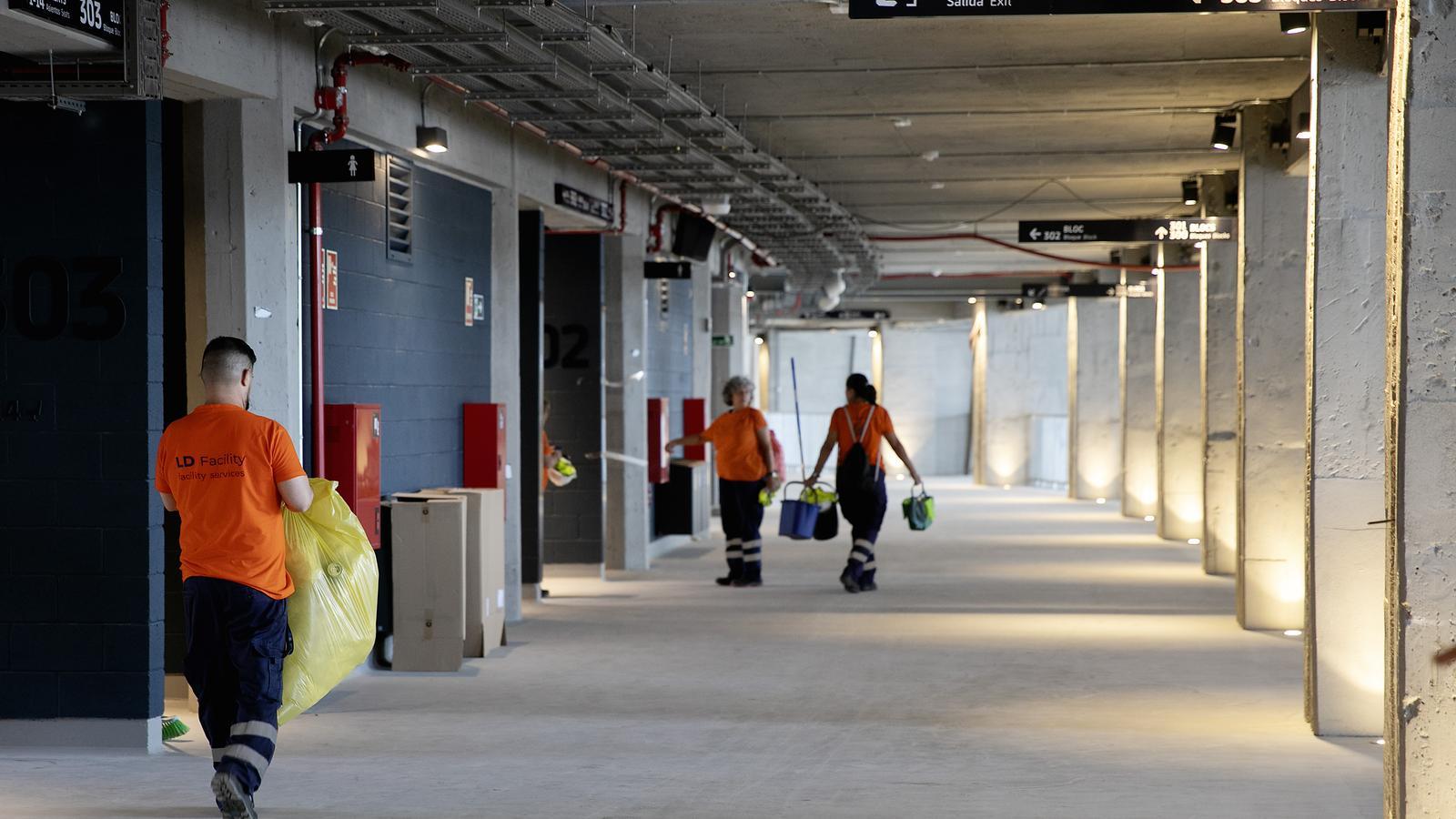
BarcelonaBarça will experience a weekend marked by labor conflict with seasonal permanent workers, employees with indefinite contracts who work periodically according to the club's needs, and who have called a strike coinciding with the 'Clásico' against Real Madrid at Camp Nou (9 pm). The mobilization, promoted by CCOO, will begin at 12 am on Friday, October 23rd, and will last until 6 am on Monday the 26th. The union denounces a deterioration in working conditions, lack of personnel, inequality among workers, and breaches of agreements and the collective bargaining agreement. It also criticizes the progressive reduction of staff while some services are handed over to external companies.
From Barça, it is assured that "the announced mobilization does not put the celebration of the 'Clásico' or the rest of the matches at risk" and defends that "the club has sufficient organizational capacity to face the strike without problems." The club, however, will not be able to cover the workers who go on strike by hiring external personnel. "It would be the classic external strikebreaking. It is prohibited by article 6.5 of law 17/1997, which regulates the right to strike," lawyer Eloi Orihuela, from Era Cooperativa Jurídica, assures ARA. According to the same law, Barça could not cover the functions of the seasonal permanent workers who are on strike with other company employees either. "It would be violating the workers' rights," states the consulted lawyer.
From 90 employees to about sixty
"We do not want to go on strike. We want to work," asserts Olga Marín, spokesperson for the Barça permanent seasonal workers' strike committee, to ARA. The group denounces that the workforce has gone from 90 employees two years ago to about sixty currently, after the club stopped filling vacancies and retirements starting in October 2024. "Every day we have to juggle to see who has to do more work because there aren't enough people," explains Marín, who demands that Barça sit down to negotiate to guarantee the continuity of the staff and adequate working conditions. The current 60 workers serve to cover services during a major match like a Clásico, although they believe that "there should be many more of us."
According to the spokesperson, this lack of personnel has favored the coverage of some services by external companies. The most evident case, she asserts, is that of the parking lots, where externally contracted assistants work. She maintains that the club prioritizes permanent seasonal workers for functions that are more difficult to replace, such as access control, event production, and the attention of the areas vip.
A strike beyond the classic
The coincidence with the Barça-Madrid match places the conflict in one of the most important showcases of the season, but the strike is not limited to men's football. It will also affect matches at the Palau Blaugrana and the Johan Cruyff stadium, together with activities for the youth categories at the Ciutat Esportiva Joan Gamper. "At the Johan and at the Palau, we are the ones who open the doors," explains Marín. Without these workers, the opening of access points could be affected, he warns.
At the Camp Nou, the permanent seasonal workers manage incidents with tickets and season passes, control access to the locker rooms, and coordinate the placement of photographers and media cameras. "We have the club's tools to be able to resolve issues on the spot," he emphasizes, while noting that this prevents members from having to travel to the Supporter Services Office. At the Ciutat Esportiva, their work includes setting up and dismantling field logistics, guiding the public, and preventing access to restricted areas.

For Marín, familiarity with how each facility operates is key to resolving unforeseen issues that may arise during events. "We adapt to each type of event and are prepared for anything that might happen," she states. The spokesperson does not specify what level of support the strike will have: "I have no idea. I can't imagine anything, to be honest." Nevertheless, she questions whether matches can proceed with the same level of normalcy if the strike is supported: "The match will be able to be played and the operations can go ahead, but not as well as usual and it runs the risk of going wrong."
The spokesperson insists that the call for a strike is not a response to a demand for financial improvements, but rather to the need to ensure the continuity and increase of staff and adequate working conditions: "We are not asking for salary improvements, but to have a certain sense of security and peace of mind every time we come to work." The workers are asking Barça to listen to their demands and open negotiations to find a solution to the conflict.
Barça's response
From Barça they explain that the permanent seasonal workers are demanding salary improvements and a 50% increase in the workforce, up to 90 employees. The club maintains that its model of in-house staff for certain auxiliary services has become "obsolete" and that other teams, such as Real Madrid, Atlético de Madrid or Espanyol, outsource these functions. However, it maintains that the strike does not put the celebration of El Clásico or the rest of the matches at risk, because there is enough organizational capacity to guarantee that they proceed normally.

