Pochettino's great challenge: uniting the two Americas in the Trump era
The majority of the national team's footballers are critical of this government, but during the World Cup they want to focus only on the game

-
CAT -
CAST
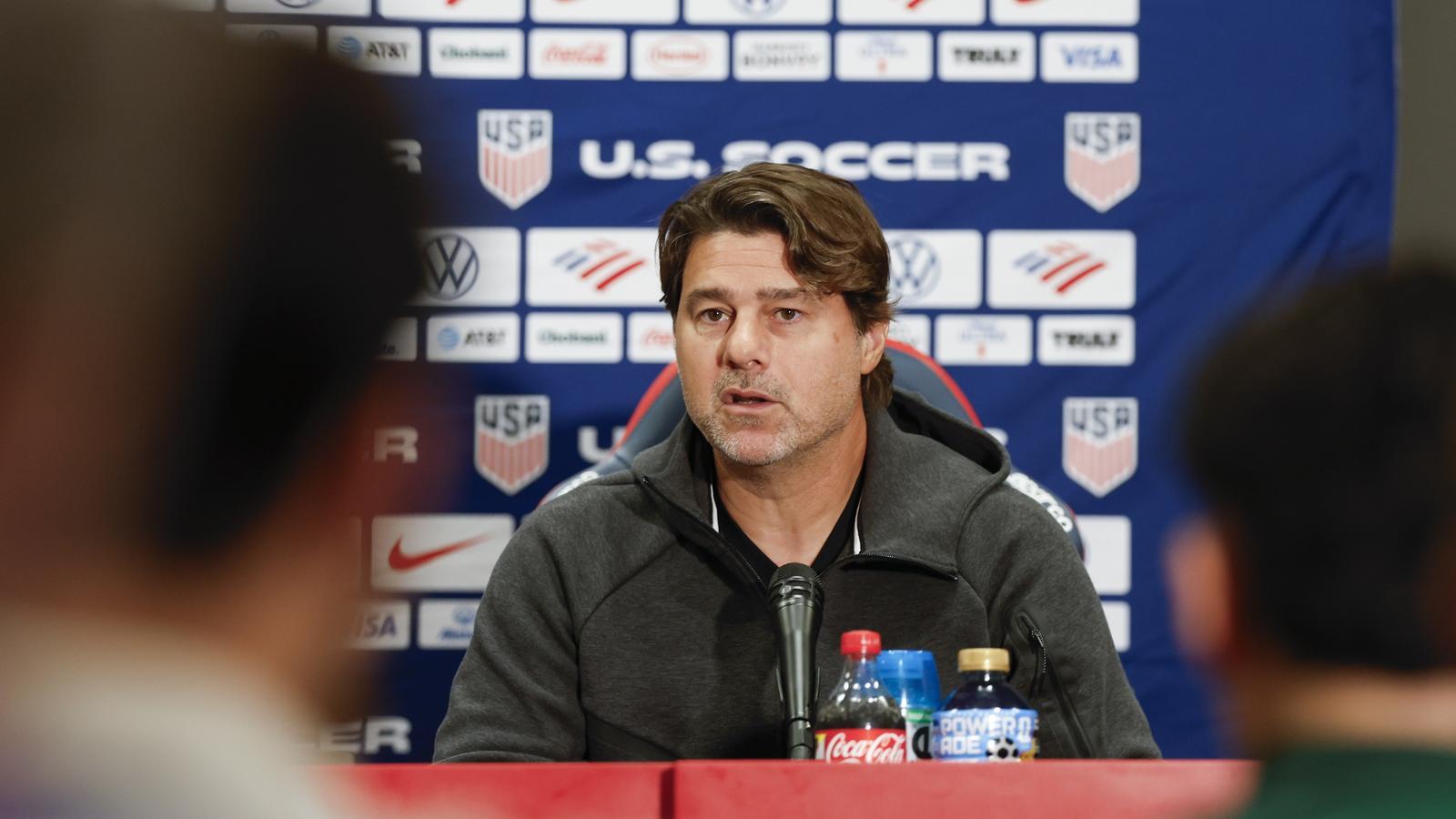
BarcelonaA few months ago, this March, Donald Trump received a delegation from the North American Football Federation and asked the coach, the Argentine Mauricio Pochettino, if the United States can win the World Cup. "I told him that we can win it," said the former Espanyol player. Pochettino has a challenge ahead: achieve good results and get the team to excite a country that arrives very divided at the event. The debut will be against the Paraguay team on Saturday at three in the morning.
The United States is hosting a World Cup for the second time. The first was in 1994, and at that time people already celebrated reaching the round of 16 as a great success. Now, on the other hand, the team of the stars and stripes is asked to go further. The United States has been betting heavily on soccer for more than twenty years, and the professional league achieves better audiences and average spectators than traditionally stronger sports like ice hockey and, at times, baseball. In 2002, the United States reached the quarterfinals and fell unfairly to the German team. For years the team competed quite well, but then it began to sink and hit rock bottom in 2017, when it didn't even qualify for the World Cup. The results have been particularly bad in the last two years. And, to make matters worse, the political situation doesn't help.
A few weeks ago, the team's forward Tim Weah stated that he disliked "seeing the price of World Cup tickets". "It will be a good World Cup, but a spectacle. Football should not move away from the people," he said. Pochettino publicly replied and said that the players' job is not to assess ticket prices or talk about politics. The Argentine, who in the past has praised the work of Javier Milei, the Argentine president, added that footballers should focus on competing and avoid generating debates that do not contribute. This has been the motto for the last year: that footballers should not talk about politics to avoid criticism from the Trump administration and to try to avoid having even more problems besides the football ones, as the team's performances have not been particularly encouraging in the previous friendlies.
But Weah paid little attention, as he inherited his father's character. His father was George Weah, the first African footballer to win the Ballon d'Or. A man who became president of Liberia, his home country. The son competes for the United States because his mother was a nurse born in Jamaica who had emigrated as a child to New York and obtained citizenship. And Tim, who will be able to debut in the final phase of a World Cup, unlike his father, loves New York so much that he participated in an event alongside the new mayor, the socialist Zohran Mamdani, to present an initiative in which the city council bought 1,000 tickets for World Cup matches in New Jersey and raffled them off to everyone who signed up for a list for $50. A campaign through which Mamdani and Weah argued that football is becoming an elitist spectacle and that ticket prices should be lowered. Pochettino didn't like it.
Unlike what the stereotypes say, football has a long tradition in the United States: matches were already played there in 1860. In 1930, in fact, the United States played in the first World Cup in history and reached the semifinals. But especially after World War II, this sport gradually lost importance and took a back seat. A sport that has always been associated with immigrants, first the Irish or Scots, then from Eastern Europe, and now Latinos. "I would say that this is the squad with the most diverse origins among the players," admitted defender Chris Richards, an African American from Alabama. The team captain, veteran Tim Ream, was born in one of the cities with the most football tradition, Saint Louis. "Our team is like a microcosm of the country. We have people with very diverse roots, from different areas, religions, ideas... It's beautiful," he explains. Richards' case shows how football has made its way, as he grew up in a state where black people usually play basketball or American football. "My father was a basketball player. But I wanted to be a footballer and for years I was the only black person on the team, until I went to Dallas. More and more young people from diverse backgrounds want to be footballers," he adds.
As a team representing diversity, the players joined the widespread protests across the country in 2020 following the murder of George Floyd by police. The footballers came out with anti-racism messages, and in some cases knelt when the anthem played. Soccer had become a politically very significant sport: at local football clubs, fans were very critical of the Trump administration and displayed banners and flags against racism and homophobia. Over the last two years, politics has been practiced in many professional league stadiums. But now that the World Cup is approaching, the players have changed their strategy.
"I think it's our turn to play. That way we can unite the country," says Tim Weah, even though he has been one of the bravest players, with his actions against ticket prices. "I have the feeling that we are going backwards when we talk about freedoms and diversity. These are not easy years, but I have the feeling that if we play well, united, we can help," adds Richards. "Nowadays, if you make a comment or a like on social media without thinking too much, you can cause a fire," he added in a comment, surely thinking of the team's big star, AC Milan player Christian Pulisic, who about a year ago celebrated a goal by imitating the dance that Donald Trump usually does. Pulisic, of Croatian descent, stated that it was a joke and that he had done "the dance that everyone does," and added that he was not taking a political stance, even though there is suspicion that he is a supporter of the current president. "He is mistaken. He represents a country and represents a team that without immigrants would not be what it has become. According to Trump's proposed laws, some teammates would not have a passport and could be deported," complained former player Tim Howard. Since this team exemplifies the diversity of the United States, there may be potential Trump voters playing for it. "If the team does well, even if the players don't take a stance, a message in favor of diversity will be sent," added Howard. If Pochettino's team achieves good results, it will be shown that together they are stronger.

