Sentenced to life imprisonment the founder of Evergrande, symbol of the Chinese real estate boom
Xu Jiayin became the richest man in China

-
CAT -
CAST
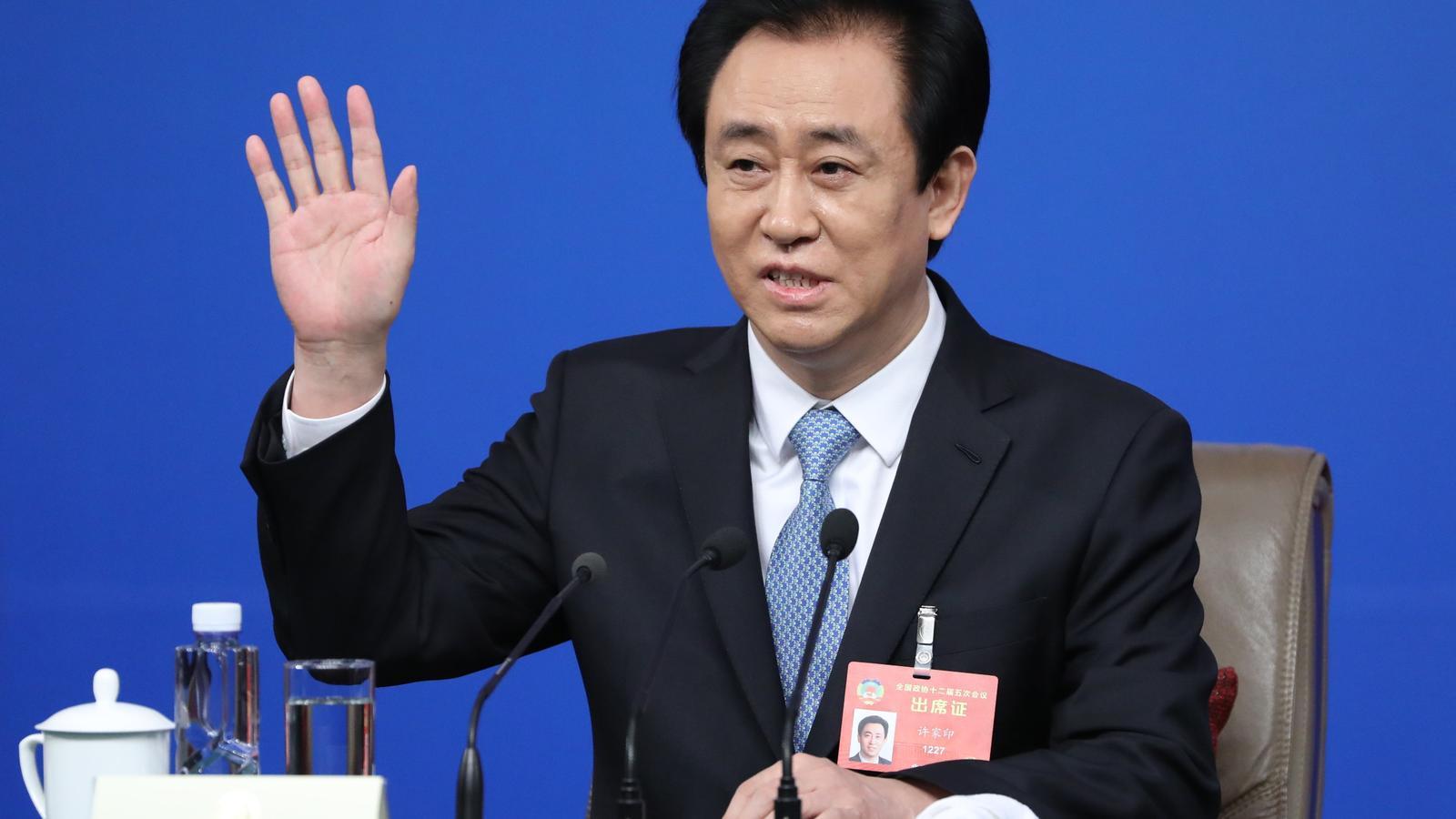
BarcelonaThe founder and former president of the Chinese real estate giant Evergrande, Xu Jiayin, was sentenced this Thursday to life in prison by a Shenzhen court for financial fraud. The sentence, issued in the first instance, also orders the confiscation of all his assets and the deprivation of political rights for life. The conviction culminates the downfall of one of China's most powerful businessmen. Xu became the richest man in the country in 2017, when Forbes estimated his fortune at 42.5 billion dollars.
The court considers it proven that between 2016 and 2021, Evergrande and its executives continuously and on a large scale falsified the company's accounts, artificially inflating assets and hiding liabilities. Specifically, the subsidiary Evergrande Real Estate inflated its revenues by approximately 72 billion euros between 2019 and 2020, partly through the premature recognition of sales of homes that had not yet been completed. The sentence also attributes to the group crimes of illegal absorption of public deposits, fraudulent fundraising, fraudulent issuance of securities, and irregular disclosure of financial information, as well as practices related to bribery and misappropriation of funds.
Evergrande Group will now have to pay a fine of 8.82 billion yuan – approximately 1.06 billion euros – and its main real estate subsidiary, Evergrande Real Estate, will have to pay 7 billion yuan – approximately 840 million euros –.
Xu, known internationally as Hui Ka-yan, has been under house arrest since 2023 and in April pleaded guilty to the charges against him. In the same proceedings, the court has also sentenced five former Evergrande executives to prison terms ranging from six to eighteen years. In total, the Chinese justice system has issued 56 rulings related to the case.
Rise and crisis of the Chinese giant
Evergrande became one of China's largest real estate developers thanks to an expansion based on heavy debt, until in 2020 Beijing began to limit financing for companies in the sector with the so-called three red lines. The measure established strict limits on three financial indicators: the debt-to-asset ratio, the debt-to-equity ratio, and the cash-to-short-term debt ratio.
Evergrande's crisis became evident in 2021, when the company began to have problems meeting its payments and ended up defaulting. The group accumulated more than 300 billion dollars in liabilities and became the most visible face of the Chinese real estate crisis. In January 2024, a Hong Kong court ordered its liquidation at the request of foreign creditors, in a particularly complex process because the majority of its assets were located in mainland China.
Politics, football and the Forbes list
Hui Ka-Yan, or Xu Jiayin in Mandarin Chinese, was born into a rural family on October 9, 1958. His father was a retired soldier who participated in the Second Sino-Japanese War in the 1930s and 1940s. Hui's mother died of sepsis when he was 8 months old and he was raised by his paternal grandmother. After high school, he worked in a cement products factory for a few days and then worked at home for two years. After retaking the college entrance examination in 1978, Hui was accepted into the Wuhan Institute of Iron and Steel (now Wuhan University of Science and Technology) where he served as hygiene commissioner for his class.
Freshly graduated, in 1982, Hui was assigned to the heat treatment workshop of Wuyang Iron and Steel Company, becoming associate director in 1983 and director in 1985. After resigning in 1992, he moved to Shenzhen, the special economic zone in Guangdong province. He was accepted by a trading company called Zhongda. On October 1, 1994, Hui moved to Guangzhou, the capital of Guangdong province, to establish Guangzhou Pengda Industrial Co., Ltd. In March 1997, he founded the Evergrande Group, becoming its president. Hui also owns the Guangzhou Evergrande football club, one of the most successful football clubs in China.
In the context of Evergrande's liquidity crisis, his net worth had fallen to $6.2 billion by December 13, 2021, according to the Bloomberg Billionaires Index, having lost $17.2 billion during the year, partly due to the sale of personal assets, including his $227 million mansion in London. On September 28, 2023, he was arrested by the police. Trading in Evergrande shares was suspended. He lost his billionaire status in October 2023, when Bloomberg estimated his net worth at $979 million.
Married with two children, Hui, like many Chinese entrepreneurs, also had political connections. In 2008, he became a member of the National Committee of the Chinese People's Political Consultative Conference (CPPCC), China's main political advisory body, and was promoted to the Standing Committee of the National Committee of the CCPCC in 2013. In November 2022, he missed a Standing Committee meeting due to the Evergrande crisis and was told not to attend the CCPCC's annual meeting in March 2023.
