Hansi Flick has reasons to get angry
The performance of István Kovács, who refereed last Champions League final, and the VAR, drove the blaugrana coach crazy

-
CAT -
CAST
BarcelonaThe fifth duel of the season between Barça and Atlètic de Madrid was the first in European competition and, therefore, had to go through the sieve of a foreign official. The Italian Roberto Rosetti, head of UEFA's refereeing, aware of the difficulty of the match, opted for one of his best cards: István Kovács. The Romanian, 41 years old, arrived with the experience of having recently refereed a Champions League final between Inter Milan and PSG and with the intention of applying his style guide: whistle few fouls, allow the game to flow, and delay the first card until exhaustion. However, the criteria applied did not sustain control of a high-demand match.
The action that conditioned the tie arrived in the 41st minute. Giuliano Simeone gained position on Pau Cubarsí a few meters from the area and the centre-back brought him down with a trip. He was the last defender and the rest of his teammates were not in a real position to contest the ball. Kovács whistled for the foul, but initially showed the yellow card, an incorrect decision according to established disciplinary criteria. The VAR, led by German Christian Dingert, intervened and, after the review on the monitor, the on-field referee rectified and showed the red card to the defender for a clear goal-scoring opportunity. The action inevitably recalls the one staged by Ronald Araujo in the 2023-24 season's Barça-PSG match, in the second leg of the Champions League quarter-finals. In that case, also with Kovács as referee, the Uruguayan was sent off for a similar action on Bradley Barcola as he was heading alone towards the goal.
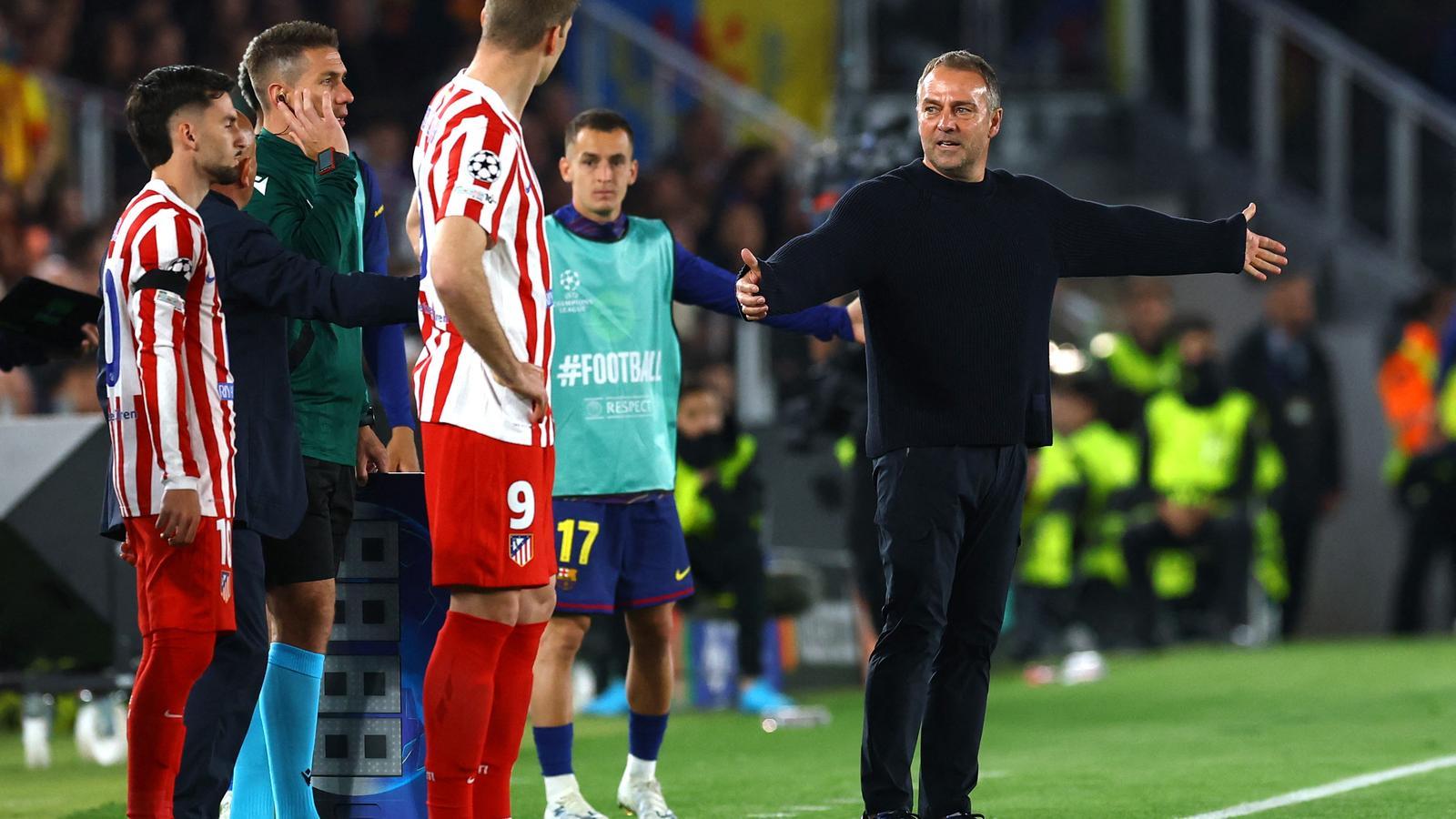
The second major controversial action of the match arrived in the 55th minute. Juan Musso, the Mattress goalkeeper, placed the ball in the small area and put it into play with his foot. Subsequently, Marc Pubill took the ball with his hands, ignoring that his teammate had already put it into play. A rare action, but punishable by a penalty. Despite this, Kovács opted to turn a blind eye. The play has recent precedents in European competitions with different resolutions – a penalty in a Bruges - Aston Villa and a repeat of the goal kick in an Arsenal-Bayern –, which highlights the lack of a homogeneous criterion. The football director of Atlètic de Madrid, the former Barça player Mateu Alemany, argued that the referee had to whistle for the ball to be put into play, but the regulations establish that the ball is in play from the moment it is clearly moved, without the need for a whistle. For his part, Hansi Flick exploded with this action. "Why do we have VAR? It's a penalty and a second yellow," the German stated.
István Kovács, a referee who was out of his depth
Beyond specific actions, the overall management of the match showed difficulties in establishing a consistent disciplinary criteria. Already in the 8th minute, a disproportionate tackle by Koke Resurrección on Dani Olmo went unsanctioned, which contributed to raising the permissiveness threshold in the early stages. The Atlético captain would eventually receive a yellow card in the 31st minute and, shortly after, would be involved in another action on Lamine Yamal which, while not clearly deserving of a second booking, did increase the pressure on the Romanian international referee.
Kovács failed to earn the players' trust and showed difficulty in discerning which actions were punishable and which were not. He refrained from issuing bookings, including one to Robin Le Normand for a trip on Lamine Yamal. The Spanish defender would have missed the return match at the Metropolitano. In fact, in one of the images of the night, after a claim from João Cancelo, the referee consulted a notebook with his own annotations, presumably related to the cautioned players. An infrequent gesture at this level that accentuated the perception of a lack of control.
In this context, the VAR intervention was decisive in correcting a key decision, but not enough to sustain a performance that was not up to the competitive demands of a match at this level.

