X-ray of the company in Catalonia: internationalization, innovation and talent
On the Company Day, the data speak of the excellent state of health of the Catalan business fabric
-
CAT -
CAST
Today, June 27, marks Catalonia's Business Day, an initiative promoted by the Government of the Generalitat of Catalonia in 2021 that aims to highlight the strategic role of the business fabric in the economic and social development of the territory. Beyond their productive function, companies, from entrepreneurial initiatives to large corporations, become key players in talent generation, wealth creation, and territorial balance, contributing decisively to collective prosperity.
The productive fabric in Catalonia has a set of first-rate companies. Its impact on the economy is driven by innovation, with a significant role for foreign companies and start-ups. Technology, research, and innovation, along with talent, form its ecosystem. In 2025, Catalonia registered 2,403 start-ups, 5.2% more than the previous year. This is the highest figure ever recorded.
According to the European Commission's Regional Innovation Scoreboard, Catalonia gains 9 positions among the most innovative regions on the continent and ranks 72nd out of 241, leading Spain and surpassing the positions of the Basque Country and Madrid. Although in the European context the 50 regions with the best results are concentrated in the north and west of the continent, Catalonia emerges as one of the few notable exceptions in Southern Europe. As stated in a report prepared by ACCIÓ (the agency of the Department of Business and Labor), Catalonia is the fifth-best ecosystem in the European Union to create a start-up, behind Paris, Berlin, Stockholm, and Amsterdam.
A favorable environment for 'start-ups'
This sustained growth evidences Catalonia's favorable environment as a country for developing new technological solutions. According to the same report, the number of start-ups in Catalonia has grown uninterruptedly in recent years and has even more than doubled (+121%) since the ecosystem was first analyzed in 2016. Furthermore, 44% of Catalan emerging companies have been created in the last five years and 61% export their products and services to major markets, such as the United States, France, Germany, Italy, and the United Kingdom. In fact, 15% of start-ups with international clients export more than 90% of their turnover.
During 2025, 203 investment rounds were closed with an average amount of 5.6 million euros (in 2025, two of the considered mega-rounds were completed) and in the last five-year period (2021-2025), 6,106 million euros in investment were received. Overall, Catalan emerging companies invoice 2,947 million euros – almost three times more than 10 years ago – 26% more than the previous year, and the equivalent of 0.9% of Catalonia's GDP. This means that more than 30,500 people hold qualified jobs, which is 34% more than the previous year.
Foreign companies choose Catalonia
Catalonia has more foreign subsidiaries than ever. Nearly 10,000 foreign companies are established in our country, and this represents 68% more than 10 years ago. The United States, with 15% of the total; France, with 14%; and Germany, with 12%, lead the list. They generate two out of every ten jobs, a business volume of 30%, and 47% of exports.
The data exemplify why Catalonia is one of the most dynamic territories in Southern Europe in terms of attracting foreign investment. The fact that many foreign subsidiaries have ended up establishing themselves in the country in the last five years speaks to the country's economic health. Catalan exports managed to break a new historical record in 2025 and exceeded 100,000 million euros for the third consecutive year.
Stability arrives with trade agreements
For Catalan companies, trade agreements like the Mercosur one have provided a stable, secure, and regulated framework to access 28% of the population, 41% of GDP, and 55% of global imports. These are the volumes that represent the sum of the EU markets with the 45 existing agreements with 80 countries, among which stand out Japan, the United Kingdom, Canada, Brazil, South Korea, and Mexico, and the new incorporation of Mercosur countries.
On the other hand, the EU has pending ratification of trade agreements with India, Indonesia, and Australia, while it maintains negotiations to reach new trade pacts with Malaysia, Thailand, the Philippines, and the United Arab Emirates. These new trade pacts would expand access to a stable market of up to 50% in terms of global GDP and population, and 67% regarding worldwide imports. This means that only 11% of Catalan exports would remain outside markets with an active trade agreement, pending ratification, or under negotiation, and which are fundamentally concentrated in the United States and China.
We are leaders in technology and innovation
Catalan leadership in the field of innovation and technology also outlines a successful model. Catalonia is the second region, after Île-de-France, with the volume of funding from the Horizon Europe program (2021-2025) received by companies; also by the number of beneficiary companies in total. Compared to Spain, it has received 34.1% of the total and once again leads patent applications in the State. According to data presented by the European Patent Office (EPO), the territory issued 754 applications in 2025, 4.1% more than last year. In line with reports from previous years, Catalonia accounts for one in three processes in the State (33.4% of the total) and Barcelona is the leading city in innovation in Spain as a whole. Catalonia is among the top 20 European regions.
Boosts to internationalization
TheOffice for Barriers to Internationalisation and the network of nearly 40 Trade and Investment Offices around the world promoted by ACCIÓ make business revitalisation possible, as well as providing tools for their internationalisation and export diversification. During 2025, ACCIÓ offered more than 30 million euros in aid to a thousand Catalan companies to boost their processes of establishment abroad, international promotion, or internationalisation through digital channels.
The new internationalisation strategy for the Catalan economy for the 2026-2030 period, promoted by the Government, aims to get 2,000 new Catalan companies to start exporting, and to reach 3,500 Catalan companies with subsidiaries abroad. This new internationalisation strategy is designed by ACCIÓ, and includes the public-private programme Catalunya Exporta, to facilitate 2,000 Catalan companies starting to export, while the establishment of foreign companies in the territory continues to grow.
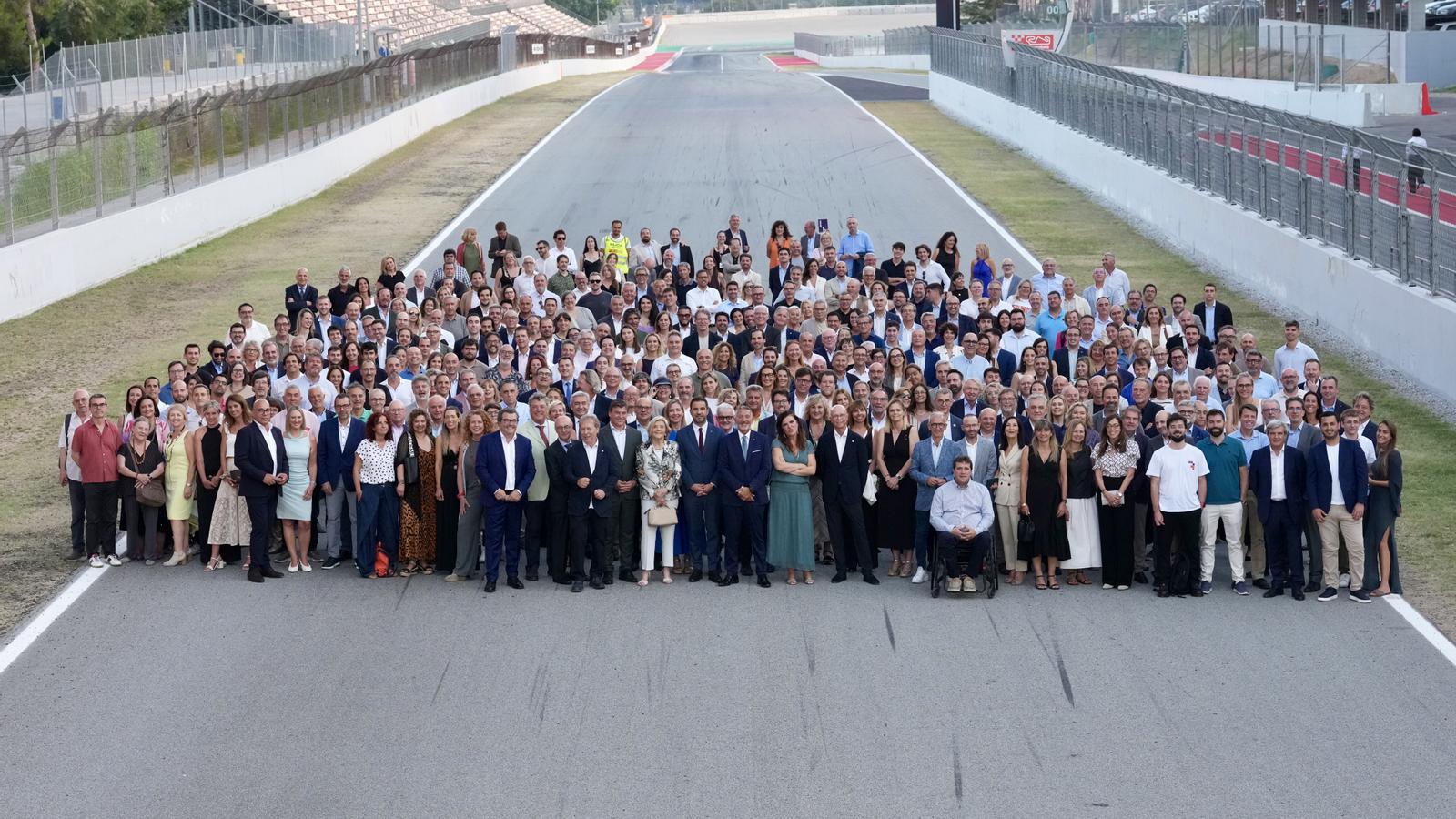
The business world celebrates the good moment of the Catalan economy at the institutional event of Company Day 2026
Nearly five hundred people linked to the Catalan business world attended last Thursday afternoon the institutional event commemorating the Day of Business 2026. The event, which this year took place at the Circuit de Barcelona-Catalunya, was closed by the Minister of Business and Labor, Miquel Sàmper, with a speech focused on the good moment that the Catalan economy is experiencing. Previously, a round table was held with the president of Torelló Viticultors, Ernestina Torelló, and the honorary president of Moventia, Miquel Martí, led by the journalist Xavi Coral, who presented the event.
A recognition was also made to centenarian companies in Catalonia with the intervention of Ignasi Escudé, retired CEO of Pont, Aurell i Armengol, which exceeds 150 years of life. In addition to businessmen and businesswomen from companies from all over the territory and from all sectors, the event was attended by the presidents of PIMEC, Antoni Cañete, and CECOT, Xavier Panés, as well as members of the Chambers of Commerce, led by the president of the General Council of Chambers and the Chamber of Commerce of Barcelona, Josep Santacreu, and prominent members of professional guilds, the tourism sector – such as CONFECAT AND ACAVE –, commercial associations, clusters, and the world of social and solidarity economy. Representatives of the parliamentary groups of the Commission for Business and Labor also attended.
