The FAR awards recognize the talent and the impact of new ideas with purpose
The ceremony recognized five companies and brought together authoritative voices from the Catalan technological world
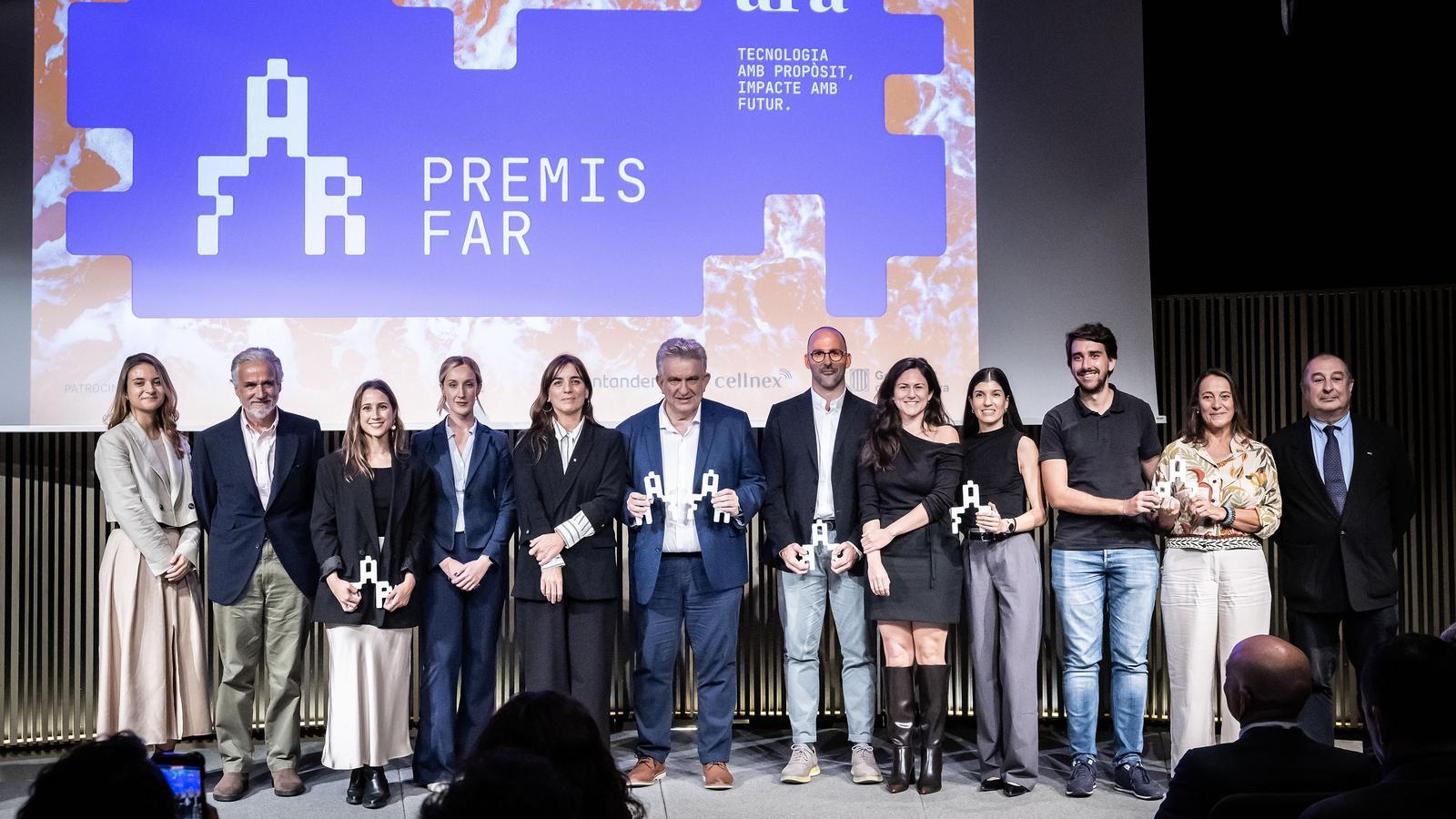
The MACBA Auditorium in Barcelona brought together last Thursday some of the most outstanding initiatives in the Catalan technological landscape. Companies and startups that have made innovation a tool to transform society and respond to current challenges. The first edition of the ARA newspaper's FAR Awards recognized five companies for their ability to develop purposeful projects, which combine technology, talent, and social and environmental commitment.
The FAR Awards are a firm commitment by the ARA newspaper to recognize the talent and initiatives that contribute to building a fairer and more sustainable future. This first edition had the collaboration of the Government of Catalonia, Cellnex, and Banco Santander, and the Polytechnic University of Catalonia (UPC) as an academic partner, an internationally renowned institution in research and higher education in the fields of engineering, architecture, science, and technology.
In Catalonia, there are many technology companies that "work to find not-too-complex solutions to very complex problems," highlighted the director of ARA, Esther Vera, during the ceremony. Precisely, recognizing this ability to innovate and improve people's lives is the goal of awards that have come to stay. "From ARA, we want to illuminate the world we live in," added Vera, taking as a reference the very name of the awards and claiming the newspaper's role in giving visibility to initiatives that contribute to transforming society.

The ceremony served to distinguish the winners in five categories: public health, education, social cohesion, sustainability and rural development, and also the Jury's Grand Prize. The event, hosted by journalists Laura Rosel and Cristina Sàez, also featured the presence and interventions of the Minister of Research and Universities of the Government of Catalonia, Núria Montserrat, as well as the General Director of Mobile World Capital Barcelona, Laia Corbella; the expert in digital transformation and president of the Accent Obert Foundation, Genís Roca; and the founding director of the Institute of Photonic Sciences (ICFO), Lluís Torner.
"These are projects that are worthwhile and useful for our society," added Esther Vera, who championed the importance of putting purpose at the center of innovation, because "technological progress is cumulative and often moral, ethical, and social progress is not." In this same vein, Minister Núria Montserrat highlighted the value of awards that aim to shed light on initiatives that contribute to improving society, doing so by evoking the Lighthouse of Alexandria, "an infrastructure that served to guide and instruct, featured in many works to shed light on what is important." The minister praised the success in choosing the name of the awards and claimed the importance of "a media outlet like ARA giving a voice and focusing on people who have ideas and want to change the world."

Future guarantee
Lluís Torner, one of the most authoritative voices in the field of technology and research in our country, pointed out some of the keys to ensuring the technological future of Catalonia. "We have an ecosystem with talent, and today's awards are a good demonstration of this: people with ideas and the desire to change the world. Those of us who work in cutting-edge technology have the obligation to transfer knowledge to the market, but without ceasing to generate new ideas". For the founder of the Institute of Photonic Sciences, Catalonia has a powerful ecosystem that "has developed especially in the last 25 years, but it is still small, even though it has centers and teams of excellence", so "we must continue to promote it, generating knowledge and supporting people who have revolutionary scientific ideas. Some will reach the market and others will not, but this is precisely how research and innovation work".
Torner also defended the researchers' desire to generate a real impact on society and, in this sense, he recalled that social recognition such as that of the ARA newspaper's FAR Awards is an important stimulus for scientists and that knowledge transfer is a way to ensure that research results benefit the public. "That what they research reaches the market and ends up improving people's lives is a spectacular prize," he assured.
Genís Roca, head of the Accent Obert Foundation, defended the country's technological opportunities in the face of the pessimism that often surrounds the sector. "We have enormous opportunities to develop cultural and technological infrastructures that depend on ourselves, not on Europe. We have a lot of work to do, but also many opportunities," he asserted. The expert also warned of the need to preserve reliable sources of information in a context of growing disinformation. To do so, he drew on one of the observations by Pilar Calzada, from Save the Children, regarding the importance of protecting sources of drinking water during disasters: "Now that everything can potentially be a lie, we must also preserve our sources of drinking water. Because, when there is so much water, the hardest thing is to find the one that is safe to drink. If not, we will end up dying of thirst in the middle of the water."
Ultimately, technology must know how to focus on the center of social well-being, the purpose for which the ARA's FAR Awards were born, and regarding which Laia Corbella, the general director of Mobile World Capital Barcelona, claimed the fundamental role of the media in providing role models: "There is a fundamental trinomial: people, companies, and role models. Without models to mirror ourselves in, it is difficult to know what we want to do and where we want to go. That is why I would encourage all finalists to become role models for new generations. And here, media outlets like the newspaper ARA have an essential role, because they contribute to giving visibility to these initiatives and inspiring other people."
Corbella spoke about the purpose of the importance of generating opportunities for companies and citizens, as the MWC in Barcelona does. "When we talk about technology, we are also defining what kind of society we want to build," she highlighted, also claiming digital talent as a strategic national infrastructure. "The first question a company asks itself before setting up in a city is what capacity it has to attract and retain talent. We need professionals who incorporate an ethical vision of technology, and we must be able to identify and foster talent in all areas."
An ecosystem full of talent
Barcelona and Catalonia are already a technological hub, with 135,000 professionals in the ICT sector, but to compete, it is also necessary to attract talent. "One in four job offers seeks technological profiles. We compete with cities like Berlin or Shanghai and, therefore, we work with the Generalitat to train, retain, and attract talent," pointed out Laia Corbera. The executive also emphasized the need to incorporate more women into the sector, where they represent 33% of professionals. "It is not just a question of equality, but also of competitiveness. We cannot afford to do without female talent."
That said, the contribution of institutions like the UPC becomes even more essential, as claimed by Francesc Torres, the rector of the Polytechnic University of Barcelona, who spoke about the importance of its graduates. "We must continue generating ideas and working in the most advanced technological fields, but we must also strengthen the industrial fabric we already have. At the UPC, we train about 5,000 engineers every year, and the main transfer of knowledge that we make to society is through our graduates, who join all kinds of companies, from large international corporations to small and medium-sized industries in the country." The UPC collaborates with more than 2,000 companies because "we know that innovation can arise from anywhere and it must be supported wherever it appears. We have a very competitive industry, but it needs talent. Our task is to generate knowledge and contribute to maintaining and improving the business fabric we already have."
The prize and the winners
The winners of the night were The Blue Box, in the health category. Its co-founder and CEO Judit Giró received the award accompanied by Lídia Navarro, head of communications. Giró, inventor of a device where it is possible to detect breast cancer through a urine sample, said upon receiving the award that "technology and innovation have no meaning if they are not dedicated to doing something good for the world". The Blue Box uses biomedicine together with artificial intelligence with very promising results that can very soon revolutionize screenings and complement many mammograms.
In the education category, the company Nextus Social Learning was awarded, an audiovisual platform with more than 2,000 educational resources that offers resources to teachers to bring to the classroom through documentaries. The project manager at the company, Eloi Trullàs, claimed the platform's ability to "help foster critical minds" among students. Isabel Minguillón, head of internationalization, posed a question that invites us to rethink the educational model: Should we continue to educate our youth the same way as 200 years ago?
SOM Care, the Group Saltó platform, was the winner of the social and community contribution award and also the Jury's Special Award, a project that combines robotics and AI to accompany the elderly and facilitate the work of social and health workers. Its purpose is to mitigate loneliness and put, as highlighted by its CEO, Jaume Saltó, "technology at the service of people".
In the environment category, the Catalan company Bound4sale took home the award for its commitment to decarbonizing maritime transport by leveraging the power of the wind. Bound4sale has developed a propulsion technology for ships, the eSAIL sail, which allows for the reduction of fossil fuel consumption and associated emissions in a sector with a high environmental impact. Lorena Herreros, marketing and digital communications manager of the company, highlighted Bound4sale's contribution in "transforming maritime transport into a more sustainable process, for the oceans and for the planet".

Finally, Altinco, integrated into the Cerestia-MatHolding group, received the award in the Sustainability category. Based in Mollerussa, the company develops biostimulants and biocontrol solutions that contribute to improving crop efficiency and making them more resilient to the effects of climate change. "Our project is very ambitious and has a great capacity to transform agriculture," highlighted the general director of Altinco, Joan Minguella, who concluded with a look to the future: "We have the opportunity to transform agriculture both nationally and globally."
If the gala was a complete success, so too was the trophy that the winners received, which stood out for its aesthetics and design. Its manufacturing was carried out by Sustain Awards, a company specialized in the production of designer trophies and unique awards with special care for aesthetics and sustainability, it is a design that bears the signature of Ricard Marfà, Art Director of the ARA newspaper.
