"We know we are late": the Government's plan to manage the forest against fires until 2030
The executive admits that the strategy that will culminate in seven years needs to be accelerated

-
CAT -
CAST
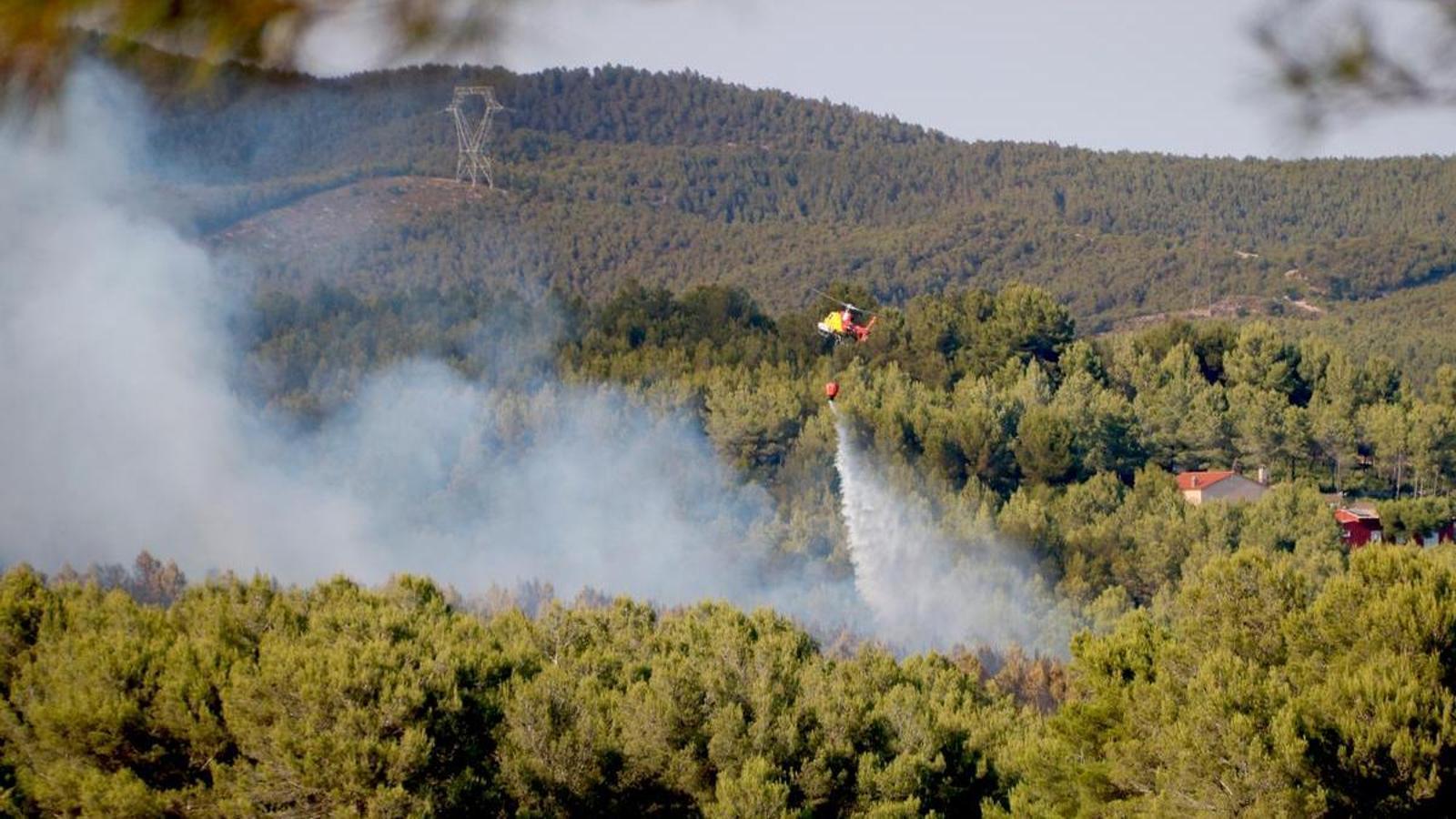
BarcelonaThe fire in Pla de Manlleu, which was brought under control last night, would have had a potential 20 times greater if it weren't for the presence of a vineyard that broke its propagation capacity. The fire could have burned up to 10,000 hectares if it weren't for these crops, which slowed the advance of the flames, and in the end only about eighty were burned. This is an example of the impact of forest and agricultural management in the face of fires, which is why the Government has planned an entire strategy to have more safety strips like this one, which it is already deploying and which will culminate in 2033.
This 2026, however, more than 3,500 hectares have already been burned, we are just at the gates of summer and the forecast from the Bombers de la Generalitat is not optimistic, as the very high temperatures and lack of humidity increase the risk of fires. Between July 1 and 8 alone, 345 fires have been registered in Catalonia, and many of the strategies to mitigate their impact will not be available until the coming years.
"We know we are late and we have to speed things up," admitted this Friday the general director of Forests and Environmental Management of the Generalitat, Jaume Minguell, who explained that forest management had to be reactivated, as the sector had been demanding for years. This involves having cultivated fields, firebreaks around urban areas, forests free of undergrowth, and opting for trees that reduce the risk of spread in case of fire. For example, from 2018 to the present, 23,000 cubic meters of pine wood have been removed from Catalan forests, and the presence of cork oak forests has been increased, which is a "much more defensible structure" if a fire starts, Minguell explained. The final objective of all these actions is that, in the event of facing a "mega-fire" – a sixth-generation fire – firefighters can penetrate the flames to try to stabilize it with the certainty that the fire will not jump from one massif to another.
The Director General of Prevention, Extinction of Fires and Rescues of the Department of the Interior and Public Security, Tamara Garcia, explained that, in the case of the Sant Andreu de la Barca fire, only 4.3 hectares burned because the forest was clean, which caused the flames to lose intensity on the ridge. Without this prior forest management, the fire would have impacted a 300-meter line of homes, which would have forced a massive diversion of forest resources to protect residents. "What worries us most is always that the fire enters an urban area. We prioritize people and we would have had to divert many resources to home fires and the fire in the forest would have escaped through one of the flanks," explained Garcia about this fire.
The three focal points of the strategy
The Catalan strategy until 2033 consists of three main pillars, explained Minguell, who assured that this week's experience with so many simultaneous fires ratifies his plan. "The strategy that is being developed and has been planned for the coming years to prevent forest fires in Catalonia works and will work". These three levels are protection strips, priority protection perimeters, and containment axes.
Protection strips
Protection strips are narrow areas of a minimum of 25 meters wide that act as immediate firebreaks around urbanizations or inhabited areas, and Minguell recalled that their execution and maintenance is the legal competence and obligation of the owners and the town councils. The Government has a line of aid of 15 million euros per year and foresees that by 2027, 3,000 hectares of strips will be executed.
Protection perimeters
Priority protection perimeters are areas of land with a high risk of fire. The Government has delimited 34 of them and now wants to "consolidate" them, as only one has been approved and the forecast is that all of them will be operational in the next two years. The objective of this strategy is to prevent the spread of large-scale fires and protect entire forest masses through the creation of prevention infrastructures, such as networks of paths and water points that emergency services can use in case of fire.
Containment axes
The last level of the plan are the containment axes, which the Government presented last May, and which aim to reduce the spread of large forest fires between massifs. It was authorized that these axes occupy a total of 2,300 hectares, of which 36.4% has already been tendered for 3.7 million euros.
Currently, there are works in progress on the Girona –Celrà, Rasquera– Perelló, Martorell, and Santa Coloma de Cervelló axes which are now "temporarily" stopped due to the high risk of fire, and it is foreseen that the 14 axes planned will be completed by 2033 for a total cost of 131.8 million euros.
