Esteve Camps: "We cannot put up a Berlin Wall to prevent tourists from coming"
Delegate President of the Sagrada Família Construction Board Foundation
-
CAT -
CAST
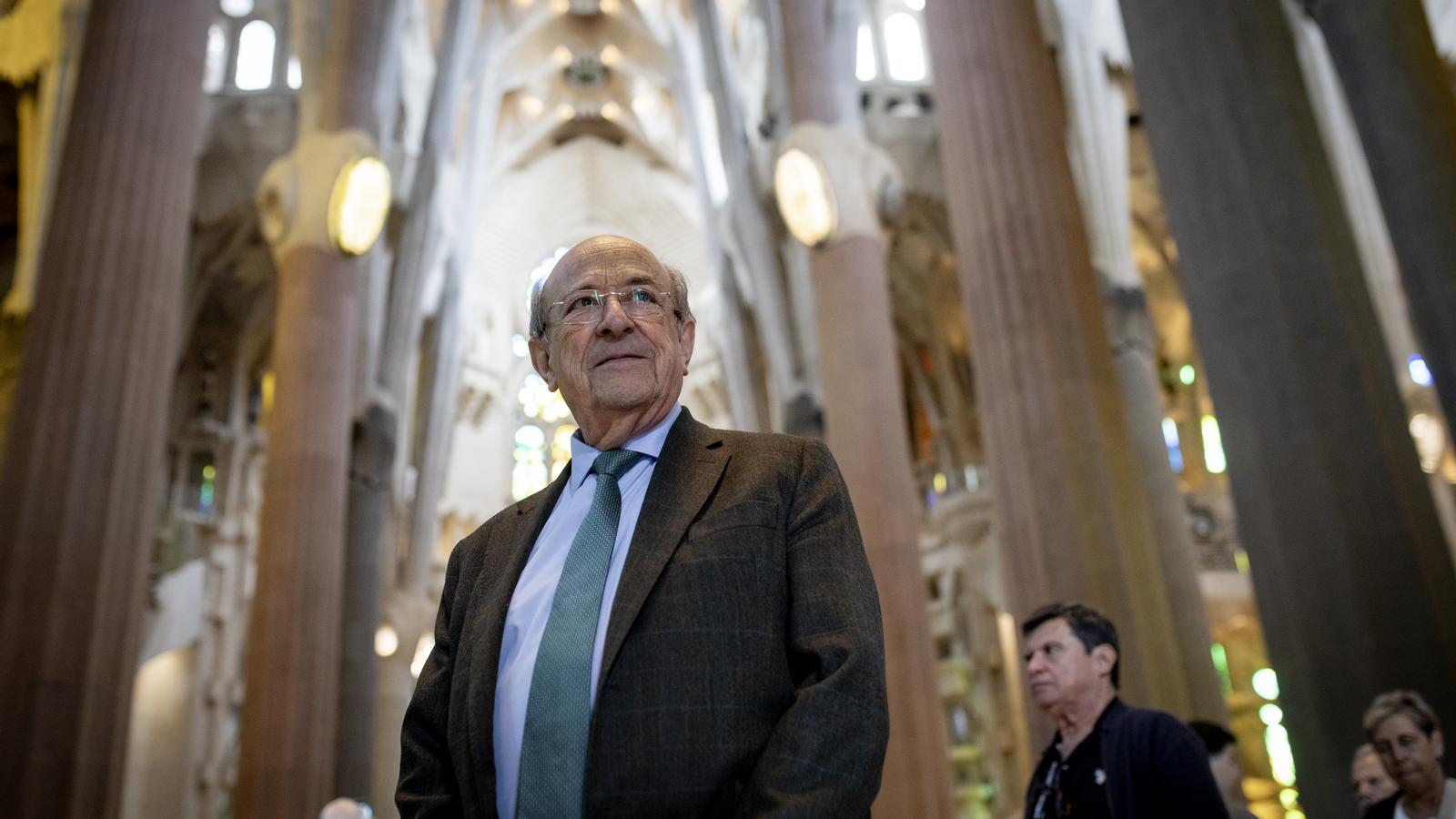
BarcelonaWe interview the delegate president of the Sagrada Família Construction Board Foundation, Esteve Camps, a few days before Pope Leo XIV visits the temple to mark the centenary of Antoni Gaudí's death.
What, personally, are you most excited about at this moment when the completion of the Jesus tower, the centenary of Gaudí's death, and the Pope's visit coincide?
— At 12 years old I already went out for the collection of Sagrada Família, with the collection box, with the school. Who could have told me then that I would become the delegate president of the temple?
Now you have 78.
— And I am one of those citizens who are proud to be born in Barcelona. Collaborating in the construction of the Sagrada Família temple at a stage like this, when the four towers of the evangelists have been built, that of Mary, the sacristy, and now the culmination of the inauguration of the Jesus tower, 172 meters high – the tallest building in the city –, the tallest temple in the whole world... It is a satisfaction that cannot even be valued.
You are a Barcelonian all your life. Gaudí fan too?
— I wasn't, a Gaudinian. But, of course, when Cardinal Carles Martínez Sistach called me and entrusted me with the job, I got into character. So many years later, I can say that I know the man and his work in depth.
The Sagrada Família is a world icon: a tourist, heritage, artistic landmark... What is it to you and what do you think it is, or should be, for the city, the country, the world?
— There are several messages. The first has to do with Gaudí's criterion of applying liturgy. When liturgy is mentioned, everyone thinks of something for priests. No. Liturgy is giving meaning to what one does. In Gaudí's Sagrada Família, there are, for example, all the plant motifs that have enchanted the Orientals. Spirituality is transmitted more to the outside than to the inside.
What exactly does it mean?
— Gaudí says: "I want to build a church for those who do not go to mass." For those who do go to mass, everything is already explained to them in every liturgical celebration. He wanted to create a Bible of stone, that is the Sagrada Familia, what can be seen from the street: the resurrection, the crucifixion... It is very much in line with what Pope Francis said: the idea of not just focusing on those of us who go to mass. It is a temple for everyone.
The battle is won, isn't it? Everyone wants to visit the Sagrada Familia.
— When the attack on La Rambla happened, a celebration was held at the Sagrada Família with the participation of all monotheistic religions: Muslims, Jews, Protestants, all came. Not a Eucharist. It was a community prayer.
This idea of an ecumenical temple...
— ... All religions have felt comfortable there when they have visited it. The Sagrada Família could be a place to shelter the economic center of the diocese. But that is a personal belief. I don't have the religious authority to say so. However: everyone, whatever their religion, finds meaning there. We do visits for immigrants, for prisoners. And they are all amazed, they feel comfortable, they do workshops. Maghrebi women also come with Caritas. We don't talk to them about the Bible, of course, they have the Quran, but we do talk about the light. "I am the light." They are amazed. We are doing a great outreach task, not sectarian. This is not about being Catholic. No. Gaudí already said: "People will come from all over the world".
There is another defining element of Gaudí: his Catalan identity.
— We try to be faithful to Gaudí's Catalan identity. Churches do not have to be spokespersons for flags. That said, every September 11, Catalonia's National Day, we put up a 15-meter Catalan flag. Not even on the day the new archbishop takes office is any other flag put up. Never any flag. And following Gaudí's Catalan identity, who had great support from Bishop Torres i Bages, when the basilica is finished, a monument will be erected to him. But first, the Passion facade must be finished, which must be the same as the Nativity facade, with a horseshoe and the two staircases on either side. Then the monument to Torres i Bages will be made.

In a decade will the entire building be finished?
— This must be said by my successor. I cannot mortgage it. But well, if all the human and economic resources we have dedicated to the tower of Jesus, to the Chapel of the Assumption and to the cloister, we dedicate them to the facade of Glory, then yes, in ten years it can be finished.
But not the staircase or the square.
— This is not. We are in talks with the City Council and agreements will be reached in due course. But urban planning processes are slow. The temple, in its vertical dimension, is already authorized: the four towers plus the first row of hyperboloids can already be built, the foundations are being laid. If there is no pandemic, if tourism continues to bring in money, it should be finished in ten years. But that will be up to the next board of trustees, which will change soon because Archbishop Omella will retire: he turned 80 on April 22, and with Pope Francis' decree he cannot continue. When he leaves, I will leave too. I believe that the change in the archbishopric will occur before the end of the year.
But you were appointed by the previous archbishop, Martínez Sistach.
— Yes. When Omella came, I submitted my resignation. Then he ratified me, first for one year and then until today. If the new prelate now asks me to continue for another year, I will accept as long as the person who is to replace me is on the board of vice presidents.
Each year tourists contribute 130 million euros. How much is spent on works?
— It depends on the year. The difference between income and expenditure is given to the Social Action Fund, created in 2023. This is the purpose. It started with 2.5% of the total and now we are at 10%.
The remaining 90% goes to the works?
— Yes. And to cope with possible operations. For example, when the pandemic occurred, the reserves we had went to the building's surveillance, custody, and maintenance service, which had to be done regardless of whether there were visitors. And also to supplement employees' salaries because the ERTE did not cover everything. With the money, we do not undertake any risky operations. In this regard, we are very conservative. If works are to be carried out on Mallorca street, the bridge, expropriations, a lot of money will be needed.
Has the war affected the works?
— And so, the costs of everything have increased. The budgets we had are no longer useful.
Miquel Barceló, Cristina Iglesias and Javier Marín: which of the three will create the façade of La Glòria? When will a decision be made?
— We have the reports from the theological, artistic, and director architect commissions. They will be presented to the board on June 29. The board may not want any of the three proposals. It may want all three to work together: then they should be asked if they want to. You may also want to negotiate fees with them. Or that they expand or clarify the proposals. And summer is in between. Perhaps the final decision can go to the December board.
How are the negotiations with the City Council going?
— We were a hundred years without an agreement and then three years negotiating with Mrs. Colau. And we reached some pacts, we paid everything they asked us for, the entire building was legalized. Now everything is in order, with the permits. We are left with the phase of La Glòria, with the staircase and the esplanade. It could take two or three years. But by talking, people understand each other.
And then there are the neighbours.
— I have to deal with the City Council so they let me do the work. I cannot negotiate with a neighbor to leave if I don't have the permit for the work.
How is the negotiation going?
— Gaudí planned to reach Valencia Street. In his script, the City Council said up to Diagonal. These are two different things.
What is the carrying capacity of the Sagrada Familia? Last year it received four and a half million visitors. Can it reach five?
— There is a problem of dying of success, isn't there? Benedict XVI's visit in 2010 represented a 48% increase in tourists. Leo XIV's visit seems to be having a much greater, unpredictable impact. Televisions from all over the world are coming, this is overflowing. We couldn't imagine such global interest.
Therefore, we will have more tourists in the coming years.
— With the new spaces that will open up within the temple in the coming years, we will have more capacity for welcome and visitor distribution, including the chapel of the Assumption in 2027 and access to the tower of Jesus in 2028.
But in the Jesus tower, the elevator will have a capacity of only 11 people.
— The overall capacity calculations have been made based on the present. We have implemented that from 9:00 a.m. to 10:00 a.m. is the silence hour: no music or guides with loudspeakers are allowed. We have also set a maximum of 16,000 daily visitors, we don't want this to be the subway. Satisfaction surveys give a score of 9.7 out of 10. This means that people leave the basilica satisfied. The maximum overall figure will be agreed with the general directorate of Heritage of the Department of Culture of the Generalitat.
Will the residents, very affected by the influx of people, have a voice?
— To a neighbor, I once said: "If you manage to only let 5,000 people into the temple per day, the basilica's income will decrease. But people will keep coming to Barcelona – they come for the Sagrada Família and for Barça – and if they can't get in, they will look at the temple from the street." We cannot put up a Berlin Wall to prevent it. And the neighbors would have even more problems.
People will continue to come and Barcelonians will continue to demand limits and achieve better coexistence.
— Years ago, Barcelonians found the Sagrada Família to be the priests' affair, they found it uncommunicative, unparticipative. Today, more than 80% make it their own.
But do they enter? The data says that 89% of visitors are foreigners.
— Yes, but for Saint Eulalia, Saint George and La Mercè we have open doors for Barcelonians, and for 4,000 tickets they ask us for 20,000. The citizen already feels the temple as their own. They have a solidarity, ecological, monumental, artistic, faith connection... That rejection from a few years ago has been overcome.
There can also be a distance when seeing the amount of money that the Sagrada Família moves in a city from which people have to flee due to lack of housing. What will happen when 130 million are collected and there is not much left to do?
— We don't know that. We start from the basis of Joaquim Mir's painting, The Cathedral of the Poor. We are clear about that. That's why we created the Social Action Fund, to which 4.9 million were allocated last year... We have 100 employees. But there are 1,000 people working for the Sagrada Família. All hoteliers want to sign agreements with us. The Sagrada Família is like a magnet, people want to see it.
Barcelona's success, which is in large part due to the Sagrada Família, also impacts the housing problem, generating a lot of precariousness. Does the Sagrada Família plan to take action to alleviate it?
— To commemorate the centenary of Antoni Gaudí's death, an important contribution has been made to Cáritas to rehabilitate the facilities for abused mothers. However, the foundation's statutes state that we cannot request subsidies because it is an expiatory temple and that the money cannot be spent on anything other than the completion of the Sagrada Família. The statutes will have to be changed.
The Pope will arrive on June 10. First he will go to Montserrat and then to the Sagrada Familia. What will this visit be like? Have you had direct contact with the Holy Father?
— The Pope had already been to Barcelona. He knows Catalonia. He speaks Spanish perfectly.
It seems he will also speak in Catalan?
— It would be a great satisfaction for us. The celebration, just like with Pope Benedict, will be in Catalan and Spanish. His going to Montserrat, where the millennium has been reached, shows that he knows the Catalan fact in depth.
To what extent has there been direct dialogue between the Sagrada Família or the Catalan Church and Pope Leo XIV to prepare for the visit?
— We have kept him informed since the day he took office. The day the Vatican flag and the Catalan flag were raised as a symbol of the completion of the tower's works, he responded with applause. He is not coming to make a discovery, but a blessing.
What would you like to remain from this papal visit?
— It is a pastoral visit and an apostolic visit. He wants to see reality. He is a man who wants to have contact with people, he will meet with the Episcopal Conference in Madrid, surely with the Spanish government. And he wants to be close to the citizens. He is a pope who has distinguished himself by his direct opposition to Mr. Donald Trump. And he maintains it with courage.
